Sam Harris returns to a 2011 essay with a startling premise: the ability to speak in public is no longer a soft skill, but a hard requirement for existence in the modern world. He argues that the era of the reclusive intellectual has ended, replaced by a marketplace where silence is indistinguishable from irrelevance. This is not a self-help platitude; it is a structural diagnosis of how information flows today.
The Death of the Invisible Author
Harris begins by dismantling the romantic notion of the solitary genius. He points to Thomas Jefferson, a figure often associated with the quiet power of the written word, noting that "John Adams once said of him, 'During the whole time I sat with him in Congress, I never heard him utter three sentences together.'" Yet, Harris immediately pivots to the present, asserting that "it is now inconceivable that a person could become president of the United States through the power of his writing alone." The historical context is sharp; while Jefferson could limit his public speaking to two low-toned inaugural addresses, the modern executive branch demands a constant, visible performance of leadership. The silence that once protected a statesman now guarantees their obscurity.
The author expands this to the literary world, observing that "refusing to speak in public is a good way to ensure that [books] will not be read." He notes that even for fiction, unless one is a recluse like J.D. Salinger, remaining invisible is a "path not to the literary firmament but to oblivion." This is a brutal assessment of the current media ecosystem. The argument holds weight because it acknowledges that the barrier to entry for ideas has shifted from production to distribution, and distribution now requires a face.
The feeling that we call 'I'—the ghost that wears your face like a mask at this moment—seems to suddenly gather mass and become the site of a psychological implosion.
The Anatomy of Self-Consciousness
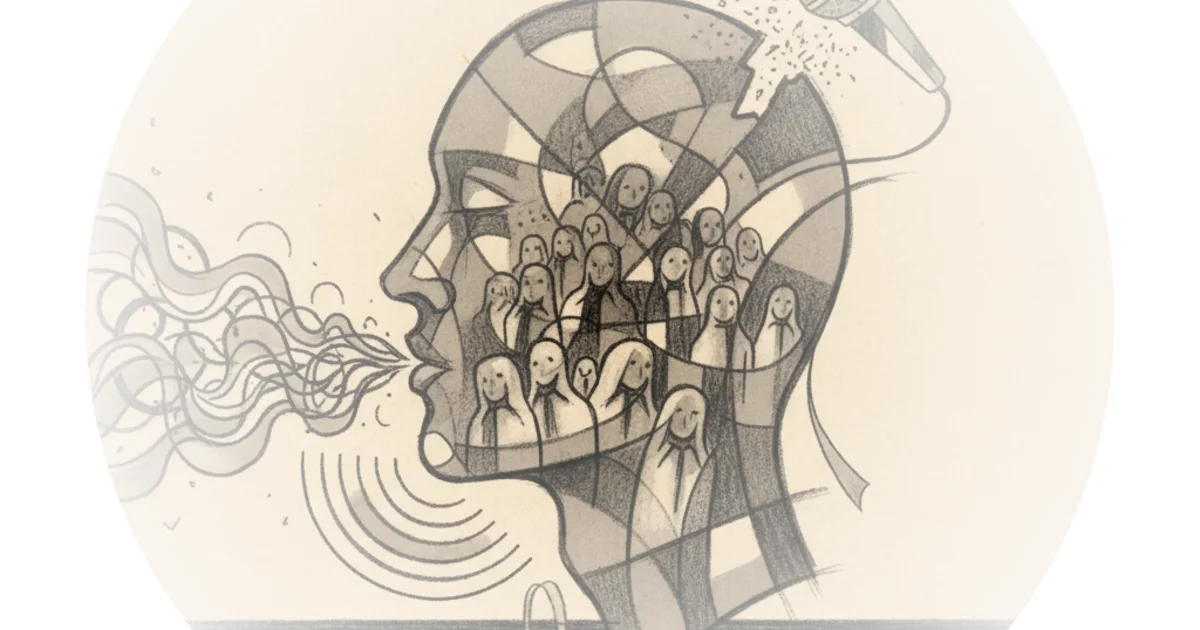
Moving from the external market to the internal landscape, Harris offers a profound psychological dissection of stage fright. He describes the fear not merely as anxiety, but as a grotesque magnification of the self. He writes, "Pathological self-consciousness in front of a crowd is more than ordinary anxiety: it lies closer to the core of the self." He compares the sensation to a doctor probing a patient's abdomen until a hidden pain is found: "Yes, that is the problem with being me. Ow …" This metaphor is effective because it grounds an abstract fear in visceral, physical reality.
He contrasts the terrified speaker with the natural performer, often a narcissist whose self has become a "wormhole to a parallel universe." However, Harris wisely notes that even these performers are not immune, citing famous actors who are "wracked by fear while accepting an Academy Award." The distinction he draws is crucial: the fear is not about the audience, but about the sudden, crushing weight of one's own identity. Critics might argue that this analysis over-psychologizes a common social anxiety, but Harris's personal admission of declining his high school valedictorian speech lends the argument a necessary vulnerability.
The Mechanics of Overcoming
Harris transitions from diagnosis to prescription, outlining a six-point strategy that rejects passive preparation in favor of active exposure. His first command is blunt: "Admit that you have a problem." He argues that while one can technically avoid public speaking forever, "the fear will periodically make you miserable, and it will limit your opportunities in life." He suggests that the only way out is through, urging readers to "address any sane audience that will listen to you," starting with small, low-stakes interactions like toasts or questions at lectures.
He emphasizes the importance of preparation without falling into the trap of memorization. He warns against the "mnemonic tightrope" of reciting a script, noting that "it becomes just that: a performance." Instead, he advocates for a middle ground of knowing the structure and the opening and closing lines. He also champions meditation as a tool to "undermine" self-consciousness, framing it as essential as sleep or food. This holistic approach—combining exposure, preparation, and mindfulness—avoids the simplistic "just do it" advice that often plagues this genre.
You cannot afford to live your life as if it were a dress rehearsal for some future life.
The Cost of Silence
The essay concludes by reinforcing the high stakes of inaction. Harris reminds us that the people who run the world are those who "were first willing to run a meeting, deliver a speech, or debate opponents in a public forum." He challenges the reader to consider the opportunity cost of their silence, noting that "you don't know what your life would be like if you had become a competent public speaker." The piece serves as a stark reminder that in an age of digital saturation, the ability to command a room is the ultimate currency of influence.
Bottom Line
Sam Harris's essay succeeds by reframing public speaking from a social hurdle to an existential necessity, backed by a psychological depth that goes beyond standard self-help. Its greatest strength is the unflinching admission that the fear is a feature of the self, not a bug to be patched, and that the only cure is the terrifying act of speaking. The argument's only vulnerability is its assumption that all audiences are "sane" and receptive, a nuance that might need adjustment in polarized environments, but the core imperative remains undeniable: silence is no longer an option.