Human evolution is not a straight line marching toward modernity, but a tangled, climate-driven bush where isolation and interbreeding constantly reshape who we are. Big Biology's re-release of its conversation with Kate Wong dismantles the comforting simplicity of our origin story, revealing that the very genes protecting us from modern pandemics may be inherited from ancient cousins we thought we had wiped out.
The Death of Binary Thinking
For decades, the scientific community was locked in a binary debate: did modern humans evolve simultaneously across the globe, or did we burst forth from a single African cradle to replace everyone else? The piece argues that both extremes are now obsolete. "Pure Multiregional Evolution and the strictest Out of Africa scenario…are really not supported at this point," Wong says in the episode. This is a crucial pivot; it moves the conversation from a tug-of-war between two rigid models to a dynamic, fluid understanding of our past.
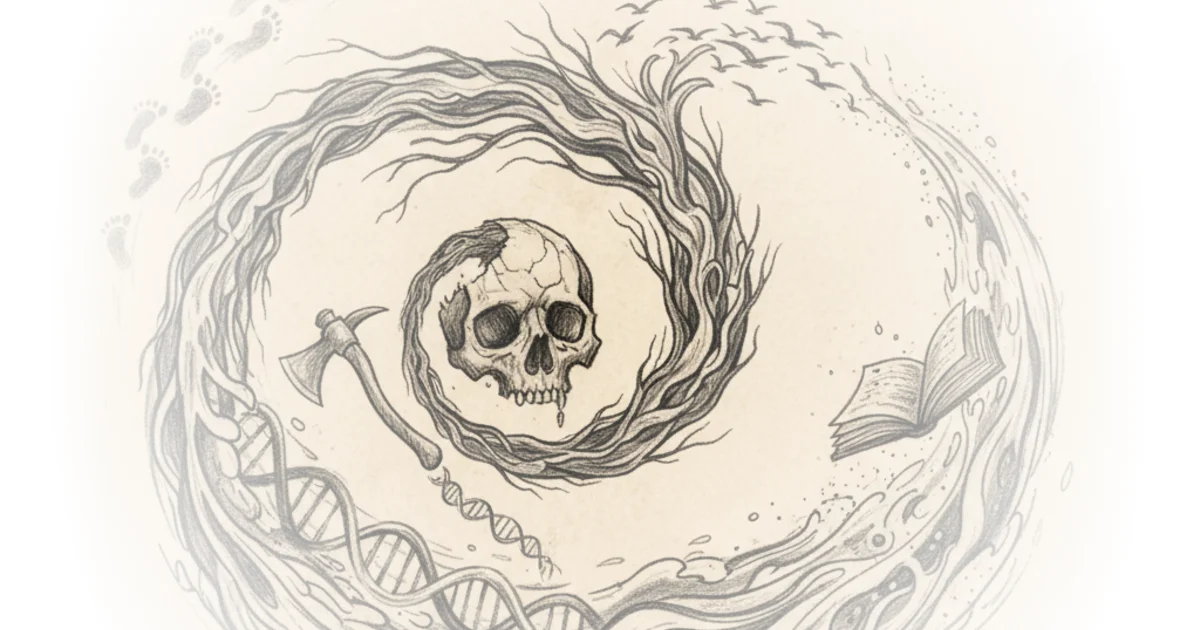
The editors note that early theories were often poisoned by the racial biases of their time, slowing progress until fossil records could no longer be ignored. The current consensus embraces a hybrid model: "Multiregional evolution within Africa is a newer idea that's being embraced," Wong elaborates. This suggests that our ancestors were not a single, monolithic group but "multiple populations of Homo sapiens that split apart, evolved along their own trajectories behaviorally and anatomically, and then came back together."
This framing is effective because it aligns with the messy reality of biology. It acknowledges that "who we are today sort of coalesces, from all of that diversity," as Wong writes. The driving force behind this coalescence was often the weather. The piece highlights how climate shifts acted as a biological valve: "when there's a drying of the climate, deserts expand, and these little populations are pushed away from each other. And then when it gets wetter and the climate is more favorable, they are more easily able to connect and interbreed and exchange culture and technology."
"Who we are today sort of coalesces, from all of that diversity."
Critics might argue that emphasizing environmental determinism risks downplaying the role of cultural innovation in human survival. While climate certainly forced migration, the ability to adapt and exchange technology was a human choice, not just a weather pattern. However, the piece balances this by noting that these alternating periods of isolation and connection were the primary mediators of our genetic history.
The Living Legacy of Ancient Cousins
Perhaps the most striking implication of this research is that we are not the sole survivors of a clean sweep, but the beneficiaries of a complex web of interbreeding. The article reminds us that "Homo sapiens are the sole surviving twig on what was once a luxuriant evolutionary bush." This metaphor is powerful because it reframes extinction not as a victory of one species over another, but as a tragic pruning of a diverse family tree.
Big Biology reports that advances in DNA technology have shattered the myth that "races are biologically discrete groups with separate origins." Instead, "Modern human variation is continuous, and most variation exists within populations rather than between them—the product of our demographic history as a species that originated in Africa with populations that mixed continuously as they migrated around the world." This is a direct rebuttal to the pseudoscientific rationalizations of the past, where "Social Darwinism... misapplied Darwin's ideas about the struggle for existence in natural selection to human society, providing a pseudoscientific rationalization for social injustice and oppression."
The stakes of this research extend far beyond academic curiosity; they are deeply personal and medical. We carry the genetic legacy of Neandertals and Denisovans in our very cells. The piece cites a 2022 study showing that certain Neandertal variants on chromosome 12 reduced the risk of hospitalization due to COVID-19 by 22 percent, while others on chromosome 3 increased that risk by 60 percent. This proves that our evolutionary history is not a distant artifact but an active participant in our current health crises.
Furthermore, the discovery of new fossils continues to rewrite the timeline. A recent study uncovered an entirely new species in the Australopithecus genus, adding a fourth distinct lineage to the mix. "The new find underscores the complexity of human origins," Wong summarizes. "Although Homo sapiens is the only hominin species on Earth today, for the vast majority of humanity's existence, multiple hominin species shared the planet."
Bottom Line
The strongest element of this coverage is its ability to translate complex genetic data into a narrative that directly challenges modern social prejudices, proving that human variation is a continuous spectrum rather than a set of discrete categories. Its biggest vulnerability lies in the sheer volume of new data; as new fossils like the one from Ethiopia emerge, the "luxuriant evolutionary bush" metaphor may need to be updated to a tangled thicket. Readers should watch for how this evolving understanding of our mixed heritage influences future medical research and public policy on race and identity.