Rafael Holmberg delivers a startling diagnosis of our digital age: the very concept of friendship has been retroactively rewritten by the logic of new media, turning a human bond into a commodity we no longer recognize. In an era where algorithms curate our social lives, Holmberg argues that we have lost the ability to see the difference between a genuine connection and a data transaction, a confusion that goes far deeper than privacy concerns. This is not just a critique of technology; it is a philosophical excavation of how our reality is being reconstructed by the tools we use to navigate it.
The Illusion of Neutrality
Holmberg begins by dismantling the idea that new media simply adds a layer on top of our existing lives. Instead, he posits that these structures actively reshape history and human interaction to make themselves seem inevitable. "New media ideology installs a new temporality, reframes itself not as a violently 'new' or irreducible formation, but rather imperceptibly imposes itself as the natural outcome of historical development," Holmberg writes. This is a crucial distinction for busy readers to grasp: the technology isn't just changing what we do; it is changing what we believe is possible and natural.
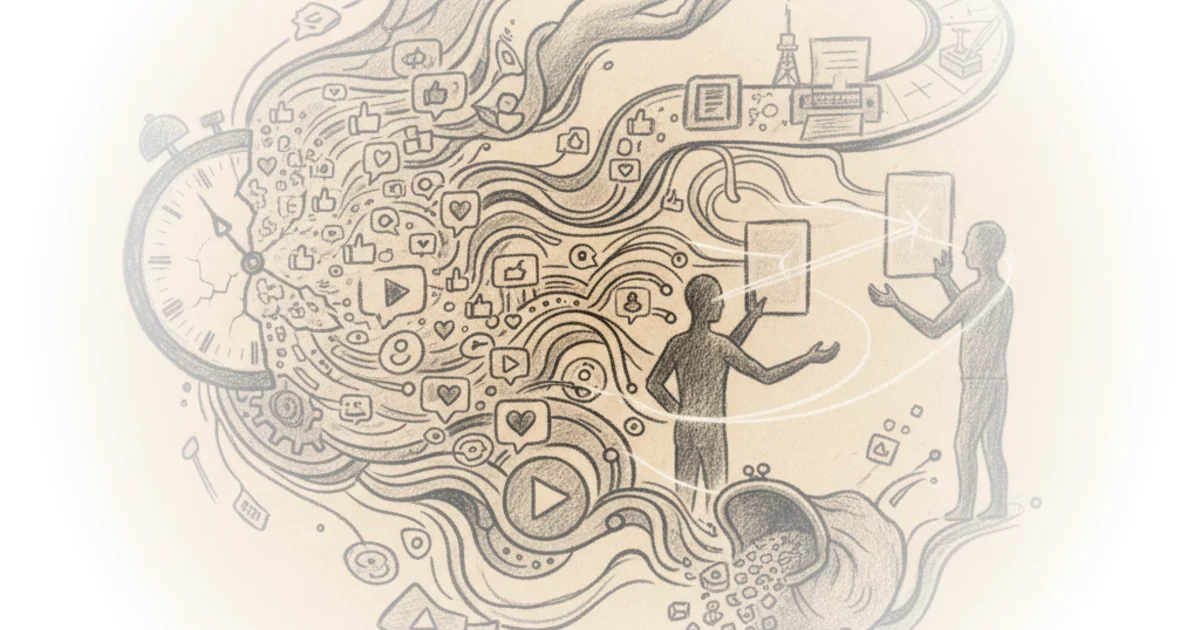
The author uses a Mullvad VPN advertisement as a jumping-off point. The ad suggests that if a friend acted like a search engine—hoarding and selling our secrets—we would be horrified. Yet, Holmberg argues this comparison reveals a "strange double-obfuscation." The ad assumes friendship is a pure, pre-existing state that the internet corrupts. Holmberg counters that this is a false comfort. He suggests that the "forced homogenisation – the conceptual equation of otherwise incompatible or qualitatively irreconcilable objects – is central to the structures of postmodern exchange." In other words, the media doesn't just invade our friendships; it teaches us to view friendship itself as a transactional exchange, blurring the lines until the distinction vanishes.
"The transgression of new media is perplexing enough to merge with, and reconstitute, what previously appeared neutral, or outside the zone of ideology."
This framing is powerful because it shifts the blame from the user to the structural logic of the medium itself. However, critics might note that this theoretical density risks overlooking the very real, tangible agency individuals still possess in resisting these algorithms. Not everyone is equally "sutured" into the system, and human resilience often defies such totalizing theories.
The Spectator and the Script
To illustrate the psychological toll of this mediatised existence, Holmberg turns to Michel Haneke's film The Seventh Continent. He describes a family trapped in the repetitive, alienating routines of corporate life, culminating in a violent self-destruction that feels both shocking and inevitable. Holmberg writes, "Repetition is never just repetition, as Freud showed, but rather a reproduction which frames the alienating core of the repeated thing." The film's horror, he argues, lies in how the family's mundane life becomes a script that consumes them, mirroring how media consumption shapes our own identities.
The author connects this to the viewer's role, citing film theorist Joan Copjec: "with the introduction of psychoanalysis into film theory the axis of investigation was shifted away from a focus on the narrative to the axis of the spectator-screen relation; the question became: How is the spectator 'sutured' into the film?" Holmberg extends this to the digital age, arguing that we are no longer passive observers but active producers of our own alienation. The media doesn't just show us a world; it makes us complicit in constructing it.
This section is particularly effective at making the abstract concrete. By linking the film's destruction of a home to the destruction of the self in the digital sphere, Holmberg makes the stakes feel personal. Yet, one might argue that equating a fictional family's suicide with the daily friction of social media use is a dramatic leap that could alienate readers looking for practical solutions rather than existential dread.
The Camera That Built Reality
Holmberg then traces this logic back to Walter Benjamin and the camera, arguing that technology does not merely reflect reality but constructs it. "The camera – in the form of film and news coverage – became inscribed in the world that it reproduced," Holmberg explains. He notes that once the camera exists, "No such thing as a pure reality could any longer be separated from its biased formulation." This leads to the extreme position of Jean Baudrillard, who claimed the Gulf War was a media event that "never took place" in the traditional sense because the representation became more real than the event itself.
"Reality as such became structured as its own displaced representation, it was itself imprinted with the permanent possibilities of cinematographic qualities."
While this perspective is intellectually rigorous, it risks sliding into a form of nihilism where nothing is real, only representations. A counterargument worth considering is that while media shapes our perception, physical consequences—like the destruction of a city or the loss of a life—remain undeniably real regardless of how they are filmed or streamed. Holmberg acknowledges the "simulacral effects" but perhaps underplays the material weight of the events being represented.
The Paradox of the Friend
Returning to the core theme, Holmberg challenges the assumption that friendship is a self-evident, innocent experience. He argues that even before the internet, friendship was fraught with "an unassimilable alterity" and "perpetual disharmony." Drawing on Jacques Lacan and the example of bathroom doors, he illustrates how simple objects gain complex social meanings once they enter a symbolic system. "Once the signifiers of 'gentlemen' and 'ladies' are supplemented on top of them, the signified doors take on a radically new meaning," Holmberg writes. Similarly, friendship is not a neutral bond but a complex negotiation of desire and alienation.
The author concludes that new media's greatest trick is convincing us that friendship was once pure and is now corrupted, when in fact, the ambiguity and opacity of human connection have always been central to it. "New media deploys a distorted use of what otherwise appears as most familiar to us... a distortion which we nevertheless feel at home with," he observes. The media doesn't create the alienation; it simply exploits the existing cracks in our relationships to sell us a fantasy of connection.
"We are reminded of Joan Copjec's statements on what psychoanalytic theory provided the modern movie-goer with: 'with the introduction of psychoanalysis into film theory the axis of investigation was shifted away from a focus on the narrative to the axis of the spectator-screen relation; the question became: How is the spectator "sutured" into the film?'"
Bottom Line
Rafael Holmberg's strongest move is reframing the privacy debate: the problem isn't just that algorithms steal our data, but that they convince us friendship was ever a private, unmediated sanctuary to begin with. The piece's greatest vulnerability is its dense reliance on high theory, which may obscure the very human, everyday experiences of connection it seeks to explain. Readers should watch for how this "mediatised" logic continues to reshape not just how we communicate, but how we define the self in an increasingly algorithmic world.