Derek Muller makes an argument that's been strangely absent from public awareness: we are spectacularly unprepared for the next major asteroid impact. The Chelyabinsk event over Russia in 2013 wasn't just a random coincidence — it was a near-miss that exposed how poorly we actually track objects that could destroy cities.
The most unsettling claim Muller makes isn't about what we've found. It's about what we've missed. "We're really not that good at detecting asteroids before they hit us," he says, and the evidence is damning: since 1988, over 1,200 asteroids bigger than a meter have collided with Earth, and we detected only five of them — never with more than a day of warning.
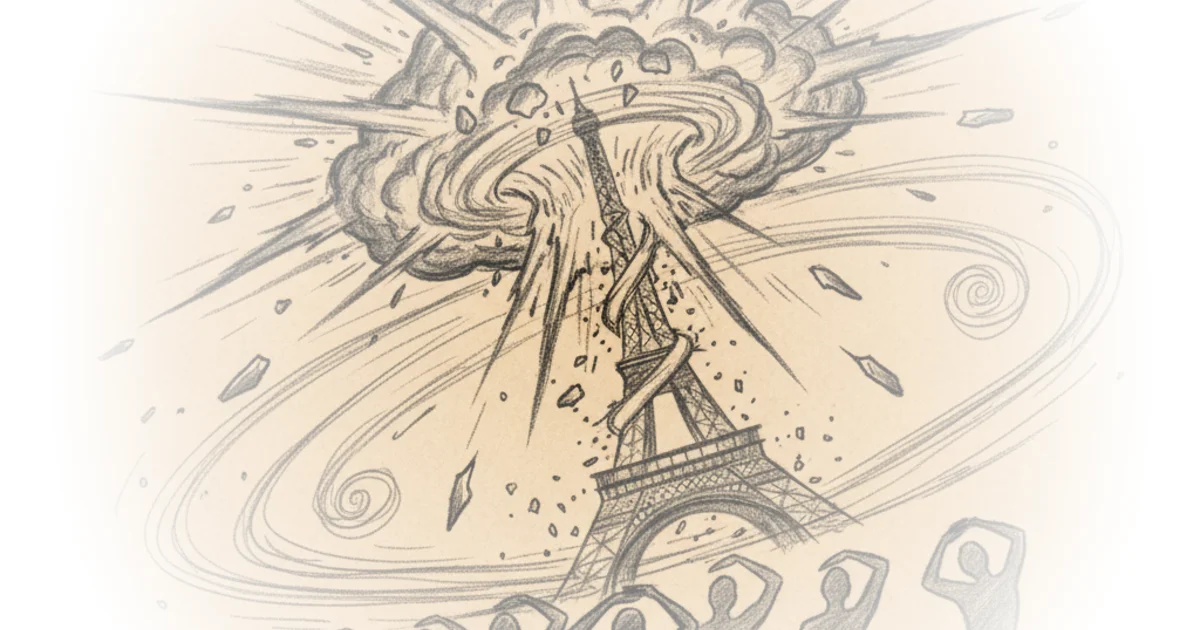
The reason isn't lack of technology. It's something Muller calls the opposition effect. Most asteroids are spotted in the 45 degrees of sky directly opposite the sun, meaning anything approaching from behind our star simply can't be seen. This is exactly what happened with Chelyabinsk — an object came from the direction of the sun and was completely invisible until it exploded over Russia.
We're really not that good at detecting asteroids before they hit us
The detection problem isn't just academic. The Chelyabinsk meteor was only 20 meters in diameter — roughly the width of two school buses — yet it released energy equivalent to 10 megatons of TNT, over 600 times the Hiroshima bomb. Muller shows what this looks like by visiting Behringer Crater in Arizona, where a similar-sized impact vaporized the projectile entirely.
The core of Muller's argument shifts from detection to deflection, and that's where things get really bleak. "To be honest we do not have a way now to deflect a kilometer-sized asteroid at all that could destroy a country," he admits. The options he's explored — bombing the asteroid, attaching rockets, lasers, even wrapping it in aluminum foil — all fail for different reasons. Bombs would just reform the rubble pile; rockets can't be attached successfully; lasers don't exist at sufficient power.
To be honest we do not have a way now to deflect a kilometer-sized asteroid at all that could destroy a country
The evacuation argument? Muller doesn't hold much hope there either. When millions of people try to flee a target zone, "all the roads will be instantly blocked" — and that's with weeks of warning.
The Bigger Picture
What makes Muller's analysis compelling is his scale. He distinguishes between different asteroid sizes: 10-kilometer impactors like the dinosaur-killer happen every 100 million years, so we can rule those out for our lifetimes. But one-kilometer asteroids could wipe out countries like France or Germany, and 800-meter objects are large enough to obliterate a major city.
The uncomfortable truth? We haven't detected all the hundred-meter-sized projectiles. These are precisely the size that cause "substantial damage on the earth depending on where they hit" — meaning a city could be destroyed tomorrow.
Critics might note that Muller's assessment of deflection options comes from a committee review from about ten years ago, and technology has advanced since then. NASA's DART mission actually tested deflection in 2022 by crashing into an asteroid — though it only changed the orbital timing by minutes. Still, for anything approaching at high speed with warning time measured in days rather than years, the options remain limited.
Bottom Line
Muller's strongest argument is that we've reduced the threat of extinction-level events to essentially zero through work already done. His weakest claim is implying there's any real solution to city-level impacts. The most unsettling sentence isn't about what we can't do — it's that "we're really not that good at detecting asteroids before they hit us." We should be better than this, and frankly, we're not.