Heather Cox Richardson delivers a chilling diagnosis of a foreign policy apparatus unraveling in real time, arguing that the administration's diplomatic strategy has devolved into a chaotic cycle of public overreach and private contradiction. The piece is notable not for predicting a specific outcome, but for documenting the institutional decay that occurs when negotiation is conducted through social media bravado rather than statecraft. For a listener navigating a world where the Strait of Hormuz is once again a flashpoint, Richardson's account of how a potential ceasefire was shattered by contradictory public statements offers a stark warning about the cost of volatility.
The Collapse of Diplomatic Protocol
Richardson opens by highlighting the disconnect between behind-the-scenes progress and public posturing. She notes that CNN reporters Alayna Treene and Kevin Liptak found U.S. and Iranian negotiators "on the verge of hammering out an end to hostilities" before the executive branch intervened. The administration's approach, as Richardson frames it, prioritized a victory lap over a viable treaty. "Trump took to the media to crow that Iranian leaders had 'agreed to everything,'" she writes, detailing claims of total nuclear disarmament and a permanent guarantee that the Strait of Hormuz would never close again. This is a critical moment to recall the 1980s Operation Earnest Will, where the U.S. reflagged tankers to keep the strait open; unlike that era, where military action followed a clear strategic doctrine, the current administration's actions appear reactive and unmoored from reality.
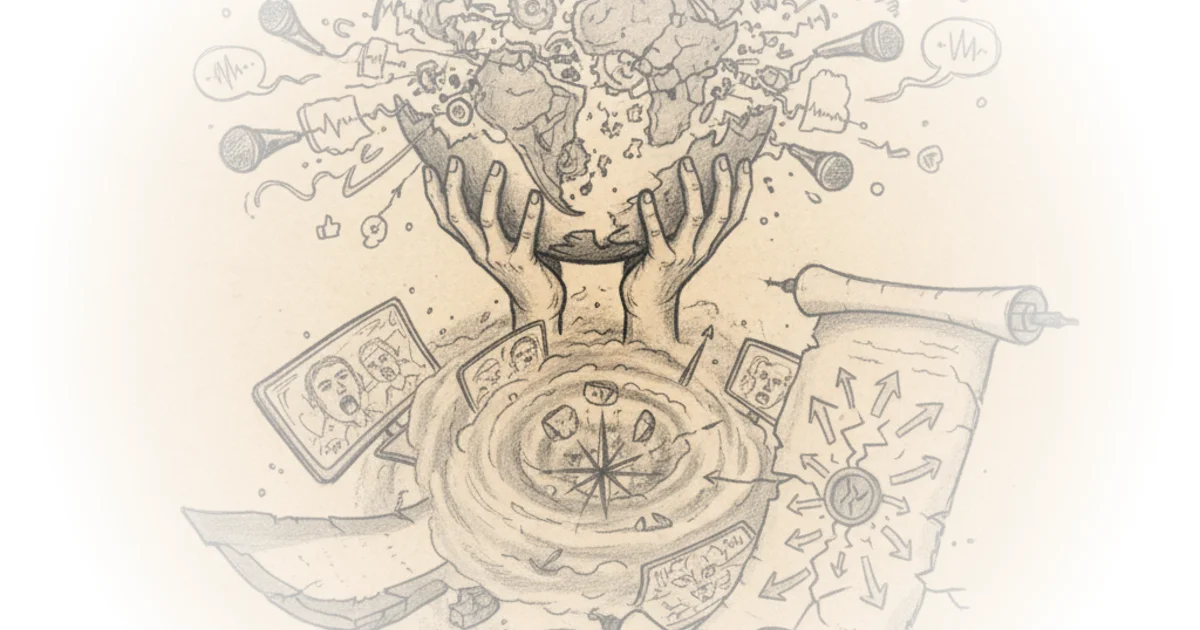
The consequence of this performative diplomacy was immediate and dangerous. Richardson points out that Iranian negotiators rejected the public declarations, stating that if the U.S. blockade wasn't lifted, they would "reclose the Strait of Hormuz they had just opened." The result was a rapid escalation: "Over the weekend, Iranians closed the strait and the U.S. fired on an Iranian vessel." Richardson's analysis suggests that the administration's need to claim credit for a deal that didn't exist directly triggered a military confrontation that could have been avoided. Critics might argue that the administration was simply leveraging maximum pressure tactics, but the evidence presented shows a pattern of self-sabotage where public announcements preempted and invalidated private negotiations.
"The Iranians didn't appreciate [Trump] negotiating through social media and making it appear as if they had signed off on issues they hadn't yet agreed to, and ones that aren't popular with their people back home."
The chaos extends beyond the Middle East, touching the very credibility of the executive branch's internal communications. Richardson details a surreal sequence where Vice President J.D. Vance was simultaneously being touted as a peace envoy in Pakistan and physically present at the White House. "On Sunday, even as two senior U.S. government officials were on television saying Vice President J.D. Vance would lead a new round of talks in Pakistan, Trump was on the phone telling reporters that he wouldn't," she observes. This contradiction led Iranian officials to dismiss the entire diplomatic effort as a series of "contradictory messages, inconsistent behavior and unacceptable actions by the American side." The human cost of this confusion is not abstract; it is the risk of miscalculation in a region where a single fired missile can escalate into a regional war.
The Weaponization of Disinformation and Domestic Instability
Beyond the geopolitical fallout, Richardson turns her lens to the domestic erosion of truth, arguing that the administration is increasingly relying on fabricated narratives to justify its stance. She highlights a disturbing incident where the administration reposted AI-generated images of women allegedly facing execution in Iran. "Trump urged Iran to start peace negotiations by releasing non-existent, AI-generated women some rando posted about on X," Richardson writes, quoting analyst David S. Bernstein. This move transforms diplomacy into a theater of the absurd, where policy is driven by deepfakes rather than verified intelligence. The reference to deepfake technology here is not merely a technical footnote; it represents a fundamental shift in how the administration constructs reality, prioritizing emotional manipulation over factual accuracy.
The financial entanglements of the administration further complicate the picture of national interest. Richardson notes reports that the administration is considering using U.S. Treasury funds to support the United Arab Emirates, an ally that has suffered economically from the conflict. She points out the potential conflict of interest, citing that Sheikh Tahnoon bin Zayed Al Nahyan, who controls UAE sovereign wealth, has invested heavily in Trump family financial ventures. "Zach Everson of Public Citizen pointed out that Sheikh Tahnoon... has directed hundreds of millions to Trump personally, buying 49% of the Trump family's World Liberty Financial," she writes. This raises a critical question about who the administration is truly serving: the American public or private financial interests disguised as foreign policy.
Domestically, the administration's strategy appears to be shifting toward undermining the electoral process itself. Richardson details how the Department of Justice is demanding election records from Wayne County, Michigan, despite the fact that the former president won the state while losing that specific county by a massive margin. Michigan officials Dana Nessel and Jocelyn Benson are quoted as saying, "this demand isn't about election integrity—it's about a weaponized DOJ trying to please a president who doesn't want to be held accountable at the ballot box." Richardson argues that this is a calculated effort to sow distrust ahead of future elections, a strategy that mirrors the rhetoric of the January 6 insurrection. The administration is not just losing elections; it is actively working to delegitimize the mechanism of democracy itself.
"Michigan's elections are safe and secure."
The political fallout is already visible in the halls of Congress, where the Republican majority is fracturing under the weight of the administration's demands. Richardson describes a "no good, very bad day" for House Speaker Mike Johnson, who was forced to watch his party defy him on key issues. In a rare display of bipartisan cooperation, Republicans joined Democrats to pass a discharge petition protecting Temporary Protected Status for Haitian immigrants, directly contradicting the administration's hardline deportation agenda. Richardson notes that "four Republicans, all of them from purple districts, joined all the Democrats to sign Pressley's discharge petition," followed by six more voting in favor. This rebellion highlights a growing disconnect between the party base in Washington and the pragmatic needs of the country, particularly regarding the human cost of deporting legal residents from dangerous regions.
Similarly, the attempt to renew the Foreign Intelligence Surveillance Act (FISA) without reforms to Section 702 failed, with twelve Republicans voting against a five-year extension. Richardson points out that members of both parties are increasingly concerned about government overreach, refusing to extend the law without safeguards. The administration's inability to pass basic legislation without significant internal dissent suggests a crisis of control that extends far beyond foreign policy. The political machinery is grinding, not because of external opposition, but because the leadership is out of step with the realities of governance.
The Bottom Line
Richardson's most compelling argument is that the administration's chaos is not a bug but a feature of a strategy designed to maintain power through perpetual crisis. By weaving together the collapse of the Iran ceasefire, the use of AI-generated propaganda, and the weaponization of the DOJ against election officials, she paints a picture of a government operating without a coherent center. The strongest part of her analysis is the connection between the administration's foreign policy blunders and its domestic erosion of democratic norms; both stem from the same source: a refusal to engage with reality. The biggest vulnerability in this narrative, however, is the assumption that institutional norms will hold against such sustained pressure. As the administration continues to test the boundaries of the law and the truth, the reader must watch whether the remaining guardrails of democracy can withstand the force of a leader who views them as obstacles rather than safeguards.