Tom van der Linden does not merely review a film; he interrogates the very machinery of how we consume stories, using Béla Tarr's notoriously difficult cinema as a scalpel to dissect our collective addiction to narrative comfort. While most film criticism focuses on plot or technical merit, van der Linden argues that Tarr's work forces a confrontation with the "death of God" and the terrifying reality of entropy, challenging the reader to abandon the search for meaning entirely.
The Architecture of Stasis
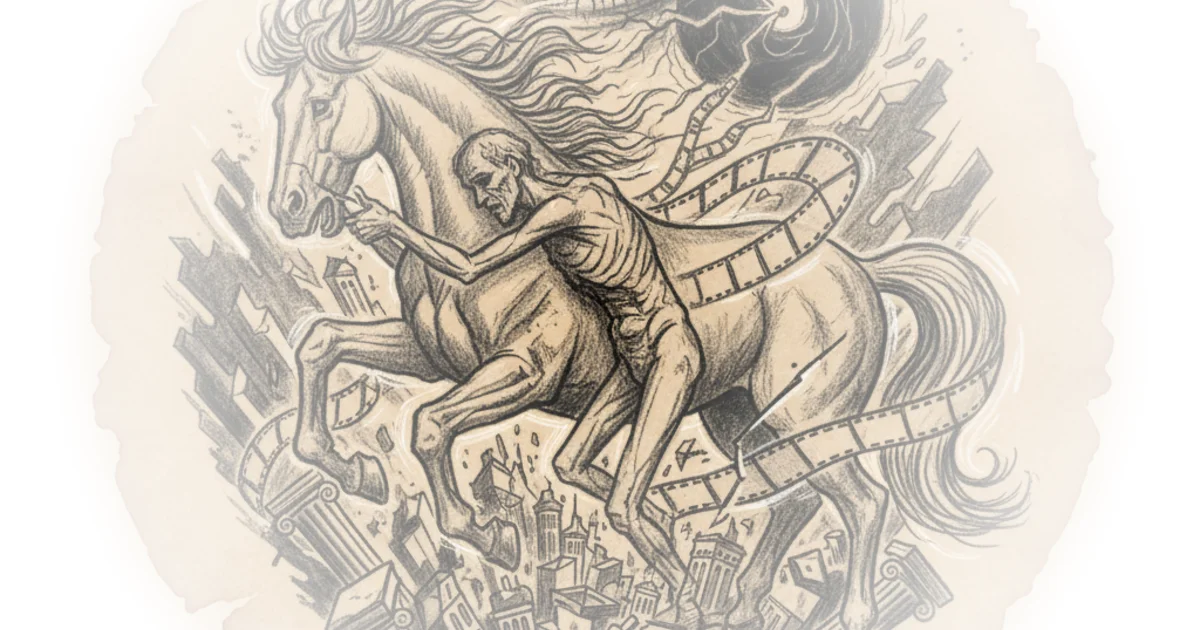
The piece opens with the legend of Friedrich Nietzsche's breakdown in Turin, a story van der Linden admits is likely apocryphal but essential to understanding the film The Turin Horse. He writes, "the narrator ends this monologue wondering not about what happened to Nietzsche but rather about what happened to the horse." This shift in focus is the crux of the argument: the tragedy is not the philosopher's collapse, but the silent suffering of the creature left behind in a world devoid of redemption. Van der Linden uses this to frame Tarr's style not as artistic pretension, but as a deliberate philosophical stance.
He describes the director's signature approach as a rejection of the "collectively agreed upon framework about how stories function." In van der Linden's view, modern audiences have been conditioned to expect progress, resolution, and moral clarity. Tarr strips these away. "Satan Tango for example is 7 hours and 19 minutes long... it was also hailed as a masterpiece that as a true cinephile you had to have seen at least once in your life," van der Linden notes, highlighting how the film's length itself becomes a test of endurance rather than a vehicle for entertainment. The argument here is that the friction we feel when watching Tarr is not a failure of the film, but a revelation of our own internalized expectations.
Critics might argue that framing such an arduous viewing experience as a "rite of passage" risks elitism, suggesting that only those with the patience to suffer through seven-hour monologues are capable of true artistic appreciation. However, van der Linden counters this by suggesting the difficulty is the point: "the question of what his films are about almost feels less relevant than the issue of why and how we pose that question in the first place."
The Cosmic Decay of Meaning
Moving beyond style, van der Linden delves into the thematic core of Tarr's work, identifying a pervasive sense of "worlds and Decay." He observes that in films like Damnation and Werckmeister Harmonies, characters are "immobilized within them" and "cannot move forward, cannot escape their fate." The author paraphrases Tarr's own evolution from social anger to a deeper cosmic realization: "the problems were not only social they are deeper they were Cosmic."
This is where the commentary becomes most potent. Van der Linden argues that Tarr's universe is defined by entropy, where "stones erode until they eventually crumble" and the entire universe is "damned." He connects this directly to Nietzsche's concept of the "death of God," explaining that for Tarr, this is not a theological crisis but an existential one. "The death of God forced us to truly consider our existence without reflexively appealing to any higher realm or being that would explain justify and validate it for us," he writes. The characters in these films do not seek God; they simply inhabit the void left behind.
In the cinematic worlds of Tarr it appears that God is history that this Nietzsche notoriously declared that God is dead.
The author illustrates this by analyzing Werckmeister Harmonies, where a fascist outsider is never seen, only felt through the "shadow he casts." This choice, van der Linden suggests, removes the safety of understanding the villain's logic, leaving the audience with only the "destructiveness and absurdity of what happens when humanity is discarded for fanaticism." The film becomes a study of how communities collapse when the foundational truths that hold them together dissolve.
The Silence of the Horse
The commentary culminates with an analysis of The Turin Horse, described as a "simple anti-creation story." Van der Linden details the film's structure: six days of a farmer and his daughter performing the same joyless routine as the world slowly dies around them. "The crickets stop chirping the horse refuses to eat and eventually dies the world dries up storms of dust ravage the land until finally all light is extinguished," he recounts. This is not a story of survival, but of inevitable cessation.
What makes this analysis particularly striking is van der Linden's distinction between Tarr and other existential filmmakers like Tarkovsky or Bergman. He notes that Tarr's work "distinguishes itself by not appealing to God not even in a metaphorical sense." There is no spiritual quest, no hidden meaning waiting to be uncovered. The characters are "fundamentally vulnerable and alone," trapped in a "shattered illusion." The author suggests that this lack of a safety net is what makes the films so terrifyingly relatable: "here nothing survives."
A counterargument worth considering is that by removing all hope and meaning, Tarr's films risk becoming nihilistic exercises that offer no insight into the human condition other than despair. Yet, van der Linden implies that the value lies precisely in this refusal to offer comfort, forcing the viewer to confront the raw reality of existence without the crutch of narrative resolution.
Bottom Line
Tom van der Linden's most compelling achievement is reframing Béla Tarr's difficult cinema not as an obstacle to be overcome, but as a necessary mirror for a culture obsessed with progress and meaning. While the argument relies heavily on the reader's willingness to accept a worldview devoid of redemption, it successfully challenges the homogenized standards of modern storytelling. The piece's greatest strength is its insistence that the "friction" we feel is the only honest response to a universe governed by entropy, not a failure of the film itself.