Walking is not merely movement — it is the architecture of thought itself. Wes Cecil's Humane Arts lecture makes a case that's been largely overlooked: walking isn't just good for your body, it's essential to every major breakthrough in human history. The evidence he assembles is staggering, and unlike most cultural criticism, this piece doesn't ask you to think differently about walking — it asks you to recognize that thinking itself was built on walking.
The Evidence Across History
The case begins with a catalog of intellectual giants who walked deliberately, obsessively, and consistently. Cecil writes that "in all truly great thoughts are conceived by walking" — this is Nietzsche's claim, and Cecil presents it as foundational. He then builds an overwhelming list: Beethoven walked so regularly in all weather that it was "basically the only thing he did regularly in his life." Einstein would walk so long he'd get lost, calling the university to be picked up because he couldn't find his way back. Schrodinger was followed by the FBI because agents thought a man wandering everywhere must be a spy — turns out he was just a mathematician working through problems on foot.
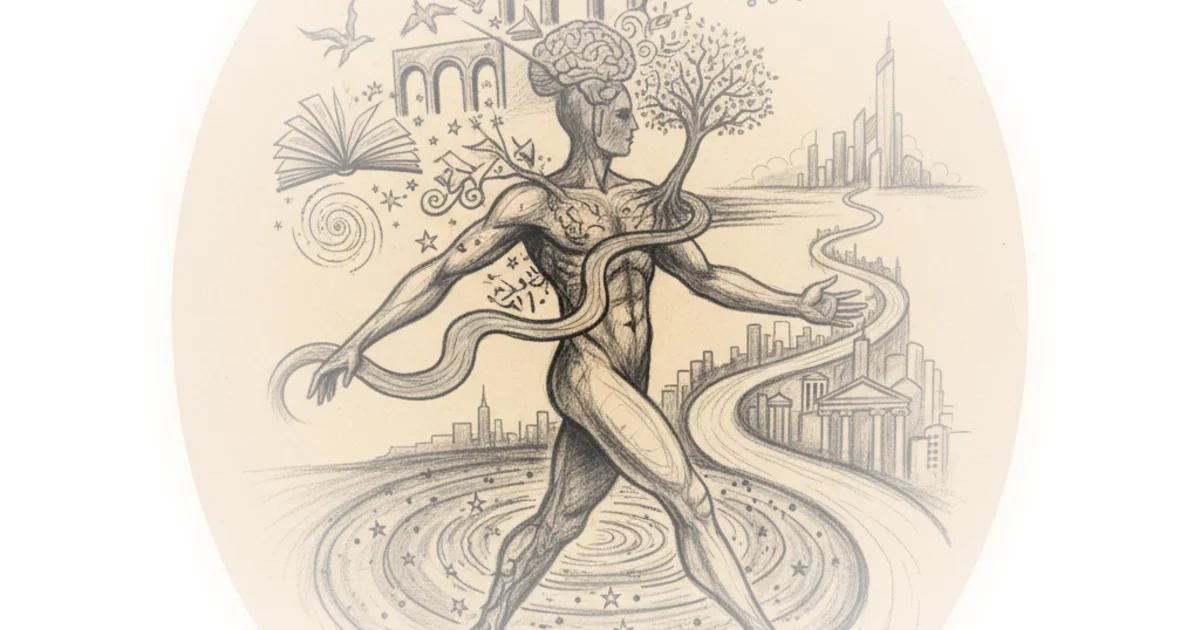
This is where the argument gains weight. The historical record shows not casual endorsement but active promotion: "the Romantic started wandering about in nature" and were "one of the early promoters of the nature hike" — meaning walking wasn't just personal habit, it became cultural movement. Wordsworth Shelley and others didn't merely walk, they advocated for it.
The Pilgrimage Tradition
Cecil turns to what might be the most compelling evidence: the pilgrimage traditions of India, where "20 to 50 million people are on a pilgrimage" at any given time. He uses the Ramayana as his centerpiece — Rama's long journey across India, his symbolic return represented by shoes placed on the throne, walking made symbolically central to Hindu tradition.
Walking is the crucible where bad thoughts die and good thoughts are born.
Cecil paraphrases Thoreau directly: "Above all do not lose your desire to walk every day I walk myself into a state of well-being and walk away from every illness I've walked myself into my best thoughts." This isn't metaphor — it's prescription. The walking isn't just physical release, it's cognitive renewal. After a day's walk, "everything is twice its usual value" — travel transforms perception itself when you're moving at the speed nature intended.
The Evolutionary Argument
What makes this piece distinctive is Cecil's attempt to explain why walking works. He offers an evolutionary answer: our brains evolved with bipedalism simultaneously. Walking on two legs is "extraordinarily rare in the natural world" — only six marginally bipedal creatures exist today, and humans are the only fully bipedal species alive. Our eyes and ears evolved to work while we walk. The argument is that walking isn't just pleasant — it's what we're designed for at every level.
Cecil makes a powerful observation: "if you were a hunter... you just walked behind it because human beings can walk any creature to death" — we can follow prey indefinitely, something no other animal can do. Horses tire; prey escapes; humans simply continue. The phrase sounds like hyperbole but it's literal: "the best thing to do is kill your horse eat it and keep walking" was actual advice for travelers.
What the Modern World Missed
The piece's most incisive critique targets modern life specifically. When you're in a car traveling at speed, "you can't smell things anything you see goes whizzing past right fast you can't stop and Ponder" — this is disorienting to the human experience. The highway designer Russell Paige understood that when traveling fast, nature appears boring; but that's because our perception evolved for walking pace, not automotive speed.
Cecil argues we are "spectacularly efficient Walkers" capable of "hundreds of miles with very limited breaks" and yet we've built environments that require us to run four miles and call it exercise — which is absurd given what humans can actually do. Most people in this room could walk 20 miles "and your knees might get a little achy but you would notice that you had done it but you could do it."
Counterpoints
Critics might note that the evidence, while compelling, relies heavily on historical figures who were already exceptional — walking may correlate with creativity but doesn't cause it for most people. The evolutionary argument is suggestive but speculative; correlation isn't causation. And the India examples, while rich, lean heavily on symbolic and religious traditions that might not translate to secular contexts.
If you can't think it while you're walking, you shouldn't be thinking it at all.
The strongest move in the piece is this standard: Nietzsche's declaration that thoughts too subtle to maintain while strolling are probably stupid. It's a brutal test for intellectual rigor — and it comes from someone who wrote extensively while walking the same paths he demanded others walk.
Bottom Line
Cecil's argument is most compelling when he's least expected: the evolutionary biology makes the case feel inevitable, not optional. His biggest vulnerability is practical — the modern world doesn't just need convincing, it needs pathways. Walking won't restore thinking if we've already severed our connection to walking entirely. The piece succeeds wildly at making the case; what remains uncertain is whether anyone will listen.