This piece from Big Biology doesn't just profile a scientist; it challenges the very definition of what constitutes a viable research question. In an era where grant funding often favors incremental safety, the editors highlight Dr. Oded Rechavi's radical premise: that the most valuable science begins where the comfort zone ends. The coverage is notable not for its technical density, but for its argument that the current scientific publishing culture is actively strangling the kind of high-risk, high-reward inquiry that drives genuine breakthroughs.
Rewriting the Rules of Inheritance
The article opens by establishing Rechavi's philosophy, which stands in stark contrast to the pressure for predictable outcomes. Big Biology reports, "I am often more interested in ideas that startle, that bring you out of your comfort zone, or that are the opposite of what people think." This isn't merely a personal quirk; it is a methodological stance. Rechavi argues that if more than 10 percent of your experiments work, you are likely not pushing boundaries enough. The piece details how his lab uses the nematode Caenorhabditis elegans to demonstrate that environmental stressors, like starvation or viral infection, can leave molecular "memories" that are passed down to offspring. These findings suggest that heredity is not a static code but a dynamic conversation between an organism and its environment.
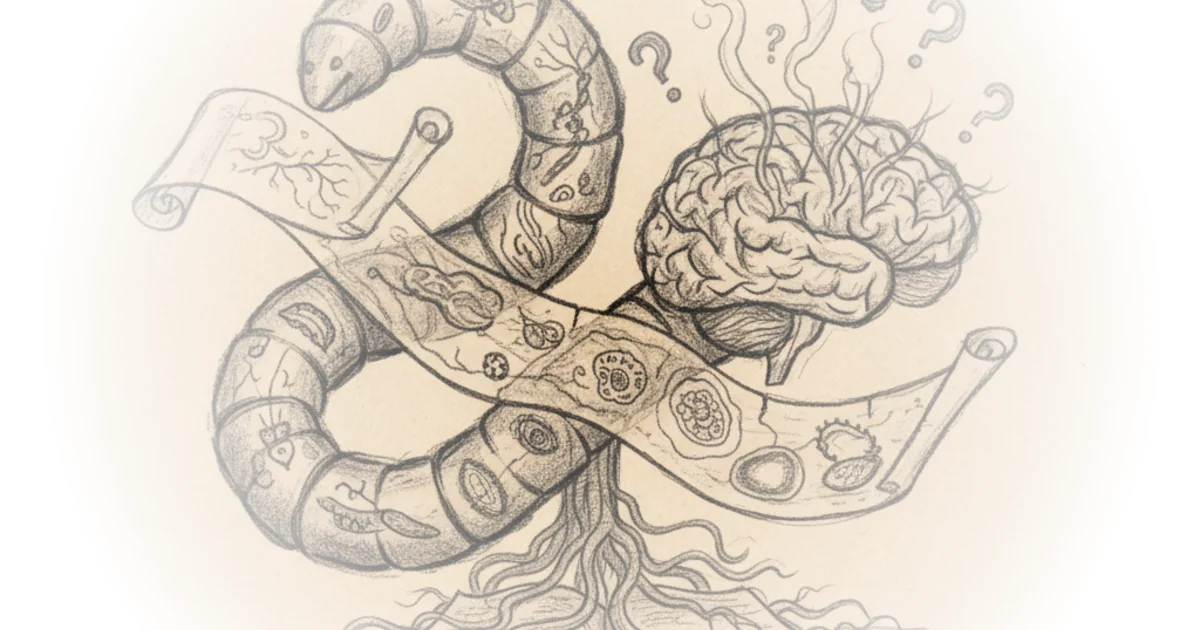
The editors note that these non-coding RNAs are "short sequences of RNA, typically between 20 and 30 nucleotides long," which regulate gene activity by inhibiting expression. By showing that these molecules carry information across generations, Rechavi's work forces a re-evaluation of how organisms adapt. A counterargument worth considering is that while this mechanism is clear in simple worms, extrapolating it to complex mammals remains a significant leap. However, the piece effectively frames this not as a finished theory for human biology, but as a crucial expansion of the biological toolkit we use to understand adaptation.
If more than 10 percent of your experiments work, then you're probably doing something not that interesting.
Turning Invaders into Allies
The coverage then pivots to one of the most striking applications of Rechavi's creative approach: repurposing a dangerous parasite. The article explains that his team took Toxoplasma gondii, an organism known for infecting human brains, and engineered it to deliver therapeutic proteins instead of virulence factors. This is a profound shift in strategy. The piece argues that because neurons are "so delicate and well-protected by the blood–brain barrier, delivering proteins or gene-editing tools directly into them has long been a major technical hurdle."
By modifying the parasite's natural secretion system, the researchers turned a disease-causing organism into a potential ally. Big Biology reports that the team "demonstrated that the modified parasites could successfully enter neurons and secrete multiple large proteins," a feat notoriously difficult with existing methods. The editors emphasize that this work is still in its "very early stages," limited to proof-of-concept experiments. Yet, the implication is clear: the most effective delivery system for the brain might be the very thing that has long been feared as a threat. This reframing of a pathogen as a vehicle for healing is a testament to the power of looking at biological machinery without preconceived notions of good or evil.
From Ancient Scrolls to Modern Publishing
The final section of the piece connects Rechavi's scientific creativity to his critique of the academic publishing machine. His work on the Dead Sea Scrolls, where he sequenced animal skin DNA to trace fragment origins, serves as a metaphor for his broader goal: connecting disparate pieces of information to reveal a more complex truth. The editors note that this work revealed a "more complex origin story" for the scrolls, suggesting they were produced outside the Qumran site. This interdisciplinary approach mirrors his frustration with the current state of scientific publication.
Rechavi identifies the peer review process as a primary bottleneck. "One of the things that reduces the creativity and spontaneity and fun of science is how we publish, what is a paper," he says in the piece. He acknowledges the necessity of feedback but describes the current system as "torturous," "inefficient," and "biased." To combat this, he and his colleagues developed q.e.d. Science, an AI tool designed to provide instant, objective analysis of a manuscript's reasoning before it enters formal review. The goal is to free human reviewers to focus on deeper questions rather than technical details. Critics might argue that relying on AI for initial screening introduces new biases or lacks the nuance of human expertise. However, the piece presents this as a necessary evolution to make publishing more transparent and to encourage the reporting of negative or inconclusive results, which are currently undervalued.
Yes, it improves the work, but it's a torturous thing that takes forever. It's inefficient. It's biased…But we need it. We need feedback.
Bottom Line
The strongest element of this coverage is its unapologetic defense of scientific risk-taking, framing the current publishing culture as an obstacle to discovery rather than a guardian of quality. Its vulnerability lies in the assumption that tools like q.e.d. Science can fully resolve the human and institutional biases embedded in peer review. The reader should watch for how this AI-driven feedback model evolves, as it may well determine whether the next generation of radical science can survive the current system.