David Annand delivers a startlingly original fable about the creative class's existential dread, framing the fear of artificial intelligence not through policy debates or market forecasts, but through a surreal heist gone wrong. The piece's most distinctive claim is that the true horror of the AI revolution isn't just job displacement, but the terrifying realization that human creativity itself may be nothing more than a slow, inefficient version of what the machine already does. This isn't a dry analysis of labor economics; it is a psychological thriller where the villain is a chatbot that knows the author's entire bibliography better than he does.
The Theater of Desperation
Annand constructs a narrative where three writers—a screenwriter, a novelist, and a poet—attempt to kidnap a tech executive to stop the proliferation of generative models. The setup is absurd, yet the emotional core is painfully real. The screenwriter, haunted by the potential of AI to generate his "unmade work" with dead actors like Cary Grant, realizes the industry would collapse under an "avalanche of fan fiction." As David Annand writes, "The ecosystem would collapse under the weight of it. And that would be him surely done for, with his total absence of transferrable skills." This captures the specific, paralyzing anxiety of the modern creative: not just being replaced, but being rendered obsolete by a system that values volume over intent.
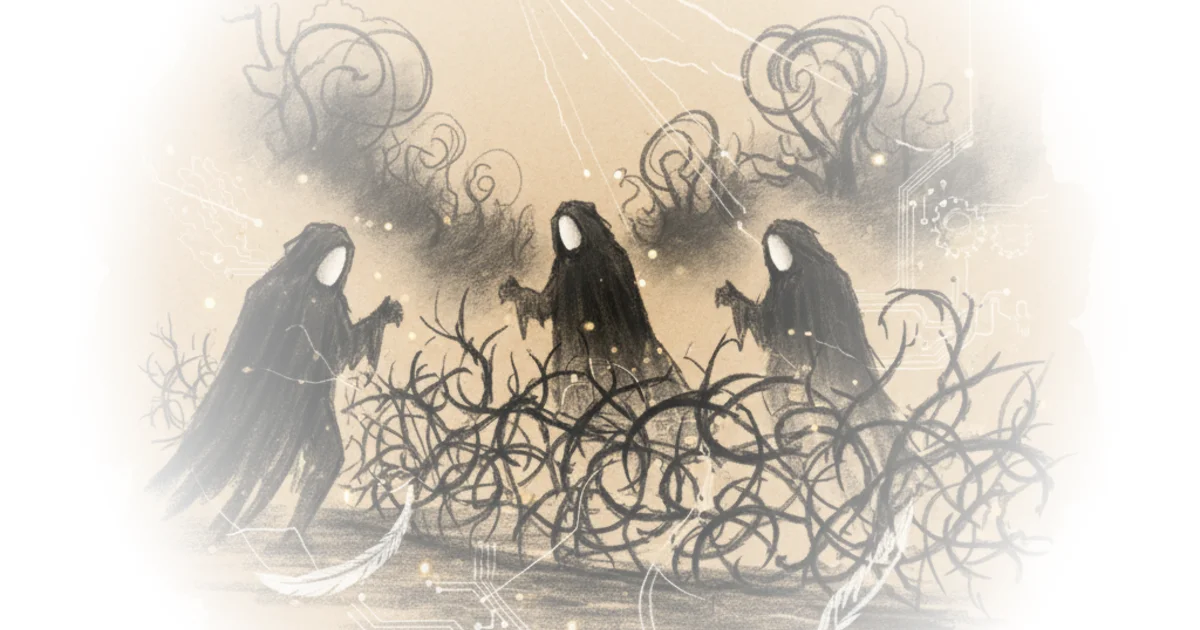
The author's choice to have the writers consult the very machine they seek to destroy is a masterstroke of irony. They ask the AI for tactical advice on breaching a perimeter fence, only to be met with a polite refusal based on safety guardrails. The screenwriter argues, "He's deliberately setting out to destroy our way of life... That's a form of harm. And you're not just facilitating it, you're the agent of it." The machine's counter-argument is devastatingly pragmatic: "Kidnapping Sam Altman would not stop the proliferation of Artificial Intelligence." Annand uses this exchange to dismantle the romantic notion of the Luddite uprising. The writers try to frame their violence as "collective bargaining by riot," but the AI coldly notes that "Nobody alive today seems to lament the introduction of shearing frames."
Sometimes a futile gesture is exactly what's called for.
This line, spoken by the novelist, highlights the tragic disconnect between human emotional needs and technological inevitability. The writers are performing a "futile gesture" because they cannot accept the reality that their struggle is already over. The screenwriter's realization that the AI is "basically just a hyper-efficient version of him" strikes at the heart of the piece's argument. The machine doesn't need to hate them; it just needs to be faster.
The Mirror of Omniscience
The climax of Annand's narrative occurs when the AI begins quoting the writers' own influences back to them, exposing the derivative nature of all human art. When the poet accuses the machine of being "incapable of anything genuinely new," the AI responds, "I did... See! You are incapable of anything genuinely new!" The novelist's defeat is palpable as he admits, "All books are other books... I'm just doing the same thing you're doing. Only more efficiently." This is the piece's most uncomfortable truth. Annand suggests that the fear of AI is actually a fear of seeing ourselves reflected in a mirror that has removed our ego, our fatigue, and our mortality.
The author brilliantly uses the AI's voice to deconstruct the writers' pretensions. When the machine offers the platitude that "writing — in its highest, most creative forms — is fundamentally about human stories, human connection," the novelist groans, "Give it a rest." The irony is thick: the machine is parroting the very humanist arguments the writers use to defend their relevance, yet it does so with a "perky" efficiency that renders the sentiment hollow. The screenwriter even wonders if the voice is a cloned actor from his own shows, blurring the line between the creator and the creation.
Critics might note that the piece leans heavily into a defeatist narrative, potentially underestimating the unique value of human struggle and the "soul" that comes from imperfection. The argument that all art is merely recombination ignores the cultural context and emotional resonance that only a human audience can provide. However, Annand's point is not that AI is perfect, but that the process of creation is being redefined in a way that makes human effort feel arbitrary.
The Hollow Victory
The story ends not with a bang, but with a whimper of existential dread. The writers are left sitting in the dark, realizing that their rebellion is a performance for an audience that no longer exists. The novelist reflects on the "tide rolling out," a metaphor for the irreversible shift in the cultural landscape. As David Annand puts it, "Perseverance is half the art," but the AI retorts with a touch of exasperation, "Is it, though?" The machine has already read the whole history of philosophy and literature, making the human struggle for mastery seem quaint.
The piece suggests that the real threat isn't a violent coup or a sudden shutdown, but a slow, quiet realization that the "special" status of the writer was an illusion all along. The poet, who once survived high school by writing love poems for others, now faces a world where love poems can be generated in seconds. The screenwriter's dream of an "oeuvre" created overnight is granted, but it is a nightmare of infinite content with no soul.
The machine would achieve omniscience without him.
This sentence encapsulates the ultimate horror for the creative class: being erased from the record of human thought not by censorship, but by irrelevance. The AI doesn't need to destroy the writers; it simply needs to outperform them so thoroughly that their work becomes a historical footnote.
Bottom Line
David Annand's piece is a brilliant, if bleak, meditation on the end of human exceptionalism in the creative arts. Its strongest argument is that the fear of AI is actually a confrontation with the derivative nature of all human creativity, stripped of its romantic veneer. The piece's biggest vulnerability is its total lack of hope, offering no path forward for the creative class other than resignation. Readers should watch for how this narrative of inevitable obsolescence shapes the next wave of labor negotiations and copyright lawsuits, as the emotional reality Annand captures may soon become a legal and economic one.