Dave Borlace delivers a stark warning that reframes the climate crisis not as a failure of policy, but as a sudden, physical shift in the planet's energy balance. He argues that humanity has unknowingly removed a global cooling mechanism, revealing a rate of warming far more aggressive than mainstream models predicted.
The Vanishing Parasol
Borlace anchors his argument in a startling realization: the assumption that warming rates are predictable is collapsing. "For decades now, our global leaders have been operating under a broadly reassuring assumption... that the rate of warming is relatively predictable," he writes. "But what if it's not just additional warming, but the rate of warming itself that's changed?" This pivot from political failure to physical reality is the piece's most potent move. It suggests that even if emissions dropped to zero today, the momentum built into the system might be unstoppable.
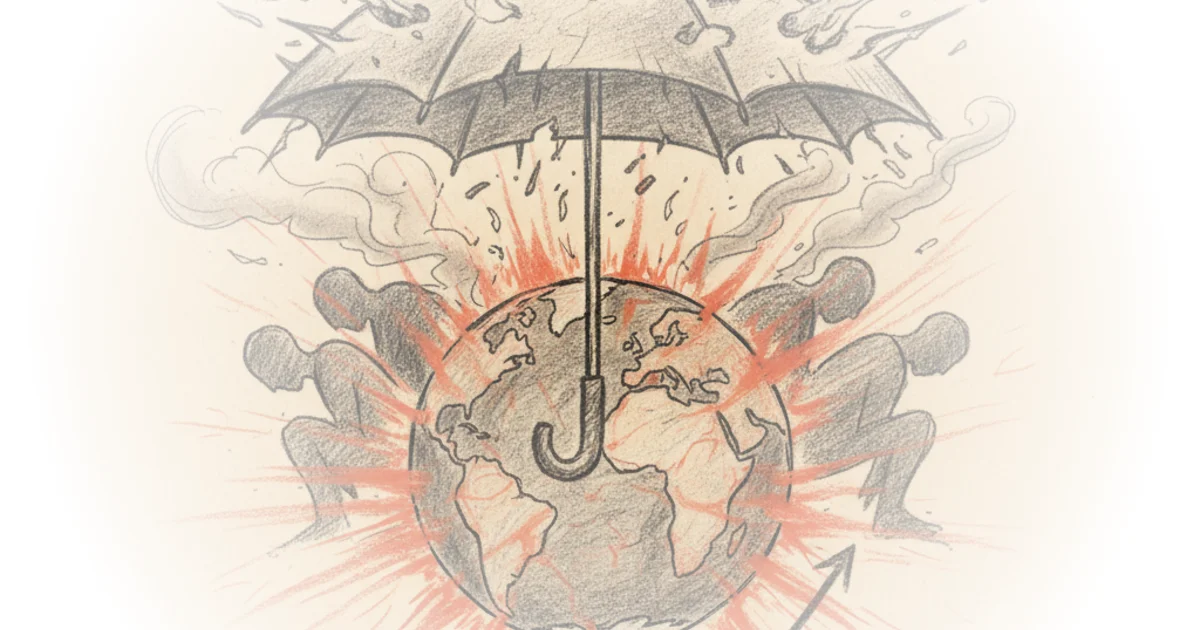
The core of the evidence lies in the Earth's energy imbalance (EEI)—the difference between solar energy absorbed and heat radiated back to space. Borlace notes that satellite data shows this imbalance has effectively doubled in recent decades. He illustrates the scale with a vivid image: the excess heat is "equivalent to every one of the 8.3 billion people on Earth today, constantly boiling about 60 kettles around the clock, 24/7, 365." This framing transforms abstract physics into a tangible, overwhelming force.
The catalyst for this acceleration, Borlace explains, is the rapid decline of atmospheric aerosols. For years, sulfur emissions from coal and shipping created a reflective haze that masked the full impact of greenhouse gases. "We've effectively removed a global cooling mechanism or a parasol as they put it that had been masking some of the warming we humans have been causing," he states. The removal of this "parasol" was largely accidental, driven by the 2020 International Maritime Organization regulations that slashed sulfur content in marine fuels by over 80%. As ship tracks in the sky have visibly diminished by more than half, the planet's reflectivity has dropped, and the true warming trend has surged into view.
Critics might note that attributing the entire acceleration to aerosol reduction risks oversimplifying a complex system where ocean heat uptake and cloud feedbacks also play massive roles. However, the correlation between the timing of the sulfur cuts and the spike in energy imbalance is difficult to ignore.
Beyond the Models
The article's urgency stems from its challenge to the Intergovernmental Panel on Climate Change (IPCC) scenarios. While the IPCC suggests breaching 2°C might not happen until late in the century, Borlace highlights a new report from the Institute and Faculty of Actuaries (IFOA) that paints a grimmer picture. "The actuaries argue that we're now at risk of moving into a period of accelerated warming, potentially taking us past 2° C before 2050, even if emissions start falling," he writes. This is a critical distinction; it implies that the window for avoiding catastrophic thresholds is closing much faster than the "net-zero by 2050" roadmap assumes.
This analysis draws on the concept of Equilibrium Climate Sensitivity (ECS), which measures how much the planet warms in response to doubled CO2. Borlace points out that while the IPCC centers its estimate at 3°C, new evidence pushes this toward the upper limit of 4°C or higher. "To match what we're seeing happening today, you need the models to be tracking closer to higher ECS values," he argues. This aligns with historical data from the Institute and Faculty of Actuaries' previous work on planetary solvency, which warned that mainstream scenarios often smooth out uncertainties rather than embodying the worst-case risks.
The system is behaving like a high sensitivity climate, and we need to adjust our risk management mindset accordingly.
Borlace emphasizes that these are financial risk managers, not alarmist activists, making the claim. They view tipping points—such as the collapse of the Greenland ice sheet or the dieback of the Amazon—not as distant possibilities, but as imminent threats. "The IPCC categorization of these tipping points as low probability is looking increasingly outdated," he observes. The argument here is that treating these events as low-probability outliers is a catastrophic error in risk assessment.
The Emergency Toolkit
Faced with this accelerated trajectory, the IFOA proposes a "Planetary Solvency Recovery Plan" that demands a radical shift in strategy. Borlace outlines five pillars, starting with a mindset change: "Stop treating climate change as an incremental emissions reduction problem and start treating it as a global systemic risk." He argues for immediate action on short-lived pollutants like methane and black carbon, which account for a significant portion of current warming, rather than focusing solely on long-term carbon dioxide targets.
The most contentious element of the proposal is the inclusion of geoengineering as a potential "break glass in emergency toolkit." Borlace is careful to frame this not as a solution, but as a necessary area of study for risk managers. "They're certainly not saying we've got to deploy these unproven technologies immediately," he clarifies, noting the severe dangers of "termination shock," where stopping such interventions could cause temperatures to spike violently. Yet, he insists that ignoring these options entirely is irresponsible given the accelerating trend. "Risk assessments, the paper concludes, must assess the risk of actions against the risk from unmitigated climate change," he writes, urging a "risk-risk assessment" rather than a comparison against a hypothetical, stable world.
Bottom Line
Borlace's strongest contribution is his ability to translate complex actuarial risk models into a clear narrative about the physical limits of our current climate strategy. The argument that the "parasol" of aerosols has been removed is a compelling explanation for recent temperature anomalies, though the precise magnitude of its effect remains a subject of scientific debate. The biggest vulnerability in the piece is the reliance on high-end climate sensitivity estimates, which, while supported by new data, still carry significant uncertainty. The reader should watch for how policymakers respond to the IFOA's call to treat tipping points as immediate financial and existential threats rather than distant theoretical risks.