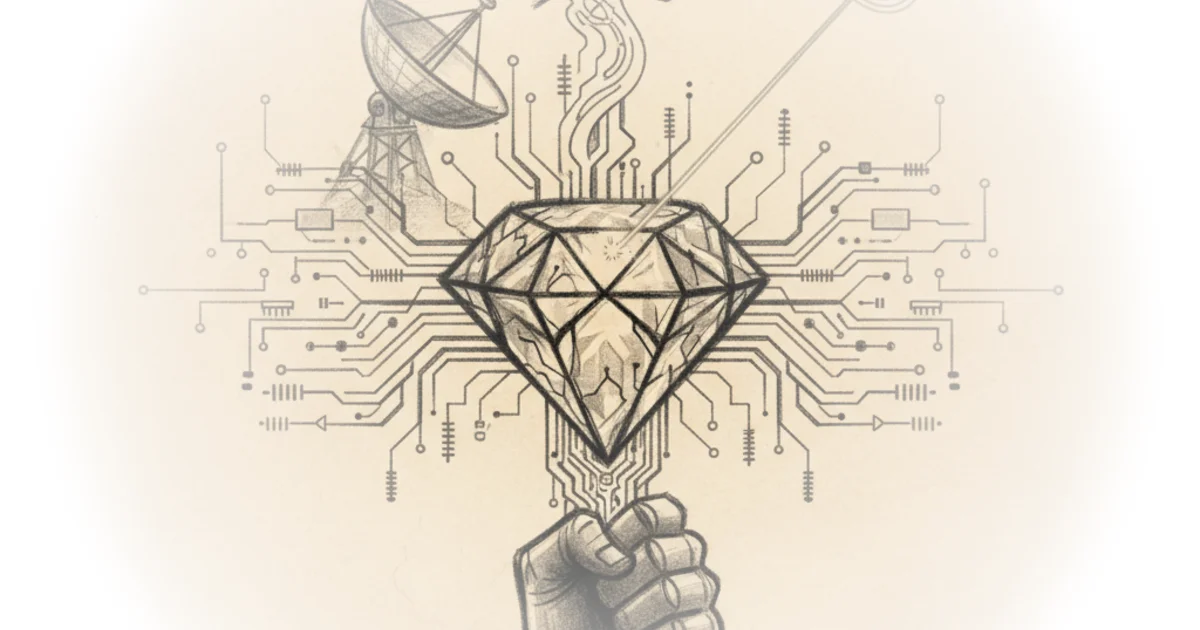
Asianometry reframes the diamond industry not as a luxury market, but as the semiconductor industry's most elusive holy grail. The author argues that while James Bond's villain might have been better off building diamond transistors than a space laser, the real villain is actually the physics of manufacturing. This piece is notable because it moves beyond the standard "diamonds are hard" narrative to dissect the specific, brutal engineering bottlenecks preventing diamond from replacing silicon in high-power electronics.
The Physics of Perfection
The core of the argument rests on a comparison of material properties. Asianometry writes, "Silicon's band gap is just 1.12 electron volts, which is relatively narrow." This narrowness creates a feedback loop where heat causes leakage, which creates more heat, eventually causing the device to fail. In contrast, the author highlights that diamond offers a massive advantage: "Diamond's band gaps is absolutely massive compared to silicons. 5.5 electron volts compared to 1.12." This wider gap means the material can withstand extreme heat and voltage without breaking down.
The commentary here is particularly effective because it quantifies the thermal advantage in terms that matter to engineers. Asianometry notes that diamond's thermal conductivity is "about 2,200 watts per meter Kelvin," which "blows away silicon's 150 watts per meter kelvin." This isn't just a slight improvement; it is a fundamental shift in how power can be managed. The author correctly identifies that this property allows for "very high densities of active diamond transistors or less cooling," a critical factor for electric vehicles and 5G infrastructure.
No other material is like this, and that makes it perfect for certain high performance niches within the 55 to 60 billion power electronics market.
Critics might note that the author briefly glosses over the fact that other wide-bandgap materials like silicon carbide and gallium nitride are already dominating these markets. While diamond is theoretically superior, the market has already moved on to "good enough" alternatives that are easier to produce. However, Asianometry's point remains valid: for the most extreme conditions, silicon carbide is not the ceiling.
The Manufacturing Nightmare
The piece shifts from theoretical promise to practical impossibility, and this is where the analysis shines. The author explains that the standard method for making silicon wafers, the Czochralski method, cannot be used for diamond because "Molten diamond turns into graphite which we cannot pull." Instead, manufacturers must rely on Chemical Vapor Deposition (CVD), a process that is slow and finicky.
Asianometry writes, "Single crystal wafers right now just 10 mm wide can cost up to 10,000 times of equivalent sized silicon." This staggering cost difference illustrates why the industry has stalled. The author details the complexity of growing these crystals, noting that the microwave plasma used in the process is "inherently non-uniform," leading to grain boundaries that ruin the electronic properties. The text describes the current state of the art with a touch of dry humor: "The target width to go commercial is about 4 in with a killer defect rate of 1 per 10 square cm. But single crystal wafers right now just 10 mm wide can cost up to 10,000 times of equivalent sized silicon."
The author also touches on the "mosaic method," where multiple small seeds are fused together, but acknowledges that this is a stopgap. The real bottleneck, however, is not just growing the crystal, but doping it. Asianometry explains that for a transistor to work, you must introduce impurities to make it conductive. In silicon, this is easy. In diamond, it is a nightmare. The author states, "The threshold for doped diamond is multiples higher or I mean like I said the correct lingo is to say deeper." Because the energy required to activate these dopants is so high, a diamond transistor might not work at room temperature.
This is great if we want to run our diamond transistor computer on the surface of Venus and it legit might perform really well there, but we are talking about Earth.
This observation is a brilliant way to contextualize the technical failure. It highlights that the material is so specialized that it is currently useless for the very environment we live in. The author notes that attempts to fix this by adding more dopants result in a "degenerate semiconductor" that acts more like a metal, losing its switching ability entirely.
The Verdict
The strongest part of Asianometry's coverage is the unflinching look at the gap between material science potential and manufacturing reality. The argument that diamond is the "perfect" semiconductor is undeniable based on physics, but the piece successfully argues that physics alone does not make a product. The biggest vulnerability in the broader industry's approach is the assumption that we can simply scale up current CVD methods. As the author implies, the solution may require entirely new paradigms in crystal growth or doping techniques that do not yet exist.
Bottom Line
Asianometry delivers a compelling case that diamond transistors are the ultimate performance upgrade, yet remain trapped by the brutal economics of synthesis and doping. The strongest takeaway is that while the material properties are unmatched, the "deep" activation energy of dopants makes room-temperature operation a distant dream. Readers should watch for breakthroughs in heteroepitaxy—growing diamond on non-diamond seeds—as this may be the only path to scaling production before the cost barrier becomes insurmountable.