In a landscape often dominated by spec sheets and price wars, Benn Jordan offers a rare, tactile defense of physical music gear, arguing that the true value of hardware lies not in sonic superiority but in the human experience of creation. This isn't a technical review of the Teenage Engineering OP-1 Field or the API 500 series; it is a philosophical inquiry into why we still reach for knobs when a mouse could do the job faster. Jordan suggests that the friction of physical interaction is not a bug to be fixed, but a feature essential to the artistic process.
The Case for Tactile Friction
Jordan opens by dismantling the utilitarian argument that software should replace hardware simply because it is more efficient. He frames the choice between a digital interface and a physical console as akin to choosing between a digital drawing and an oil painting. "Why use hardware when you can do it in software?" he asks, only to immediately counter with a compelling analogy: "Why do an oil painting when on an ipad you can make a drawing that looks like an oil painting?" The point is that the medium shapes the mind; the physical act of creation teaches the artist something that a simulation cannot.
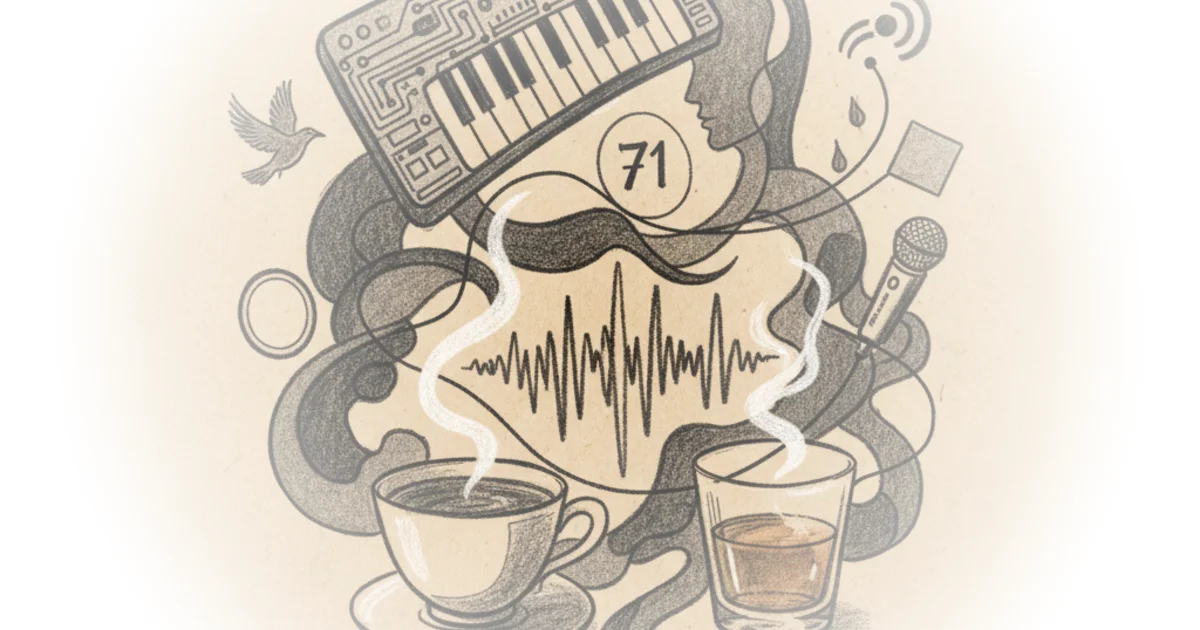
This argument resonates because it shifts the metric of value from "fidelity" to "engagement." Jordan notes that while a mouse is a functional tool, it feels "strangely industrial office" compared to the direct connection of fingers on a fader or a knob. He highlights the cumulative effect of this interface, stating, "it doesn't seem like a big deal until you do it 10,000 times in an hour and then you know you're like oh I've actually saved myself a huge amount." The efficiency here isn't in speed, but in the reduction of cognitive load required to translate thought into action.
The experience of a 550 api eq it's a stepped eq right like what is the vibe tactile vibe of go yeah yeah it's not that strong right if you've got like i've got this sail eq1 i highly recommend you get that one for your test because it's um it's a playable parametric eq sounds amazing legitimately good and um all kinds of gain staging that you can play
Jordan's critique extends to the design philosophy of modern manufacturers, specifically targeting Teenage Engineering for prioritizing aesthetics over functionality. He points out a critical oversight in their modular system: the lack of reverse circuit protection. "if you accidentally plug in the wrong which you know look at how many of these like wall work things you have here if you accidentally plug the wrong one and you fry your whole modular and that costs to i don't know how much now at the time of of making that that component that diode to prevent that cost about point seven cents why would you do that," he argues. This is a sharp critique of a "Lambo life" mentality where design flair supersedes user safety and durability.
Critics might note that this focus on hardware fetishism ignores the accessibility and democratization that software has brought to music production, allowing creators with no budget to access world-class tools. Jordan acknowledges this, admitting that "nobody is going to just be like you know i'm thinking of getting into music i'm going to buy some 500 series," but he maintains that for those who do, the investment is about the joy of the process, not just the output.
The Open Standard Dilemma
The conversation pivots to the broader ecosystem of music technology, where Jordan champions the philosophy of open standards over proprietary lock-in. He contrasts the collaborative spirit of the past with the siloed nature of modern protocols. "the cool thing about midi was it was a open standard," he reflects, lamenting that newer technologies like Dante are closed systems where companies must pay licensing fees for every unit sold. This shift, he suggests, stifles the kind of organic innovation that occurred when engineers could freely build upon each other's work.
Jordan's frustration is palpable when discussing the API 500 series, a standard that has become a cornerstone of professional audio. He questions whether the industry is moving toward a future where every component requires a royalty payment, asking, "if everybody has to pay five cents to make a api 500 module." This concern highlights a tension between the need for intellectual property protection and the health of a creative community that thrives on interoperability.
I'm not saying that owning a 2500 piece of rack here makes my thing sound any better but if i enjoy it then there must be some value to it
This quote encapsulates the core of Jordan's thesis: the subjective value of enjoyment is a valid economic and artistic metric. He cites artist Marta Salami, who relies on tape machines not just for their sound, but for the sensory experience: "she goes a lot you know it means a lot to me to use my body to use my hands to use my smell like they smell like they're mechanical." In an era of sterile digital interfaces, this connection to the physical world becomes a form of resistance.
Bottom Line
Benn Jordan's commentary succeeds by reframing the debate over hardware versus software from a question of quality to one of human connection. His strongest argument is that the tactile friction of physical gear is not an obstacle to efficiency, but the very thing that makes the creative process sustainable and enjoyable. However, his defense of expensive hardware risks alienating a generation of creators who have never had access to such tools, potentially limiting the piece's reach to a niche of established professionals. The reader should watch for how the industry balances the demand for open standards with the reality of proprietary business models in the coming years.