The most distinctive thing about this Close Reading Poetry piece is how it frames Wordsworth's "Tintern Abbey" not as a nature poem, but as an argument about faith — specifically, what keeps us going when political revolutions fail. The author makes a case that seems obvious once he explains it: Wordsworth's poem isn't about Christianity emerging from older forms, but about a faith in the possibility for goodness that answers how to go on living.
The Landscape Is Just the Beginning
The video opens with what feels like unnecessary background — the full title, the location, the Abbey ruins — but then something interesting happens. Close Reading Poetry argues that this landscape description isn't "mere throat clearing." It's foreshadowing. The poem is "situated in a Locale" and also "situated in time." That's crucial: July 13th, 1798, corresponds to Bastille Day in 1789. Wordsworth was an undergraduate at Cambridge when the French Revolution happened. He was excited — he was a republican. He went to France twice. And then he witnessed the dissolution of the Revolution into chaos, including the September massacres in Paris.
"This date is important for that reason it's commemorating so not only is this poem situated in a Locale it's also situated in time."
What makes this framing effective? It connects a personal meditation on beauty to political history — something most readers wouldn't catch on their own. The author is pointing out that Wordsworth's "faith" isn't abstract. It's tested by what he actually witnessed: the failure of revolutionary hope.
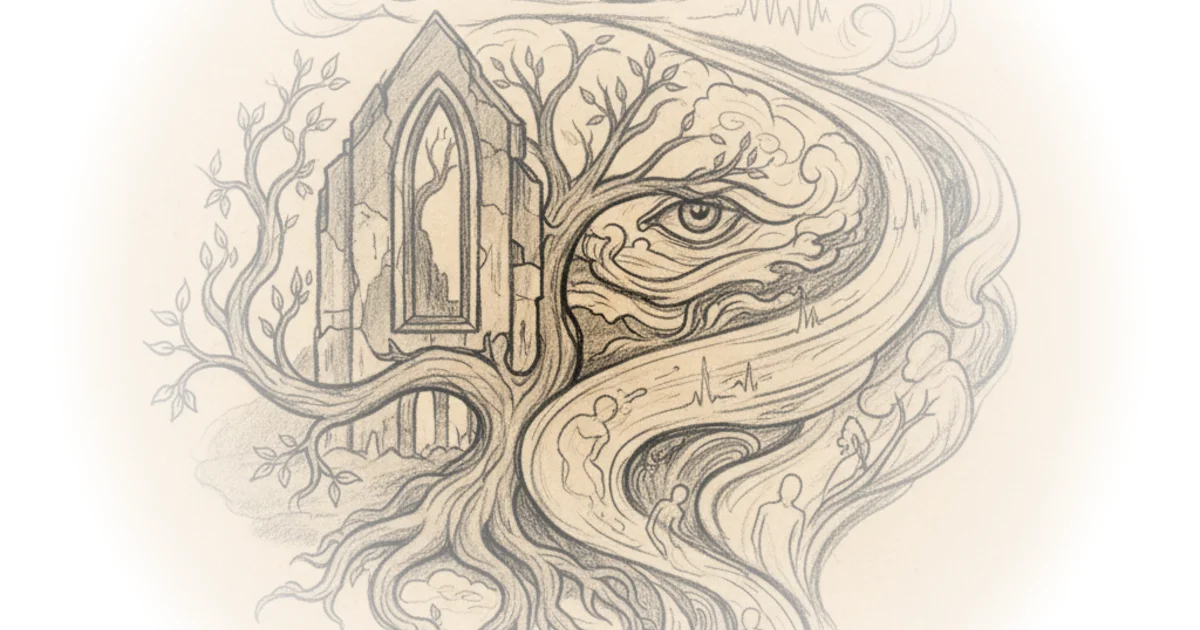
Vision, Hearing, and the Blurring of Distinction
The poem relies heavily on two senses: sight and hearing. Close Reading Poetry draws attention to how Wordsworth uses these not just as descriptions, but as symbolic structures. The "Waters rolling from their Mountain Springs" — this verb "rolling" comes up again later, connecting physical motion to spiritual motion.
But here's what caught my attention: the author emphasizes that one green hue, the "one green Hue," is blending everything together. The unripe fruit with the leaves, the landscape with the sky. This isn't just poetic imagery. It's symbolic of something else — a blurring of distinction between wild and domesticated nature, between the hermit in isolation and the community he might join later.
"These hedgerows are not marking property they're sportive they're playful they're running wild and so this is not a domesticated landscape it's a place where domestication and Wilderness are blending into each other."
The author sees this as intentional — Wordsworth is setting up themes that will echo throughout the entire poem. The landscape meditation isn't throat clearing; it's foreshadowing.
The Inward Turn
After the landscape description, the poem turns inward. Close Reading Poetry makes a crucial distinction here: the memory of the landscape hasn't been absent to him — he's carried it in his memory, and now he's going to trace what that memory has done for him.
The language is worth pausing on. He "owed" these sensations — owed them in the sense of being indebted, of having something borrowed or held in trust. The memory of natural beauty has nourished him in body, in heart, in mind, and even in spirit. Notice the Anglo-Saxon roots: blood, heart, mind — earthy, monosyllabic words that give way to Latinate phrases like "tranquil restoration."
"This is a radical idea that beauty can inform our moral compass it can dilate our sensibilities and can make us not only sensitive to Beauty but also the worth and dignity of humanity."
That's a bold claim. The author argues that Wordsworth is proposing something subversive: beauty doesn't just please the senses — it makes us morally better people. It leads to "unremembered acts of kindness and of love." This is where the poem becomes revolutionary, not in its political sense, but in its moral ambition.
The Doubt and Its Resolution
Then comes a moment of doubt. What if this is "vain belief"? What if the power of nature's memory is useless or false? But Wordsworth can't even complete that thought. He cuts it off: "yet oh how often Darkness amid the many shapes of joyless daylight" — and Close Reading Poetry connects this to Hamlet, to depression, to the "unprofitable" feeling of a world that seems meaningless.
"How weary stale flat and unprofitable seemed to me all the uses of this world which is an unweded Garden grown to seed."
This is the counterargument: without nature's memory, Wordsworth would have sunk into depression. The memory of the Y Valley, the river, the woods — these safeguard him from despair. It's a beautiful testament to how we're dependent on natural beauty not just for survival, but for spiritual well-being.
Critics might note that this framing leans heavily on biographical reading — the speaker isn't exactly the poet, but Close Reading Poetry treats it as if Wordsworth the person is what matters. Still, the emotional argument lands: nature isn't neutral; it's necessary.
The Visionary Aspect
At the end of the poem's argument about memory and beauty, there's a "Visionary faculty" — seeing into the life of all things. But then before explaining this fully, there's a shift. A moment of doubt is entertained, then resolved through personal experience. He turns to the river, to the woods, to what he remembers.
"In that beauty in really specifically the memory of that beauty there is life and food for future years."
The iambic rhythm here — "there is a life in food" — the author notes this as deliberate. Wordsworth often touches down from imaginative flights by settling into iambic rhythm. The F sounds carry along like feathers, like sound itself.
Bottom Line
Close Reading Poetry's strongest move is connecting the personal to the political without reducing either. The argument that beauty can inform moral action — that's radical, and it's worth sitting with. The weakest point is perhaps the biographical reading itself: treating Wordsworth as if his experience is the poem's primary meaning. But even if you disagree with that framing, the piece does something valuable: it makes a 1798 poem feel urgent, like it matters now. And for readers who want to understand why Tintern Abbey still matters, this video does the job.