Dave Borlace doesn't just report on China's energy grid; he exposes a stark, uncomfortable reality: the West is choking on its own renewable potential because it lacks the transmission backbone to move electrons from where they are made to where they are needed. While the UK and US celebrate new solar farms, Borlace highlights a critical bottleneck where operators are literally paid to shut down because the grid cannot handle the load. This piece is essential listening for anyone who believes the energy transition is merely a matter of installing more panels, revealing instead that the true challenge lies in the invisible arteries of the grid.
The Physics of Distance
Borlace cuts through the technical jargon to explain a fundamental principle of physics that dictates modern energy policy. He writes, "When you're trying to push electricity over very long distances, the single most important trick is to crank up the voltage." He explains that failing to do so forces current to rise, which causes wires to heat up and waste energy as warm air. This is a crucial distinction for busy readers to grasp: it is not just about generating power, but about moving it efficiently across thousands of kilometers.
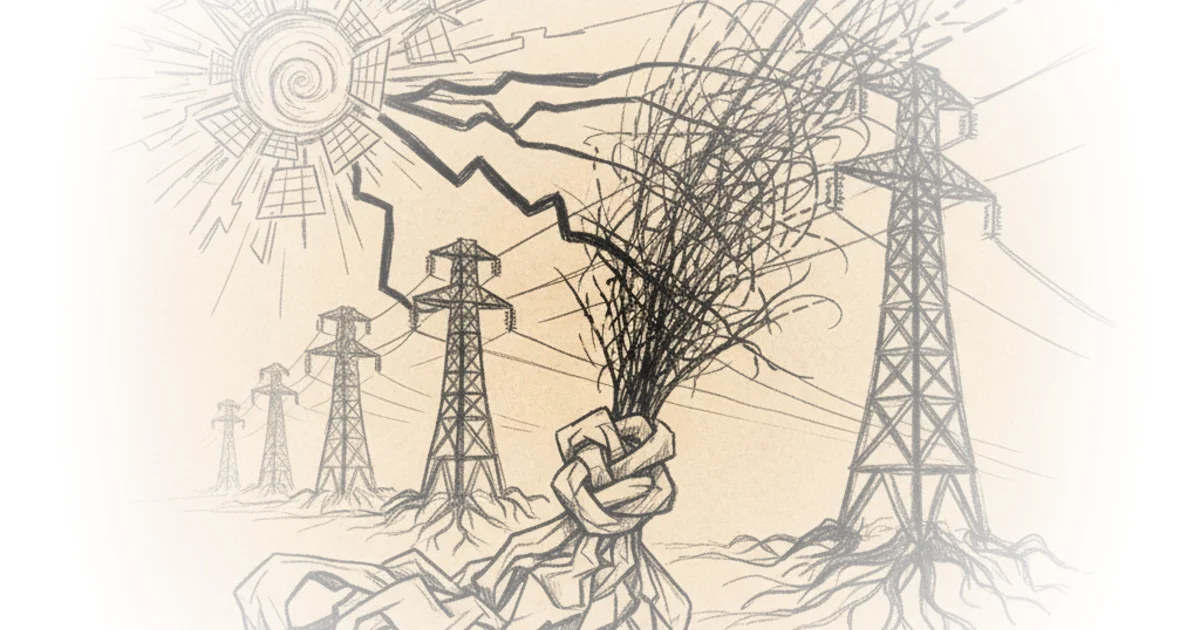
The author contrasts the Western reliance on alternating current (AC) with China's mastery of direct current (DC) for long-haul transmission. As Borlace puts it, "the sloshing of alternating current combined with electromagnetic radiation leads to energy losses in power lines and as distances get longer those losses reach a point where the economics of direct current... start to become a bit more convincing." This argument holds up well against standard engineering critiques; the physics of resistive loss is undeniable, and China's shift to Ultra-High Voltage Direct Current (UHVDC) is a direct response to the geography of its renewable resources.
Critics might argue that DC conversion technology is prohibitively expensive for smaller grids, but Borlace counters this by showing how China has scaled these costs through volume and state planning. The result is a network that treats what the West considers impossible as routine infrastructure.
By ramping up the voltage, you keep the current low, you keep your wires cool, and you keep your losses down to a minimum.
A Grid of Unimaginable Scale
The scale of China's achievement is the piece's most arresting feature. Borlace details the Changji-Guquan line, a 3,000-kilometer monster that carries 12 gigawatts of power. He notes, "That's roughly equivalent to the generating capacity of the entire electricity grid of a country the size of Ireland down a single transmission line." The evidence he cites from 2024 shows this line operating near maximum capacity for days at a time, delivering energy equivalent to burning 120 million tons of coal.
This is not a theoretical exercise. Borlace points to a new project stretching from the Tibetan plateau to the Hong Kong-Macau region, a 2,681-kilometer corridor budgeted at $7.5 billion. He writes, "By 2050, the plan is for more than 10 HVDC and UHVDC power corridors to be coming out of the Tibetan plateau, exporting more than 500 billion kwatt hours of electricity every year." The sheer ambition here is staggering, suggesting a level of long-term strategic planning that is virtually non-existent in Western democracies.
The author's tone shifts slightly here to acknowledge the political reality behind the engineering. He observes, "China has the dubious luxury of a non-democratic authoritarian regime that can set long-term goals and stick to them without worrying about the periodic inconvenience of elections." This is a sharp, if uncomfortable, observation. It forces the reader to confront the trade-off between democratic deliberation and the speed of execution required for climate mitigation.
The Western Bottleneck
Borlace identifies the true barrier for the West not as technology, but as governance. He argues that while European firms like ABB can build the massive transformers, the West lacks the "geographical terrain to justify it" in the same way China does. He writes, "By contrast, both Europe and the US face dense settlement patterns, complex land regimes, and lengthy permitting processes." The author suggests that the fragmentation of regulatory bodies in the US and Europe makes the coordination required for multi-gigawatt lines nearly impossible.
He poses a provocative question: "Would we trade our democratic way of life for technological progress, though? I suspect not." This is the piece's most nuanced moment. Borlace does not advocate for authoritarianism; rather, he highlights the paralysis of a system where "cross-border or interstate transmission lines require alignment on standards, pricing, governance, and maintenance responsibilities." He notes that this non-technical barrier "often exceeds the technical one."
Critics might note that the author underestimates the potential for market-based solutions or regional compacts to solve these coordination issues without sacrificing democratic oversight. However, the historical record of the last decade suggests that without a centralizing force, these projects often stall in litigation for years.
Mammoth projects like these only make economic sense if there's sustained surplus generation at one end and predictable long-term demand at the other. If either of those parameters changes, then the financial return on investment can vanish into thin air very quickly.
Bottom Line
Dave Borlace's strongest argument is his unflinching demonstration that the technology to solve the renewable energy crisis exists and is already operational at a continental scale in China. The piece's greatest vulnerability is its reliance on a political system that the Western reader may be unwilling to emulate, leaving the solution feeling out of reach. The reader should watch for whether Western nations can develop a hybrid model that matches China's execution speed without sacrificing their own democratic principles, or if the grid bottleneck will remain the primary brake on the energy transition.