In a world obsessed with the quantifiable, Maria Popova uncovers a profound anomaly: a letter from a man who built his life on the laws of physics, written to a woman who no longer exists in the physical realm. This piece is not merely a biography of grief; it is a forensic examination of how a rationalist confronts the one variable his equations cannot solve—permanent loss. For the busy mind seeking depth in minutes, this narrative offers a rare glimpse into the moment the "Great Explainer" realized that some mysteries refuse to be explained.
The Rationalist's Dilemma
Popova begins by establishing Feynman not just as a scientist, but as a man whose worldview was predicated on the "indomitable laws of physics that tend toward decay." She argues that his character was defined by a "resolutely rational and unsentimental" reverence for these laws, making his subsequent actions all the more startling. The narrative arc hinges on the tension between his scientific training and the chaotic reality of his wife Arline's illness. Popova notes that when Arline fell ill with what was initially misdiagnosed as typhoid, Feynman found himself stripped of his usual tools. "He had come to believe that the scientific way of thinking brought a measure of calmness and control in difficult situations — but not now," she writes. This observation lands with force because it humanizes the icon; it suggests that the scientific method, while powerful, has a hard ceiling when facing biological randomness.
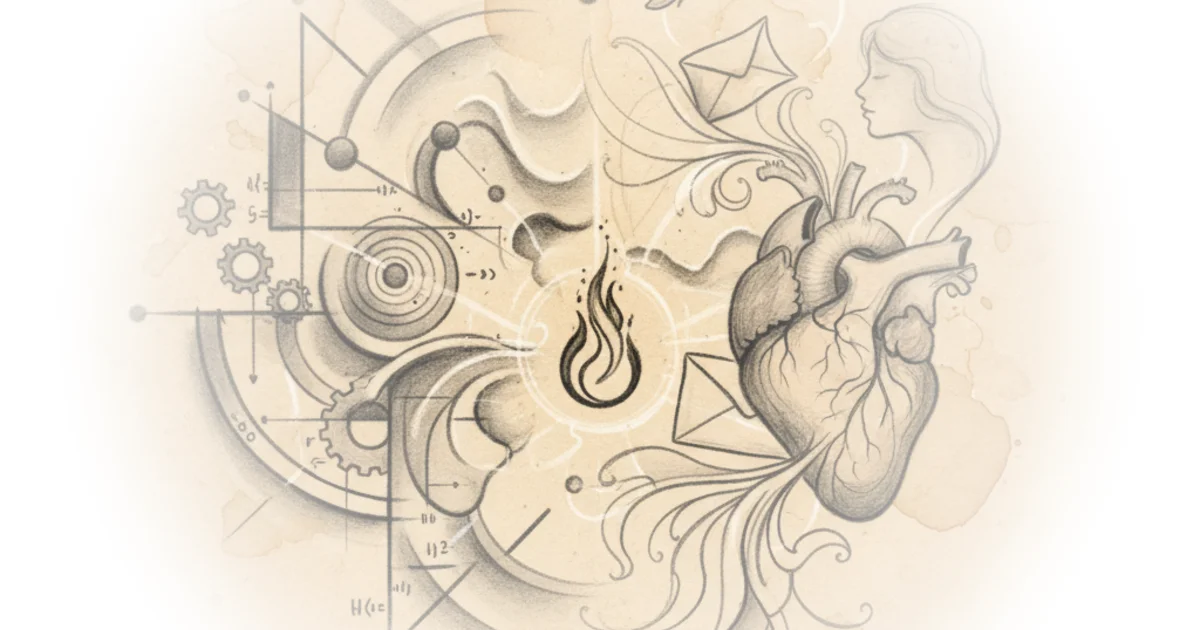
The article details the agonizing decision Feynman faced regarding Arline's terminal diagnosis. While his family and doctors urged him to maintain the deception for her sake, Feynman's commitment to "unremitting truthfulness" clashed with social convention. Popova highlights the emotional cost of this integrity: "His sister, Joan, sobbing, told him he was stubborn and heartless." Yet, it was this stubbornness that allowed Arline to face her end with clarity. The author frames this not as a failure of empathy, but as a triumph of character, even if it meant bearing the burden of being the "cruel" one in the room.
"He had impishly countered Arline's insistence that there are two sides to everything by cutting a piece of paper and half-twisting it into a Möbius strip, the ends pasted together to render a surface with just one side."
This metaphor, used by Popova to describe Feynman's view of reality, sets the stage for the letter's discovery. Just as the Möbius strip defies the binary of inside and outside, Feynman's love defies the binary of life and death. Critics might argue that Popova romanticizes his rigidity, suggesting that his refusal to lie was a form of emotional inflexibility rather than moral courage. However, the text supports the idea that this honesty was the only language they shared, a shared code that survived even when their physical world collapsed.
The Weight of a Promise
The narrative shifts to the couple's wedding, a ceremony stripped of all ceremony due to the stigma of tuberculosis and the pressures of the Manhattan Project. Popova paints a stark picture of their union: a drive in a borrowed station wagon, a marriage in a city office with strangers as witnesses, and a honeymoon that was a transfer to a sanatorium. The historical context here is vital; Popova reminds us that at the time, tuberculosis was a death sentence, a disease that had claimed more lives than all wars combined and had also taken the love of Alan Turing's life. This parallel deepens the tragedy, placing Feynman's personal loss within a broader historical tapestry of scientific brilliance cut short by a lack of medical understanding.
Despite the grim reality, the couple found moments of levity. Arline, knowing Feynman's love for puzzles, wrote letters in code to amuse him, even as military censors grew alarmed. Popova writes, "The levity masked the underlying darkness which Richard and Arline tried so desperately to evade." This framing is effective because it refuses to let the tragedy consume the humanity of the subjects. They were not just victims of disease; they were active participants in their own story, using humor and creativity to carve out space for joy in a dying world.
As Arline's health failed, Feynman's role shifted from husband to caretaker and finally to witness. Popova captures the surreal nature of his grief, noting how he "methodically collected her personal belongings" and recorded her death with scientific detachment: "June 16 — Death." This clinical approach, she suggests, was a defense mechanism, a way to manage the unmanageable. Yet, the article reveals that this detachment was a facade. The discovery of the letter, written 488 days after her death, shatters the illusion of the stoic scientist.
"I find it hard to understand in my mind what it means to love you after you are dead — but I still want to comfort and take care of you — and I want you to love me and care for me."
Popova uses this quote to illustrate the central paradox of the piece: the rational mind trying to process an irrational emotion. Feynman admits to a "serious affliction: loving you forever," a phrase that contradicts his lifelong rejection of metaphysical conjectures. The author argues that this letter is not a retreat into mysticism, but an expansion of his understanding of reality. He acknowledges that while Arline can give him nothing now, she remains "the idea-woman and general instigator of all our wild adventures."
The Physics of Grief
The climax of Popova's argument is the letter itself, a document that bridges the gap between the physical and the metaphysical. She points out the irony that Feynman, who once dismissed Descartes' proof of God as "intellectually lazy," now finds himself engaging in a one-sided conversation with the dead. The letter is filled with practical plans—learning Chinese, making clothes, getting a movie projector—projects that are impossible to execute but essential to his emotional survival. Popova writes, "You, dead, are so much better than anyone else alive." This line is devastating in its simplicity, suggesting that the memory of a loved one can hold more weight than the presence of the living.
The author also touches on the clock that stopped at the exact moment of Arline's death. While Feynman initially sought a physical explanation for this coincidence, Popova suggests that the event serves as a narrative anchor for the reader, a moment where the universe seems to pause in solidarity with human loss. However, she quickly grounds this in Feynman's own reasoning, reminding us that he attributed the stopped clock to a mechanical failure, not a spiritual sign. This balance between the mystical and the mechanical is the piece's greatest strength.
"My wife is dead. Rich. And then, with the sole defibrillator for heartache we have — humor — Feynman adds: PS Please excuse my not mailing this."
This final touch, noted by Popova, encapsulates the entire essay. It is a reminder that even in the face of absolute loss, the human spirit seeks connection, even if that connection is purely internal. The letter was never meant to be sent; it was a tool for Feynman to process his own reality. Popova's choice to highlight this detail underscores the private, intimate nature of the grief, separating it from the public persona of the Nobel laureate.
Bottom Line
Maria Popova's piece succeeds by refusing to sanitize the grief of a scientific giant, instead presenting it as a complex, messy, and deeply human experience that defies the very laws Feynman spent his life studying. The strongest element is the juxtaposition of his rigorous rationality with the irrational persistence of love, a tension that resonates long after the final sentence. The article's vulnerability lies in its reliance on a single biographical anecdote to make a universal claim about love, but the emotional weight of the evidence is so heavy that it carries the argument effortlessly. Readers should watch for how this narrative reframes the legacy of scientific rationality, suggesting that the most profound truths may lie not in what can be measured, but in what cannot be let go.