The Man Who Never Explained His Fortune
A billionaire with no verifiable income. A financier who befriended presidents, princes, and royalty — yet whose wealth remained a mystery.
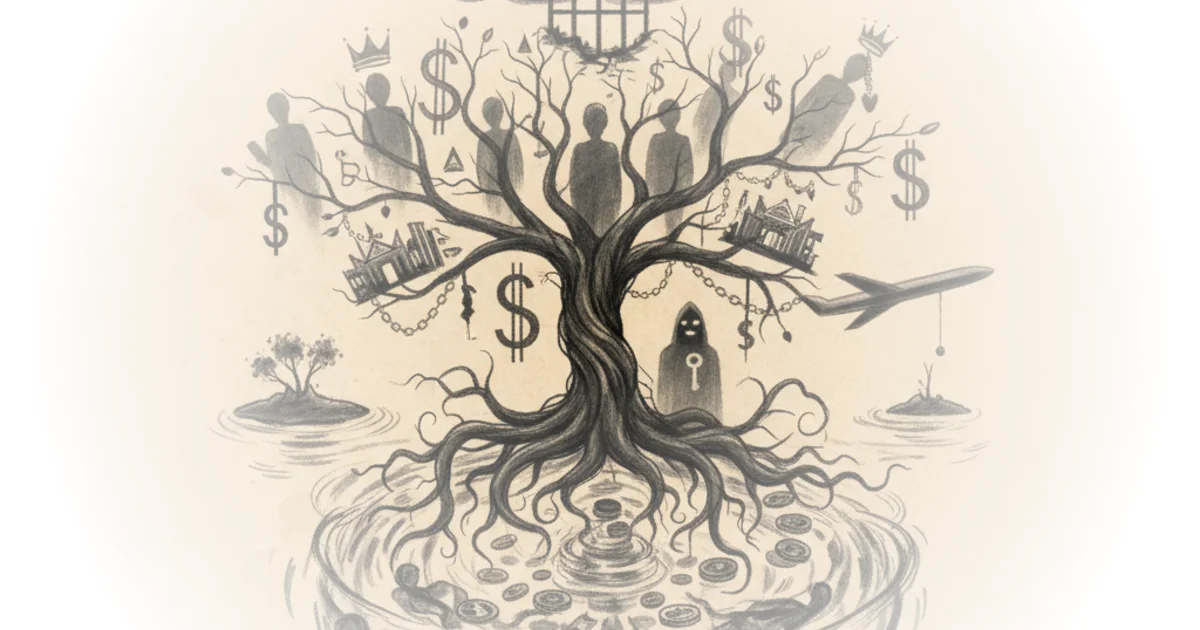
For decades, journalists have tried to answer one question: how did Jeffrey Epstein make his money? The answer remains elusive.
Epstein was born in Brooklyn in 1953 to working-class parents. He attended Cooper Union briefly before dropping out — never earning a degree. After falsely claiming to have a college degree, he taught math and physics at the elite Dalton School in Manhattan before being dismissed after two years for poor performance.
In 1976, Alan Greenberg, then chairman of Bear Sterns, helped Epstein secure an entry-level position at the investment bank. He rose rapidly, becoming a partner within four years — an unusually fast ascent for someone with no formal financial training. But just one year after making partner, his career at Bear Sterns ended abruptly.
According to the New York Times, Epstein told the Securities and Exchange Commission during an insider trading investigation that he had been let go for three reasons: he lent money to a friend to buy stock, there were irregularities with his expense account, and there were rumors of an affair with a secretary. Though never charged with wrongdoing, this episode marked the beginning of a pattern — Epstein's ability to gain access to elite institutions without the transparency typically required.
After leaving Bear Sterns, Epstein launched his own firm, claiming to specialize in recovering stolen or embezzled funds. By the late 1980s, he had formed J. Epstein and Company, announcing that he only accepted accounts worth over $1 billion. At the time, there were fewer than 500 billionaires worldwide — making his supposed client base extraordinarily exclusive.
In reality, evidence suggests Epstein had only one major confirmed client: Les Wexner, the billionaire founder of Elbrands. For more than a decade, Epstein served as Wexner's personal money manager and adviser, reportedly earning hundreds of millions in the process. Their relationship was unusually close — so close that Wexner transferred ownership of a $77 million Manhattan mansion to Epstein's Virgin Islands-based company for no recorded payment.
A 2002 corporate filing revealed that Epstein's asset management firm had just $88 million in shareholder contributions and around 20 employees — far fewer than the 150 claimed in media profiles. The contradictions between his public image and limited financial operations only deepen the mystery of the true source of his wealth.
Beyond Wexner, Epstein had ties with Leon Black, the billionaire co-founder of Apollo Global Management. Black paid Epstein $158 million in fees, reportedly for tax advice and estate planning — somewhat surprising given that Epstein had no obvious tax experience. The FT reported in 2021 that Leon Black attributes a sizable part of his family wealth to Epstein, suggesting as much as $2 billion of his then $8 billion fortune could be traced back to Epstein's financial acumen.
Even after Epstein's 2008 conviction, Black continued the relationship, later justifying it as a belief in second chances. In October 2020, new revelations about Black's payments prompted pension funds to freeze further investments with Apollo. Black hired a law firm to investigate his behavior and found nothing wrong.
One of the most troubling aspects of the Epstein saga is how long it took for federal charges to be brought despite mounting evidence. In 2008, Epstein faced serious allegations in Florida but instead of being prosecuted federally, he struck a controversial plea agreement with then US attorney Alexander Aost — who would later serve as Donald Trump's labor secretary.
The deal allowed Epstein to plead guilty to lesser state charges of soliciting prostitution, resulting in just 13 months in a county jail with work release privileges. This agreement was kept secret from Epstein's victims — a violation of federal victim's rights laws. The leniency of the original plea deal and the powerful figures involved have fueled conspiracy theories questioning whether Epstein was protected by a broader network of elites.
Despite the opacity around the origins of his wealth, the scale of Epstein's fortune was undeniable. A filing in his criminal case pegged his net worth at roughly $560 million. His assets included luxury homes across the world — a $77 million Manhattan townhouse where he was arrested, a $12 million estate in Palm Beach, a $17 million ranch in New Mexico, and an apartment in Paris.
He owned two private islands valued at $86 million at the time of his death, three private jets, a helicopter, and a fleet of at least 15 vehicles. Yet despite all this evidence of immense financial power, no clear or credible explanation of how he acquired it has emerged.
Critics might note that Epstein's wealth was never independently verified — his firm, Financial Trust Company, was based in the US Virgin Islands and never released audited statements or performance data. The lack of transparency combined with conflicting reports about the size of his staff and losses during the 2008 financial crisis cast serious doubt on whether his fortune ever reached the scale he claimed.
Despite years of investigations, no one can say with certainty how Jeffrey Epstein made his money — yet he moved among presidents, princes, and billionaires with ease.
Bottom Line
The strongest thread running through this story is the documented discrepancy between Epstein's public image and his actual financial operations. His biggest vulnerability is that despite all the speculation, there remains no credible explanation for how a man with no verifiable income accumulated hundreds of millions. The mystery has fueled conspiracy theories — but those theories have not been substantiated by evidence.