Michael Huemer delivers a provocative thesis that upends the standard hierarchy of knowledge: he argues that the very foundation of what we consider 'evidence' is simply how things appear to us. In a field often bogged down by abstract technicalities, this piece cuts through to the raw mechanics of human cognition, suggesting that every belief we hold, from the mundane to the mathematical, rests on a single, intuitive principle. This is not just a dry academic exercise; it is a challenge to how we validate reality itself.
The Primacy of Appearances
Huemer begins by dismantling the idea that evidence must be something external or independently verified before it can justify a belief. Instead, he posits that justification flows directly from our mental states. "I think that all justification for belief derives from appearances, or seemings," he writes, defining these as the sensory experiences, memories, and intuitions that make something feel true to us. This framing is powerful because it aligns with our lived experience; we do not typically demand a certificate of authenticity before trusting our eyes or our gut.
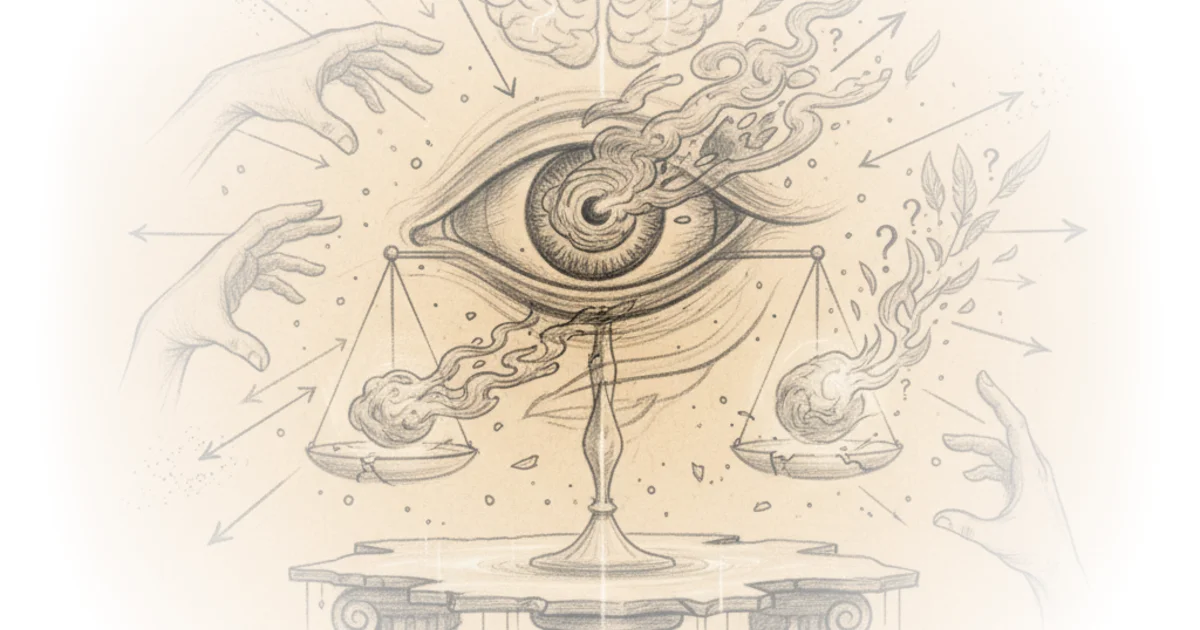
The author expands this to include abstract reasoning. When we consider a logical truth like "if a equals b and b equals c, then a equals c," we do not run a calculation to verify it. As Huemer notes, "When you think about this proposition, it just seems obvious. That is a type of appearance (sc., an 'intuition')." He argues that even our most rigorous a priori knowledge is rooted in these intuitive seemings. This is a bold move, effectively democratizing the source of knowledge by placing the intuitive on par with the empirical.
It is rational, I claim, to presume that things are the way they seem, unless and until you acquire reason (which would itself have to come from other seemings) for doubting that.
The strength of this argument lies in its ability to explain why we trust our senses even in the absence of proof. Huemer suggests that skepticism is the outlier, not the default. He writes, "You don't start by assuming that memory is untrustworthy until proven trustworthy. You start by assuming that what you seem to remember is what happened, unless and until you have grounds for doubt." Critics might argue that this approach is too permissive, potentially validating hallucinations or cognitive biases as legitimate evidence. However, Huemer anticipates this by insisting that doubt must also be grounded in a seeming, creating a self-correcting loop rather than a free-for-all.
The Limits of Awareness and Inference
The piece then pivots to dismantle alternative theories, specifically the idea that justification comes from direct awareness of reality. Huemer uses the classic example of a hallucination to drive his point home. If a person hallucinates a porcupine, they are not aware of a porcupine, yet they still have justification for believing one is there. "Intuitively, this person does still have justification for thinking there is a porcupine (in the absence of grounds for doubt)," he asserts. This distinction is crucial: it separates the truth of a belief from the justification for holding it. A belief can be justified even if it is false, provided the appearance was convincing.
He also tackles the reliance on inference. While a detective might claim to base a belief on DNA evidence, Huemer argues this chain must eventually terminate in a direct appearance. "The starting point, I claim, is going to be appearances," he writes, noting that the investigator must first have a sensory appearance of the hair or the testing apparatus. Without these foundational seemings, the chain of reasoning has no anchor.
If you carefully reflect, I claim, you will find that almost all of your beliefs rest on appearances: you believe things because they seem right to you.
This leads to what Huemer calls the "self-defeat argument." If one were to deny that appearances are a valid source of evidence, that very denial would have to be based on how things seem to the denier. It is a philosophical trap that leaves the skeptic with no ground to stand on. The argument is elegant in its simplicity, yet it forces the reader to confront the inescapable nature of their own subjective experience.
Addressing the Objections
No theory of knowledge is complete without grappling with its failures, and Huemer addresses several sharp critiques from his opponent, Maria Lasonen-Aarnio. One objection concerns memory: can we hold a belief based on memory without a current "seeming"? Huemer counters that retention does not require new evidence, only the absence of defeaters. He distinguishes between the justification for acquiring a belief and the justification for keeping it.
A more complex challenge involves "corrupt-source appearances," where an irrational belief creates a false appearance later on. Huemer's response is strikingly pragmatic. He argues that even if the origin of an appearance is flawed, the appearance itself can still justify a belief if the subject is unaware of the flaw. He illustrates this with a diary example: if you write a false entry due to a momentary irrationality and forget it, reading that entry years later still provides justified evidence for the belief it contains. "It's irrelevant that this evidence was caused by an earlier unjustified belief," he concludes. This stance prioritizes the subject's current epistemic position over the historical pedigree of their evidence, a choice that emphasizes the internal consistency of the mind over external facts.
This is just a case in which a person gives himself misleading evidence at a later time.
He also tackles the mathematical objection regarding prior probabilities, arguing that our limited discriminatory capacity means we never actually perceive infinite precision, thus avoiding the paradoxes of zero-probability events. While this defense relies on the limitations of human perception, it effectively neutralizes the mathematical counter-argument by grounding it back in the physical reality of the observer.
Bottom Line
Huemer's defense of Phenomenal Conservatism is a compelling reminder that our connection to the world is fundamentally mediated by how things appear to us, not by some direct, unmediated access to truth. The strongest part of his argument is the self-defeat challenge, which leaves little room for a coherent denial of seemings without falling into paradox. However, the theory's biggest vulnerability remains its potential to validate misleading evidence when the source of that evidence is obscured, a risk that requires careful navigation in real-world decision-making. Readers should watch for how this internalist framework holds up when applied to complex, high-stakes scenarios where the cost of being wrong is catastrophic.