Kings and Generals reframes the Hundred Years' War not as a dry chronology of dates, but as a "clash filled with daring Knights cunning tactics and epic battles that would shape the course of European history." This animated retrospective distinguishes itself by treating the conflict as a structural paradox of feudal law rather than a simple story of national hatred, offering a clear-eyed look at how the unworkable status of English vassalage on the continent made war inevitable.
The Feudal Paradox
The narrative begins by dismantling the modern notion of clear borders, focusing instead on the "paradoxical situation" created when William Duke of Normandy conquered England. Kings and Generals writes, "the monarchs of England now held ancestral territories on the continent as a vassal of the French Kings while also being rulers of a strong realm." This framing is crucial because it explains why the conflict was so intractable; the English King was simultaneously a sovereign ruler and a subordinate subject to the French Crown.
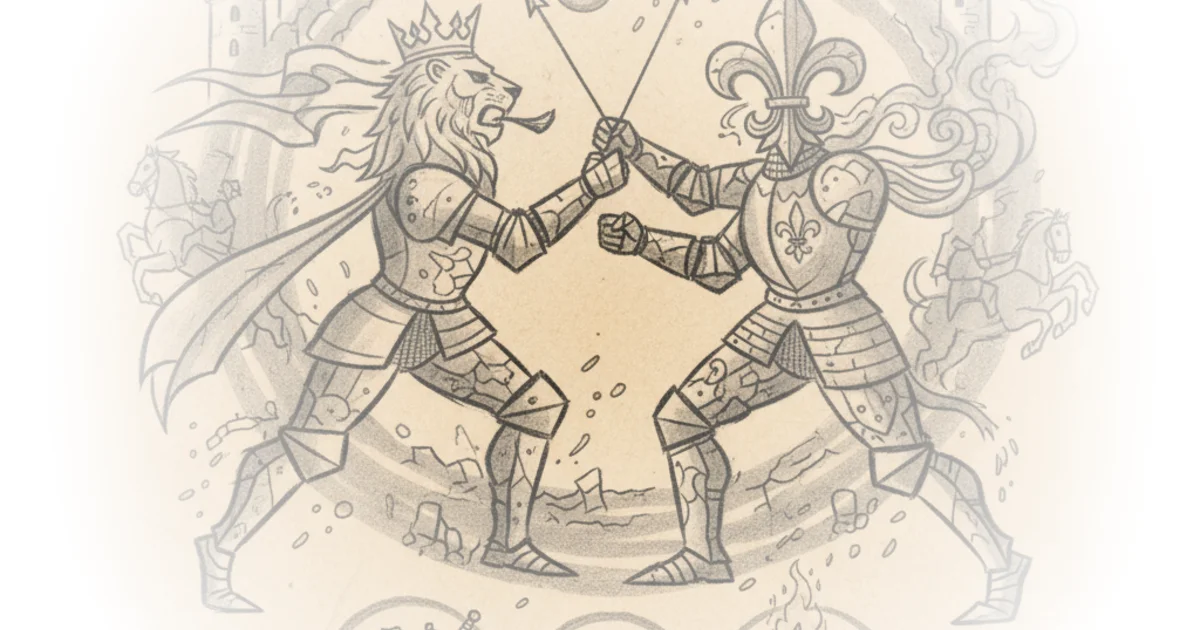
The commentary highlights how the Duchy of Gascony became the flashpoint. As Kings and Generals notes, the region "developed into an important source of Royal income through the wine trade often raising more in annual revenue than England itself." The local population's distinct identity is emphasized, with the text citing contemporary author Jean Froissart, who called the inhabitants "the English" rather than French. This detail matters because it suggests the war was not just a royal squabble but a genuine struggle over the allegiance of a prosperous, distinct population.
The unworkable nature of the Plantagenet vassal status and the gradual centralization of government made the conflict inevitable.
The piece argues that the dynastic crisis following the death of Charles IV in 1328 was merely the spark, not the cause. Kings and Generals explains that the French Lords invoked the "ancient Salic law which prevented women from inheriting any land" to block Edward III's claim, despite his being the nephew of the dead king. This legal maneuvering forced Edward into a humiliating position where he had to pay homage to his cousin, Philip VI, a dynamic that Kings and Generals identifies as the true engine of the coming war.
The Evolution of Strategy
Once the conflict ignites, the coverage shifts to the tactical innovations that defined the era. Kings and Generals describes the birth of the chevauchée, a strategy of systematic devastation. The text writes, "medieval military strategy was to inflict as much Carnage against hostile cities and agriculture as possible which would weaken the enemy government economy and ultimately hamper its ability to wage war." This is a sophisticated point: the war was not just about capturing land, but about breaking the economic backbone of the opponent.
The narrative details how Edward III, despite being "cash strapped," launched campaigns that were "nightmarish for the local populations." Kings and Generals notes that these were "lowcost raids using limited resources with the deliberate aim of systematically devastating and lowering the product activity of territories." This reframes the English raids not as mindless brutality, but as a calculated economic warfare strategy that proved "indispensable" as the war progressed.
Critics might note that the video glosses over the immense human cost of these tactics on the peasantry, focusing heavily on the strategic utility for the kings rather than the humanitarian catastrophe. However, the analysis remains effective in showing how military necessity drove the evolution of medieval warfare.
The Naval Turning Point
The coverage reaches its dramatic peak with the Battle of Sluys, where the stakes were the survival of England itself. Kings and Generals sets the scene by noting that Philip VI had the larger Navy and there was "a real possibility of England being invaded." The tension is palpable as the text describes Edward III assembling a fleet of "mainly converted Merchant vessels known as cogs."
The decision to attack is portrayed as a moment of supreme confidence. Kings and Generals quotes Edward III defying his advisors: "I shall cross the sea and those who are afraid may stay at home." This quote captures the high-stakes gamble that defined the English approach. The battle description is visceral, detailing how the French fleet was drawn up in a "great wood" formation that left them unable to maneuver.
The French shooters couldn't do anything and were riddled with arrows or jumped overboard to escape the Mayhem.
The outcome was catastrophic for France. Kings and Generals reports that "the French had lost 190 vessels either to the English or to the Sea with only 23 managing to escape." The loss of 16,000 to 18,000 men is described as a "crushing" blow to French morale. The commentary effectively uses the scale of the disaster to explain why the French could not launch an invasion of England for years, shifting the initiative permanently to the English for the early phase of the war.
Bottom Line
Kings and Generals succeeds in transforming a complex century of warfare into a coherent narrative of structural failure and tactical innovation, proving that the war was driven by the impossibility of feudal vassalage as much as by royal ambition. The strongest part of the argument is the clear linkage between the economic value of Gascony and the inevitability of conflict, while the biggest vulnerability is the tendency to romanticize the "daring Knights" without fully addressing the devastation visited upon the civilian population. Readers should watch for how this structural analysis holds up when the narrative moves to the later phases involving Joan of Arc and the shifting balance of power.
The unworkable nature of the Plantagenet vassal status and the gradual centralization of government made the conflict inevitable.