In a culture obsessed with resume-building and algorithmic optimization, this piece from Wayfare makes a startlingly counter-intuitive claim: the most urgent work for the next generation isn't learning to code or securing a lucrative internship, but learning how to be. The article argues that the pervasive anxiety plaguing students isn't a failure of ambition, but a symptom of a civilization that has lost its spiritual compass, offering a radical pedagogical shift from "doing" to "being" as the only viable path forward.
The Hollow Pursuit of Success
Wayfare reports that despite the relative comforts of globalized capital, students face a "thin thread of disquiet under the achievements" that no amount of academic or professional success can dislodge. The piece describes a generation absorbing a constant barrage of calls to "attain, succeed, perform, accomplish, secure, advance, and do" through the "amorphous matrices of digital culture." This framing is powerful because it moves the diagnosis away from individual burnout and toward a systemic cultural failure. The author notes that students admit to feeling a "hollowness, an emptiness, a hunger, and an itch" even after securing college admissions or job offers.
This observation resonates deeply with the historical concept of Homo economicus—the idea of humans as rational, self-interested actors driven solely by utility maximization. The piece suggests we have hit the limits of this worldview. As Wayfare puts it, "things have gone terribly wrong with our civilization," echoing the warnings of scholars like Charles Taylor regarding the secular age. The argument holds weight because it identifies a specific, unnamable dissatisfaction that standard economic or career counseling cannot address. Critics might argue that this focus on spiritual malaise overlooks the very real material precarity facing young workers, but the piece insists that the crisis is ontological before it is economic.
"We are looking for a narrative that will bridge the incoherence of contemporary culture with the depths of our intuitions, aspirations, and inner experience."
Re-enchantment as a Pedagogical Imperative
The article pivots from diagnosis to action, proposing that the solution lies in "re-enchantment." Wayfare argues that this doesn't mean a return to religious purity, but rather a "shared, multi-polar vision of the human capacity for transcendence." The piece suggests that the era's declining religiosity is slowing or reversing, replaced by a "thirst for religious experience and spiritual encounter." This is a crucial distinction; the author is not calling for dogmatic conversion but for a reconnection with mystery and wonder.
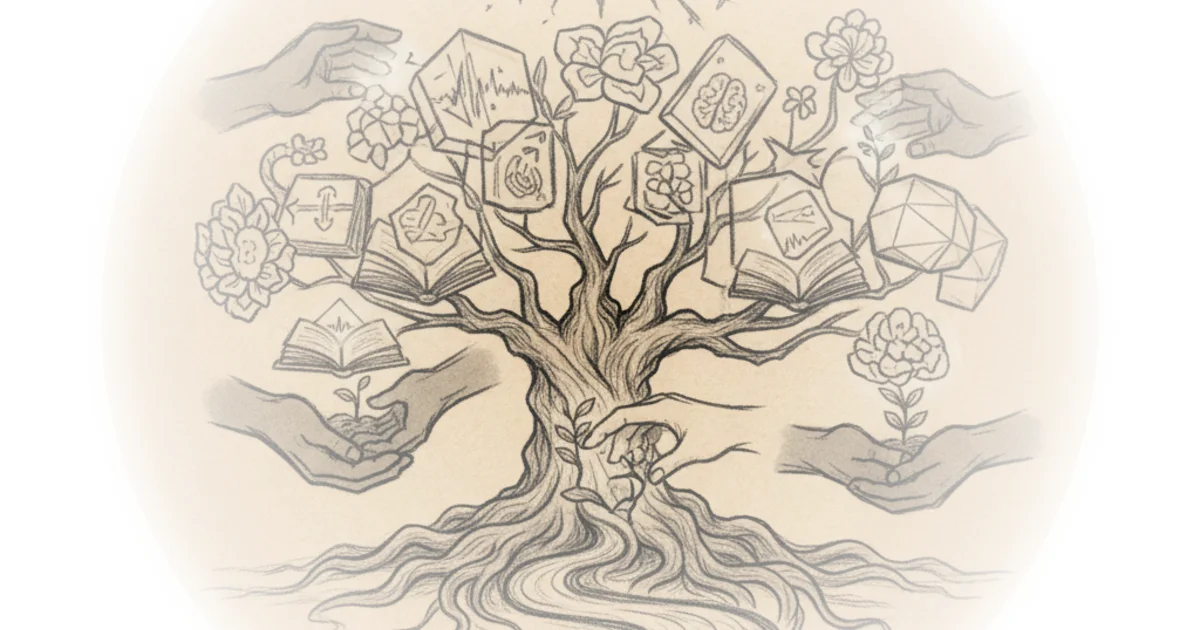
The author, a scholar of comparative religions, frames the teacher's role not as a proselytizer but as a "fire kindler" or a "tender of the fire of wonder." This metaphor is the piece's most evocative element. Wayfare writes, "Teachers are tenders of the fire of wonder, those who guard and tend the holy fire of that which is essential for our survival in the long, cool, dark night of the modern world." This reframing of education is vital. Instead of filling students with data, the goal is to "invite students to linger in the mystery and beauty of the world." The piece argues that wisdom must be adaptable, noting that "any good pedagogy is adaptable, fluid, and responsive" to the capacity and context of the learner.
Shifting the Metric of Worth
The most practical application of this philosophy appears in the author's classroom experiments, where the standard questions of career planning are replaced by existential inquiries. Wayfare reports that the author has shifted from asking "What do you want to be when you grow up?" to asking, "What is the quality by which you want to be known by your grandchildren and neighbors?" This subtle shift moves the student's focus from "occupational and production-oriented ontological measures" to an "ontology of wonder, humility, and awe."
The piece details a course on creativity taught during the rise of generative AI, where students were liberated from rote problem sets to simply create. The result was a discovery of "the liberation of the creative act from the demands of a product." This is particularly striking given the context of McDonaldization—the process by which the principles of the fast-food industry (efficiency, calculability, predictability) are dominating society. By prioritizing the "play of exploration without having to rush to a destination," the author offers a direct antidote to the efficiency-obsessed culture that defines modern education. The piece notes that even STEM students, often driven by parental pressure for lucrative careers, found joy in this "ungraspable clarity of insight."
"It is a shift from the dominant post-Enlightenment anthropology of doing, towards a re-enchanted anthropology of being."
The argument acknowledges that this work is partial and interdependent, noting that re-enchantment must be built in governance, healthcare, and architecture, not just in classrooms. While the piece leans heavily on spiritual and philosophical traditions, it avoids being esoteric by grounding its arguments in the tangible reality of student anxiety and the practical mechanics of teaching.
Bottom Line
Wayfare's strongest move is reframing the student crisis not as a lack of skills but as a crisis of meaning, offering "wonder-tending" as a tangible pedagogical strategy. Its biggest vulnerability is the assumption that educational institutions have the freedom to prioritize "being" over the economic imperatives that drive enrollment and funding. The reader should watch for how these philosophical shifts translate into actual policy changes in schools that are increasingly pressured to produce measurable economic outcomes.
"Teachers are not charged with teaching students what to think, but the many ways of how one may think."
This piece serves as a necessary corrective to the relentless pressure of the modern world, reminding us that the ultimate goal of education is not to produce a worker, but to cultivate a human being capable of wonder.