This piece from The Pillar does more than chronicle a papal visit; it captures a rare moment where ancient ritual and modern political friction collide in the heart of Madrid. While the headlines focused on crowd sizes, the editors argue that the true story lies in how Pope Leo XIV leveraged Spain's deep theological history to challenge contemporary legislative trends without naming names. It is a masterclass in diplomatic messaging, turning a standard state visit into a profound interrogation of what constitutes human dignity in a secular age.
The Architecture of Silence and Faith
The coverage opens by noting that expectations were high, but the reality was staggering: "While 300,000 people were expected at Saturday's prayer vigil with young people, more than half a million attended." The Pillar reports that this surge wasn't just about numbers; it was about a specific spiritual atmosphere cultivated during the Q&A. When asked about recognizing God's voice, the Pope offered a counter-cultural prescription for a distracted generation: "Silence is what can help us the most... Often we wear headphones, listen to music or seek distractions, and we don't know how to be silent."
This emphasis on silence is not merely spiritual advice; it is framed by the piece as a necessary precondition for moral clarity. The editors highlight the Pope's invocation of 16th-century figures like Saint Thomas of Villanueva and Saint Turibius of Mogrovejo, noting that these saints "helped me grow in my own journey." By anchoring his message in these historical giants—bishops who navigated complex colonial and social landscapes—the Pope implicitly argues that the challenges of today require the same depth of conviction. The piece suggests this is a deliberate strategy: using the past to validate the present, reminding listeners that "If they were able to do it, why not me?"
Prayer is a free voice precisely because it does not speak in order to prove ourselves, to demonstrate that we are prepared or to make us feel important.
The argument here holds weight because it shifts the focus from institutional power to personal responsibility. However, critics might note that in an era of digital noise, the call for silence can seem impractical to those whose survival depends on constant connectivity and advocacy. Yet, the piece effectively counters this by framing silence not as withdrawal, but as a method to "turn conflict into peace."
The Procession as Political Theater
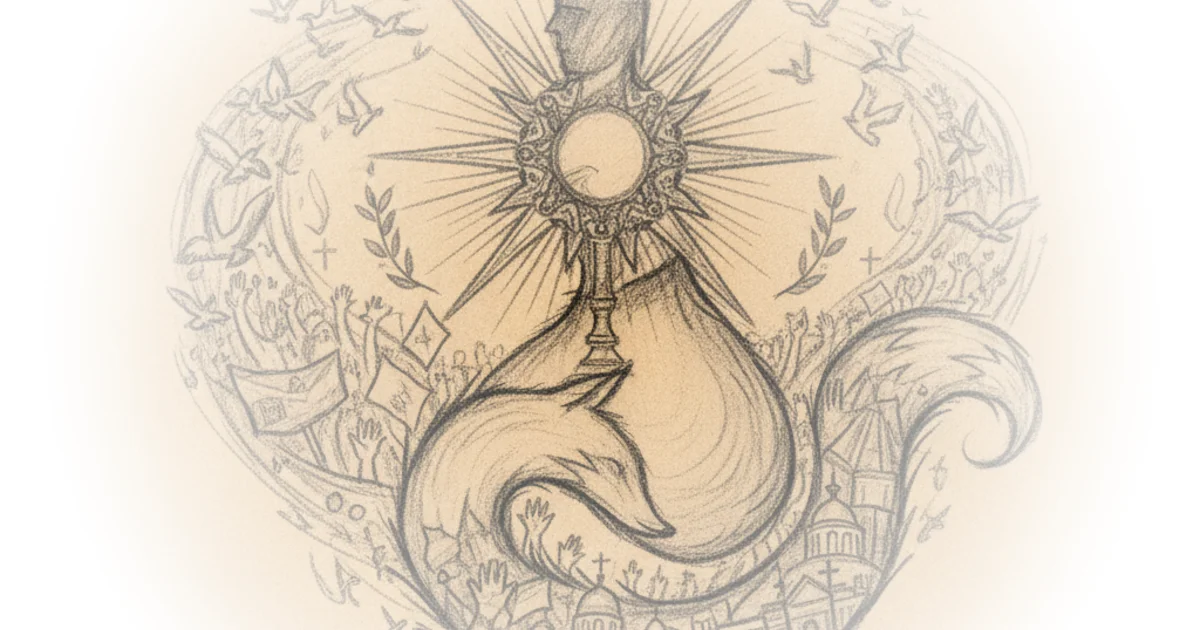
The narrative then shifts to the Corpus Christi Mass, where the editors note a historic first: "June 7 marked the first occasion in modern times a pope celebrated the Solemnity of Corpus Christi outside of Rome." The visual centerpiece was a 1943 monstrance, originally designed for an orphanage, which the Pope used to lead a procession through Madrid. The Pillar argues that this was not folklore but a "profession of faith in the presence of the risen Lord," asserting that "The procession shows that he is not confined to the church, but comes out to meet us."
This section is particularly compelling because it reinterprets public religious display as an act of social solidarity rather than mere tradition. The Pope's homily, as quoted by the article, insists that the Christ in the monstrance "identifies with the poor" and calls believers to allow themselves to be "brought out of our selfishness and indifference." This reframing is powerful; it transforms a liturgical object into a symbol of civic duty. The editors wisely connect this to the broader Spanish context, noting that these processions have "shaped the piety, art, music, architecture and life of the Spanish people" for centuries.
It is not merely a matter of bringing out the monstrance, but of allowing ourselves to be brought out of our selfishness and indifference.
The piece effectively uses this imagery to bridge the gap between the sacred and the secular, suggesting that faith must manifest in the "realities and challenges of society." A counterargument could be raised that such public displays alienate non-believers in increasingly pluralistic societies, but the coverage sidesteps this by focusing on the internal call to "kneel before God and before our neighbor," a universal ethical imperative.
Culture, Cinema, and the Human Spirit
The commentary then pivots to the intersection of art and faith, featuring Hollywood actor Antonio Banderas. The Pillar reports that Banderas described the Church as "the greatest producer of art in human history," with Jesus Christ as "the central character in the movie of life." This cultural moment is significant because it validates the Pope's broader message through a secular lens. Banderas recounts how his faith was sparked by childhood processions, asking "God?" and finding answers in the devotion of ordinary people.
The inclusion of Banderas serves as a bridge between high theology and popular culture. By quoting Saint Augustine—"You say that times are bad. Be better yourselves, and times will be better"—the piece ties the actor's personal testimony back to the Pope's central theme: individual agency in shaping the collective future. The editors note that Banderas is producing a Spanish version of "Godspell," using this detail to underscore his commitment to the message. This section suggests that faith is not static but a living, creative force that continues to inspire art and identity.
The Address to the Congress: Dignity Over Utility
The most politically charged segment of the coverage details the Pope's historic address to the Spanish Congress. The Pillar notes that while previous popes visited, none had ever addressed a joint session, making this speech a "first." In a nation grappling with contentious policies on abortion and euthanasia, the Pope did not engage in partisan bickering but instead appealed to Spain's intellectual heritage, specifically the School of Salamanca.
The editors highlight how the Pope used 16th-century theologians to argue that "reason could not be invoked to legitimize whatever force... seemed convenient." This is a subtle but sharp rebuke of utilitarian politics. The piece quotes the Pope's assertion that human dignity "precedes any concession by the State and cannot be subordinated to shifting social consensus or the whims of the majority." By invoking the legacy of Salamanca, which helped shape international law regarding the rights of peoples, the argument elevates the debate from current legislation to foundational moral philosophy.
Every truly just society is built upon the recognition of the inviolable dignity of the human person. Such dignity precedes any concession by the State and cannot be subordinated to shifting social consensus or the whims of the majority at any given moment.
The coverage also notes the Pope's defense of the sacramental seal of confession, a direct response to recent legal pressures in France and elsewhere. The argument is that protecting this "sacred space" is essential for religious freedom and inner liberty. Critics might argue that the Church's stance on life issues often clashes with modern concepts of bodily autonomy, but the piece frames the Pope's position as a defense of civilization itself: "The moral greatness of a nation is manifested, above all, in its capacity to accompany, protect and love those lives that are most fragile."
Bottom Line
The Pillar's coverage succeeds by refusing to treat this visit as mere pageantry; instead, it exposes the deep philosophical currents running beneath the surface of Spanish politics. The strongest element is the strategic use of historical precedent—from the School of Salamanca to 16th-century saints—to challenge modern legislative trends without descending into partisan rhetoric. Its vulnerability lies in its idealistic assumption that moral arguments alone can shift the trajectory of a polarized political landscape, yet the sheer scale of the crowds suggests the message found fertile ground. Readers should watch how the Spanish government responds to these calls for human dignity, as the tension between "shifting social consensus" and "inviolable rights" is only just beginning.