Most historical accounts treat Pyrrhus as a footnote to Rome's rise, but Kings and Generals reframes him as the definitive architect of Hellenistic warfare who nearly reshaped the Mediterranean before the Roman machine fully engaged. This documentary script argues that Pyrrhus's true legacy isn't the idiom 'pyrrhic victory' but his unparalleled ability to integrate disparate military cultures into a cohesive fighting force. For the busy professional, this offers a masterclass in strategic adaptation and the high cost of ambition in a fragmented geopolitical landscape.
The Exile's Crucible
Kings and Generals opens not with Pyrrhus's triumphs, but with the chaos that forged him. The narrative posits that his survival was a matter of political utility rather than mere luck. "His mother Olympius... was threatened by the son of Antipater Cassander," the authors note, setting the stage for a life defined by displacement. They detail how the young prince was spirited away to Illyria, where he was raised by a king who saw him as a bargaining chip. "He also possibly did this for several practical reasons either because he decided a claimant to the effort throne was more valuable to him than casandra's possibly empty promises."
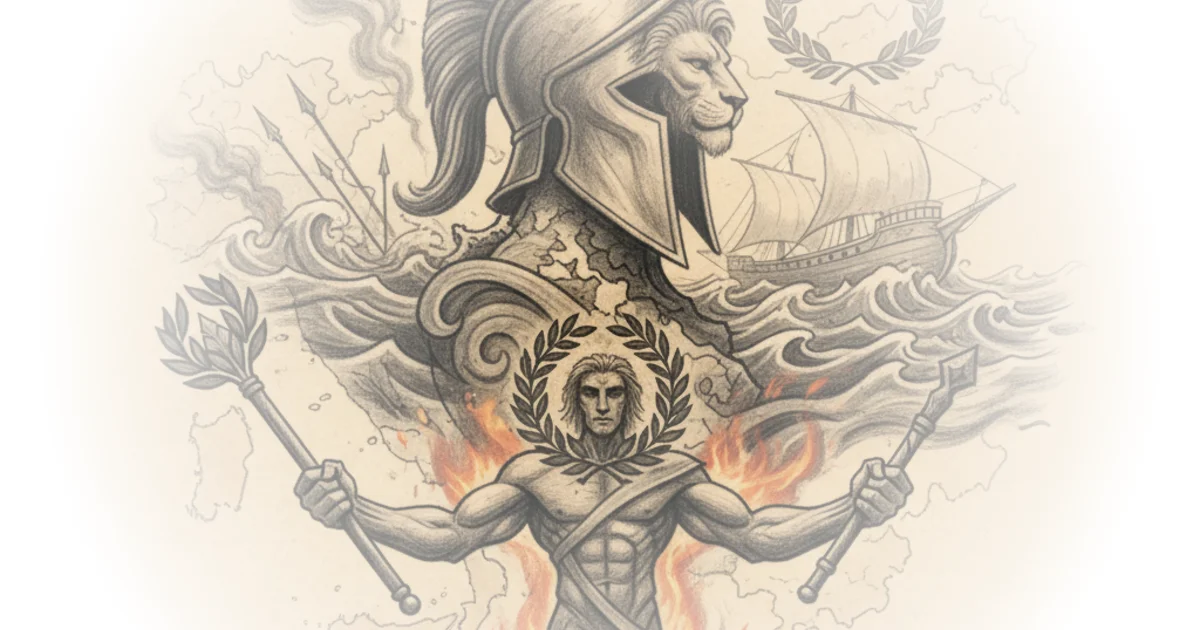
This framing is crucial because it strips away the romanticism of the 'noble exile' and replaces it with cold Realpolitik. The authors suggest that Pyrrhus's early years were a crash course in the transactional nature of Hellenistic alliances. By the time he reached the court of Demetrius, he wasn't just a refugee; he was a student of siegecraft and generalship. As Kings and Generals puts it, "Antigonus supposedly acknowledged his talents stating that Paris would be the greatest general of his time if he lived long enough." This assertion serves as the documentary's thesis: Pyrrhus was a genius operating in an era that demanded constant innovation, yet his environment was too volatile to sustain long-term gains.
Critics might note that the script glosses over the moral ambiguity of his early political maneuvering, particularly the assassination of his co-ruler Neoptolemus. "Predictably both Kings immediately began plotting after a conspiracy by Neoptolemus was uncovered Paris invited him to dinner and assassinated his co-ruler becoming the undisputed king of Epirus." While the authors present this as a necessary consolidation of power, it highlights a recurring theme in Pyrrhus's career: the reliance on personal daring over institutional stability.
The Eagle of Epirus
The coverage shifts to Pyrrhus's emergence as an independent commander, focusing on his first major victory against the Macedonian general Pantelis. The authors emphasize the personal nature of ancient warfare, where the fate of armies often hinged on the duel of their leaders. "Antilochus challenged the operating to individual combat Pyrrhus not being one to yield to anyone in daring and prowess accepted the challenge." The narrative describes the duel vividly: "Pyrrhus was wounded at first but then quickly gave Pantelis to wounds in return one on the thigh and then the deciding wound to the neck."
This moment is presented as the birth of his reputation. The authors argue that his leadership style was unique because he led from the front, earning the loyalty of his troops through shared risk. "The airport King in an act of humility to this soldiers stated through you I am an eagle for how should I not be when I have your arms to sustain me." This quote encapsulates the symbiotic relationship between Pyrrhus and his men, a dynamic that allowed him to punch above his weight class against the massive Macedonian phalanxes.
Through you I am an eagle; for how should I not be when I have your arms to sustain me.
The documentary effectively uses this victory to illustrate the tactical flexibility of Pyrrhus's army. Unlike the rigid Macedonian formations, his forces were a hybrid of tribal levies and professional phalanx troops. "Fusa Diddy's describes the typical 5th century army of Epirus as a tribal levy disorganized grave when things were going their way but quick to diss Hardman to flee at any setback." Yet, under Pyrrhus, this force became a match for any contemporary power. The authors suggest that his genius lay in his ability to modernize a tribal army without losing its ferocity.
The Strategic Dilemma
As the narrative moves toward the Italian campaign, Kings and Generals highlights the strategic trap Pyrrhus found himself in. The authors detail how he was drawn into a conflict with Rome not out of pure ambition, but because of a complex web of alliances and threats. "To further pressure his Western rival into going to Italy so that he could concentrate on the East Ptolemy the Thunderbolt of Macedon offered Paris 5000 more phalange days for the campaign." This reveals the interconnected nature of the Hellenistic world; a decision in Italy was often dictated by events in Macedonia or Egypt.
The script argues that Pyrrhus's decision to intervene in Magna Graecia was a calculated risk to secure resources and prestige. "The force which embarked in Emperor's consisted of 20,000 men mostly Macedonian and Epirus erisa pikemen and possibly some mercenaries 3000 cavalry two thousand archers 500 slingers and twenty war eleph." The inclusion of war elephants is noted as a psychological weapon, a tactic that terrified the Romans but also stretched Pyrrhus's logistical capabilities to the breaking point. The authors imply that while Pyrrhus was tactically superior, he lacked the strategic depth to sustain a prolonged war of attrition against a rising power like Rome.
A counterargument worth considering is that Pyrrhus's failure was not due to a lack of skill, but the sheer demographic and industrial advantage of Rome. The documentary focuses heavily on Pyrrhus's personal agency, potentially underestimating the structural advantages his opponents held. As the authors note, "Tarentum... had provoked the Romans by attacking their ships and humiliating their own voice," suggesting that Pyrrhus was stepping into a conflict that was already spiraling out of control.
Bottom Line
Kings and Generals delivers a compelling portrait of Pyrrhus as a brilliant but tragic figure whose tactical genius was ultimately overwhelmed by the shifting tides of history. The strongest part of this argument is its focus on the personal dynamics of command and the fluid nature of Hellenistic alliances. However, the piece's biggest vulnerability is its tendency to attribute strategic failures solely to circumstance rather than the inherent limitations of Pyrrhus's resource base. For the modern reader, the lesson is clear: in a fragmented world, even the most brilliant commander cannot outmaneuver a system that outproduces them.