This piece by Adam Tooze offers a startling intellectual rescue mission, arguing that the survival of liberal democracy depends not on policy tweaks, but on a profound cultural reimagining of the middle class's role. By juxtaposing the economic theories of John Maynard Keynes with the literary evolution of Thomas Mann, Tooze reveals a shared, desperate strategy from the 1930s that remains urgently relevant today: the need to actively "guide" society into a new age before it collapses into authoritarianism.
The Alchemy of the Bourgeoisie
Tooze begins by dismantling a common assumption: that the soaring, almost mystical rhetoric about the "new, socialized world" and the "infinite potentialities" of the middle class belongs to the economist Keynes. Instead, he reveals these words come from Thomas Mann's 1932 speech on the centennial of Goethe's death. Tooze writes, "It is the text of a speech written by Thomas Mann speaking on the centennial of the death of his great literary hero Goethe on March 22, 1932." This distinction is crucial because it highlights how Mann, once a defender of German Kultur against Western "civilization," had undergone a radical transformation to embrace the very democratic rationalism he once scorned.
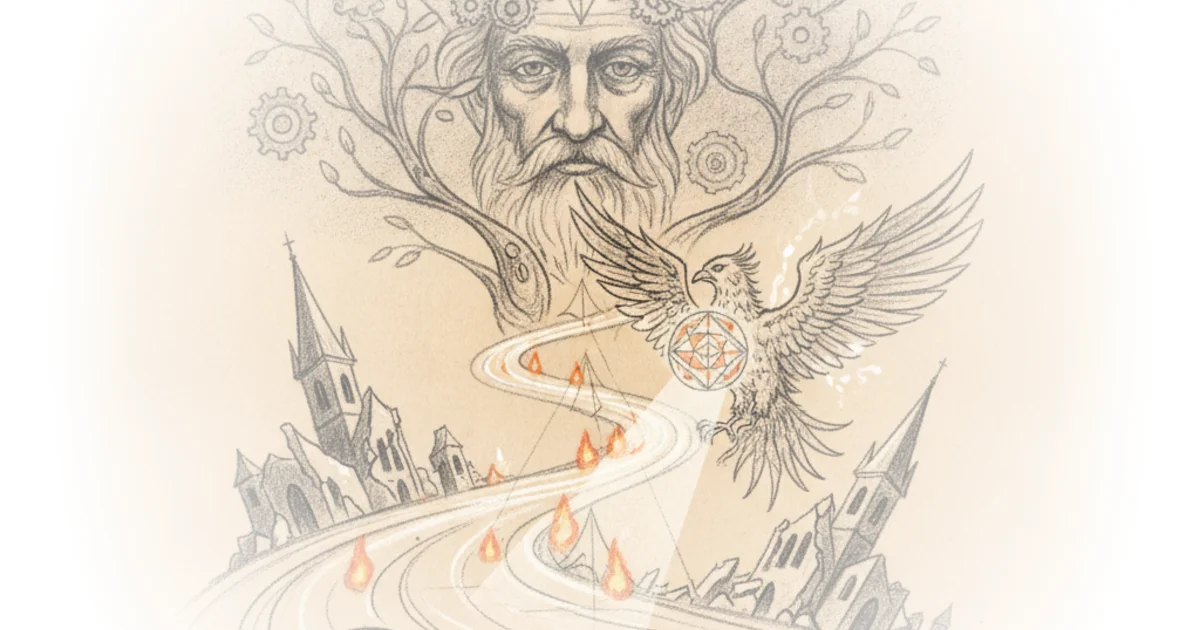
The author argues that this shift was not merely a change of heart but a strategic necessity. Mann realized that the "bourgeois republic" was on "borrowed time" and that its legitimacy rested on a specific faith. As Tooze puts it, "The right to power is contingent upon the conviction that one has a historic mission to perform." This framing is powerful because it moves the debate from abstract ideology to the gritty reality of political survival. It suggests that without a sense of mission, the middle class will inevitably "step aside, abdicate power, and make way for a type that knows none of the inhibitions and ties of atavistic sentiment."
"The greatest of these, Goethe, hails it: Turn your backs upon dead trappings, Let us love what is alive!"
Tooze notes the irony that while Mann and Keynes never directly corresponded, their diagnoses of the era were eerily synchronized. Both men recognized that the pre-war order was a "thin and precarious crust" maintained only by "rules and conventions skilfully put across." For Keynes, as quoted in his 1938 memoir, the realization that "civilisation was a thin and precarious crust erected by the personality and the will of a very few" was a "startling confession" that drove his entire economic project. This shared anxiety about the fragility of civilization is the piece's emotional core, grounding high theory in a visceral fear of collapse.
The Realist's Dilemma
The commentary then pivots to a fascinating literary-economic parallel. Tooze invokes the Hungarian Marxist critic Georg Lukács, who labeled Mann the "last great critical realist." Tooze asks a provocative question: "Was Keynes, in his General Theory (1936), not trying to do something similar?" The argument posits that just as Mann's novels captured the "disintegration of the classic unity of subjective time and objective historical development," Keynes was attempting to corral the "dispersed fragments of a late-nineteenth-century coherence into a new and more general framework."
This is a bold claim, suggesting that the General Theory was not just a technical manual but a narrative act of preservation, much like Mann's The Magic Mountain. Tooze writes, "Keynes's basic diagnosis was that the old properties of a well-functioning market economy and with it the self-confident subjectivity of bourgeois identity... were no longer in evidence." The author suggests that both men were trying to save liberalism from itself, refusing to let it be defined by the "hard-faced return to the nineteenth century" or the "distasteful centralized authoritarian regimes" of the era.
Critics might note that equating the structural analysis of a novel with the mathematical modeling of an economy risks overextending the metaphor. While both were responses to crisis, the mechanisms of literary realism and macroeconomic policy operate on fundamentally different levels of abstraction and agency. However, Tooze's point holds weight: both men were attempting to construct a new "technology of sense-making" for a world that had lost its old coordinates.
The Goethean Anchor
The piece concludes by rooting this intellectual migration in the figure of Johann Wolfgang von Goethe. Tooze explains that Mann's return to Goethe in 1932 was not nostalgic but forward-looking, tapping into the "age of alchemy supposedly overcome by enlightenment rationalism." This connection to the Sattelzeit—the critical transition period between the 18th and 19th centuries—provides the historical depth for their shared project.
Tooze highlights Mann's observation of Goethe's later years, noting the author's "enthusiasm for undertakings like the cutting through of the Isthmus of Panama." This detail is vital; it shows that the "magician" of literature was also a man of engineering and planning. Tooze writes, "He talks of these things insistently and goes into detail as if these were of more importance to him than all the poetry in the world." This reframes the liberal project not as a retreat into sentiment, but as a "great and sober effort" to build a "rational outward order of things."
"The new, socialized world, the world of planning and co-operation, will come; humanity will get rid of unnecessary sufferings that are a disgrace to intelligence."
This vision, Tooze argues, is the missing link in modern political discourse. It demands that the educated elite stop "staging celebrations for its great sons" and instead take up the burden of guidance. The argument is that liberalism must "demonstrate its capacity to 'guide'" or risk being swept away by forces that lack "inhibitions and ties."
Bottom Line
Tooze's most compelling contribution is the synthesis of literary and economic history to show that the crisis of the 1930s was as much about the failure of imagination as it was about policy failure. The piece's vulnerability lies in its reliance on a speculative "what if" regarding the connection between two men who never met, though the thematic resonance is undeniable. The takeaway for today is stark: democracy survives only when its guardians actively construct a new future, rather than merely defending the past.