Dave Borlace identifies a silent, accelerating crisis that overshadows the usual debates on electric vehicles and renewable energy: the insatiable global appetite for petrochemicals. While the world focuses on decarbonizing transport, Borlace argues that the chemical industry is quietly becoming the largest remaining growth engine for fossil fuel demand, with emissions projected to skyrocket unless we fundamentally rethink the materials that build our modern lives.
The Invisible Carbon Giant
Borlace begins by dismantling the assumption that the energy transition is on track, pointing to three specific blind spots identified by the International Energy Agency. He highlights that while trucks and air conditioning are well-known consumers of energy, the third blind spot—petrochemicals—is often ignored despite its ubiquity. "They're in like well almost everything really," Borlace notes, listing everything from insulation and plumbing to the synthetic fibers in our clothing and the packaging for our food. This framing is crucial because it shifts the conversation from abstract emissions to the tangible objects we touch daily, making the problem immediate and personal.
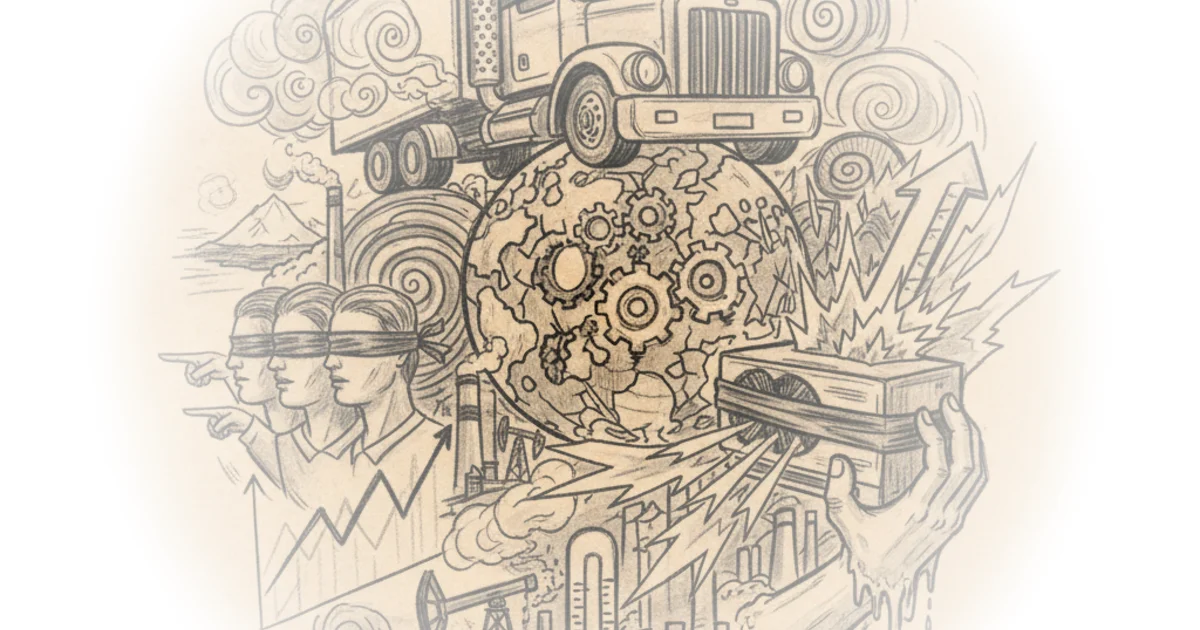
The scale of the issue is staggering. Borlace presents data showing that while the production of steel, aluminum, and cement has grown roughly in line with global GDP, plastics have exploded exponentially. "If we stay on our current business as usual trajectory, then by 2050 that number is predicted to rise to 20 million barrels a day and more than two billion tons of CO2 per year." This projection is not merely a statistic; it represents a future where the chemical industry alone could negate the gains made by decarbonizing the power grid. The argument lands hard because it exposes a paradox: we are building a green future using materials that are fundamentally incompatible with a stable climate.
"The trick is finding a way to extract them and make them into something useful."
The Bio-Based Promise and Its Perils
In response to this looming crisis, Borlace turns his attention to the race to develop bio-based chemicals—molecules derived from plants rather than ancient crude oil. He details several promising contenders, such as polylactic acid (PLA), which can be fermented from corn or sugar cane to replace plastics in packaging and textiles. He also highlights furandicarboxylic acid (FDCA), a material that outperforms traditional PET in gas barrier functions, potentially revolutionizing how we store beverages. "Two of the world's largest chemical manufacturers, DuPont and BASF, are both now producing new polymers from FDCA derived from fructose." This section is compelling because it moves beyond theoretical solutions to showcase active, industrial-scale innovation, proving that the technology to replace fossil feedstocks exists today.
However, Borlace does not shy away from the complexities of these alternatives. He examines levulinic acid, derived from cellulose, which can replace toxic solvents and superabsorbent polymers used in diapers. He also explores lignin, a natural polymer in trees that has long been a waste product of the paper industry but holds massive potential for creating adhesives and other materials. "The team claim their tape performs on par with Fisher brand labeling tape and Scotch magic tape." This specific comparison grounds the high-tech discussion in everyday utility, suggesting that bio-based materials can match, and sometimes exceed, the performance of their petrochemical counterparts.
Critics might note that the rapid scaling of these bio-based solutions carries its own risks, particularly regarding land use and biodiversity. Borlace acknowledges this tension, warning that "in our rush to maximize commercialization and profit, we forget to implement sustainable land management programs to grow the feed stocks." He draws a parallel to the biomass industry, which started as a way to utilize sawdust but devolved into vast monoculture plantations that destroy ecosystems. This counterpoint is vital; it prevents the piece from becoming a naive techno-optimist manifesto and instead frames the transition as a delicate balancing act between material substitution and ecological preservation.
The Land Use Dilemma
The most critical part of Borlace's analysis is his confrontation with the "elephant in the room": land use. He argues that simply swapping oil for corn or trees is not a silver bullet if it leads to the same destructive practices we are trying to escape. "Biomass is a perfect example of an industry that started life in the United States as a smart and efficient way to utilize the piles of sawdust created by the timber yards, but which has ended up with vast monoculture plantations." This historical context serves as a stark warning to policymakers and investors: the path to a sustainable chemical industry must be paved with rigorous land stewardship, or we risk solving one environmental crisis by creating another.
Borlace's choice to focus on the specific chemical pathways—fermentation, depolymerization, and synthesis—rather than vague promises of "green chemistry" adds significant weight to his argument. He effectively demonstrates that the solution lies in the molecular details, not just in broad policy shifts. "We can use the same separation purification polymerization and characterization methods to make these materials as they used to make the current commercial petroleum based analogs but we can get better properties and we can use a much greener source." This insight suggests that the industrial infrastructure for the future already exists; it simply needs to be redirected toward renewable feedstocks.
"It's yet another reminder of how careful we need to be as a species, not to go diving headlong into what appear to be better solutions that are more friendly to our climate and environment without ensuring that they don't themselves end up having similar consequences."
Bottom Line
Dave Borlace's analysis succeeds by exposing the petrochemical industry as the final, formidable frontier of the climate crisis, one that cannot be solved by electrification alone. His strongest argument is the detailed breakdown of viable bio-based alternatives that already exist, proving that the technological barrier is no longer the bottleneck. However, the piece's greatest vulnerability lies in the economic and logistical hurdles of scaling these solutions without triggering a land-use catastrophe, a challenge that requires as much political will as chemical innovation. Readers should watch for how governments and corporations navigate the tension between rapid decarbonization and sustainable resource management in the coming decade.