Devin Stone cuts through the noise of geopolitical headlines to ask a question most commentators are avoiding: Is the United States currently engaged in a war that the Constitution never authorized? His most provocative claim is that this isn't just a policy disagreement, but a fundamental breakdown of the rule of law where the executive branch has unilaterally assumed the power to declare war. For a busy professional tracking the erosion of institutional norms, Stone's forensic breakdown of the War Powers Resolution offers a chilling clarity on why this specific escalation in the Middle East matters more than the usual diplomatic posturing.
The Constitutional Fault Line
Stone anchors his argument in the deliberate friction between Article I and Article II of the Constitution. He writes, "Only Congress has the constitutional power to declare war, but they only learned of the strikes the same time that the rest of the world did." This observation strips away the administration's ability to claim legal cover through ambiguity. The author effectively dismantles the idea that the President can simply act as Commander-in-Chief without legislative input when the scale of conflict shifts from a targeted raid to a sustained campaign.
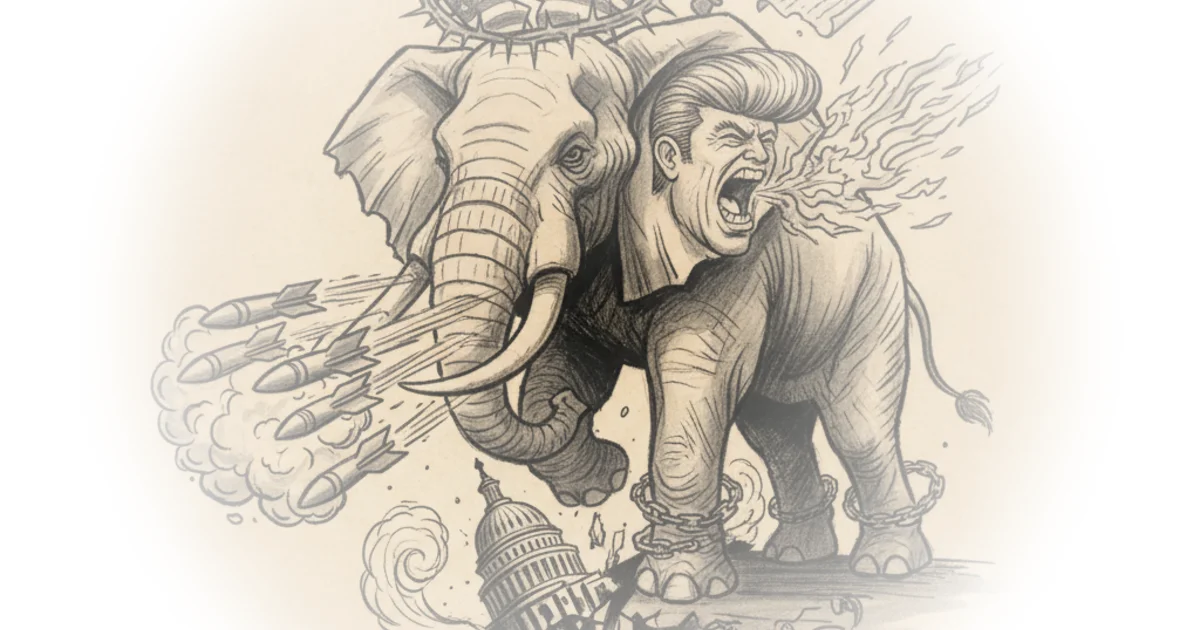
The commentary highlights a critical distinction often missed in the rush to judgment: the difference between a defensive reaction to an imminent attack and a pre-emptive strike to compel a nation's behavior. Stone argues that the administration is trying to shoehorn this massive operation into a defensive category, but the facts don't fit. He notes that while the President doesn't have to wait for Congress to be in session to defend the country, "it's difficult to argue that Iran's or any other country's nuclear ambitions constitute an actual or imminent attack." This is a vital legal nuance. By framing the conflict as a response to a "Schroinger's cat state" of nuclear readiness, the executive branch is attempting to justify force based on a hypothetical future threat rather than an immediate one.
The distinction matters because the US Constitution has clear rules for both. If this is a war, the President is acting outside the law.
Critics might argue that the speed of modern warfare and the lethality of nuclear programs require a more flexible interpretation of the War Powers Resolution. However, Stone counters that the historical precedent for such flexibility is narrow. He points out that even in the first Barbary War, Thomas Jefferson sought congressional authorization before escalating hostilities, setting a precedent that "Congress simply authorized President Thomas Jefferson to instruct the commanders of armed American vessels to seize all vessels and goods." The current administration's failure to seek even a similar authorization, let alone a formal declaration, suggests a deliberate bypassing of the legislative branch.
The Historical Echoes
To understand the gravity of this moment, Stone weaves in the deep history of US-Iran relations, reminding readers that the current conflict didn't emerge from a vacuum. He traces the lineage back to the 1953 CIA-backed coup that overthrew a democratically elected leader, noting that "the people of Iran didn't like this," leading to the 1979 revolution. This historical context is not just background noise; it is the fuel for the current fire. Stone argues that the administration's refusal to engage with the diplomatic frameworks established in the 2016 nuclear deal has directly led to the current crisis.
He writes, "Trump torpedoed the deal and reimposed sanctions, sending a clear signal his objective was the total collapse of the Iranian regime." By dismantling the inspection regime that kept a lid on nuclear enrichment, the executive branch created the very conditions it now claims justify a military strike. Stone's analysis here is sharp: the administration is fighting a war to fix a problem it actively exacerbated. He describes the current situation as a "sequence of tasks and purposes that uses force to compel your stated enemy to do what you want," which is the classical definition of war, not a limited police action.
The scale of the operation further cements this classification. Stone points out that the US and Israel launched "the largest combat sort ever flown by its air force" and targeted the Supreme Leader of Iran. This isn't a covert drone strike; it's a full-scale assault. As Stone puts it, "The purpose was to Iran's capacity to defend itself from further attacks and govern itself without US intervention." This intent to overthrow a government's ability to function is the hallmark of war, making the administration's refusal to use the word legally significant.
Whenever a sitting US president uses military force to compel another nation to bend their will, politics and the legality of any given war are inseparable.
A counterargument worth considering is that the administration might claim the strikes were necessary to prevent an imminent nuclear breakout that intelligence agencies had confirmed. However, Stone notes that US intelligence assessments found the strikes likely only set the program back by "months or maybe years," undermining the claim of an immediate, existential threat that would justify bypassing Congress.
The Consequences of Lawlessness
The most unsettling part of Stone's commentary is his warning about the long-term impact on the rule of law. He suggests that if this action goes unchallenged, it sets a dangerous precedent for future administrations. "The consequences to the fragile rule of law at home and across the international order could be catastrophic," he warns. The author argues that the administration is effectively rewriting the Constitution by executive order, turning the War Powers Resolution into a suggestion rather than a mandate.
Stone's analysis of the political dynamics is equally damning. He observes that the administration is relying on the fact that Congress is often gridlocked and unable to act quickly. But as he notes, "Congress isn't always in session to declare war or authorize hostilities" is a valid excuse for defense, not for launching a pre-emptive war. The author concludes that this is not a "special military operation" but a full-blown war, and by failing to declare it, the executive branch has committed a constitutional violation.
Bottom Line
Devin Stone's strongest asset is his ability to separate the political rhetoric from the legal reality, demonstrating that the scale and intent of the strikes against Iran meet the definition of war, regardless of what the administration calls it. The argument's greatest vulnerability is its reliance on the assumption that Congress will eventually act to check the President, a check that has proven increasingly ineffective in recent decades. The reader should watch for whether the courts or Congress step in to challenge the legality of Operation Epic Fury, or if this new precedent of unilateral executive war-making becomes the norm.