BobbyBroccoli reframes a pivotal moment in scientific history not as a triumph of policy, but as a cautionary tale of American ambition outpacing its own political will. The piece's most striking claim is that the discovery of the charm quark in November 1974 was so transformative it deserved the title "November Revolution," yet the true revolution was the decade of discovery that followed, only to be derailed by the collapse of the Superconducting Super Collider. This narrative connects the dots between a microscopic particle and the macroscopic failure of a national infrastructure project, offering a rare lens on how scientific progress relies as much on political continuity as it does on mathematical proof.
The Coincidence of Discovery
The author anchors the story in a remarkable historical synchronicity. BobbyBroccoli writes, "physics is about to experience a coincidence so remarkable so improbable that we're unlikely to see anything like it ever again." The core of the argument rests on the simultaneous, independent discovery of the same particle by two rival teams: Burton Richter at Stanford and Samuel Ting at Brookhaven National Laboratory. BobbyBroccoli notes that Richter initially wanted to name the particle "sp" after his accelerator, but settled on "psi" because the particle's trail in a spark chamber resembled the Greek letter. Meanwhile, Ting named his discovery "J," a choice BobbyBroccoli describes as potentially linked to Ting's Chinese name or his daughter's name. The convergence of these efforts is the piece's emotional high point. "On the 11th of november ting flew to stanford for unrelated reasons and just happened to cross paths with richter when both men excitedly told the other about their recent breakthrough," BobbyBroccoli recounts. This framing effectively humanizes the abstract world of high-energy physics, turning a dry scientific report into a story of serendipity and shared triumph.
"We don't call it the november revolution because of one discovery we call it that because it pointed the whole field in a specific direction kicking off a decade of discoveries."
The author argues that this single event validated the quark model, transforming it from a "band-aid applied to what was a huge hole" into a robust framework for the Standard Model. By detailing the subsequent discovery of the bottom and top quarks, BobbyBroccoli illustrates how this initial breakthrough unlocked a cascade of theoretical and experimental progress. Critics might note that the piece glosses over the intense theoretical work that preceded these discoveries, potentially oversimplifying the scientific process as a series of lucky breaks rather than a rigorous, decades-long effort. However, the narrative choice to focus on the "November Revolution" effectively highlights the pivotal nature of that specific month.
The Race for the Next Frontier
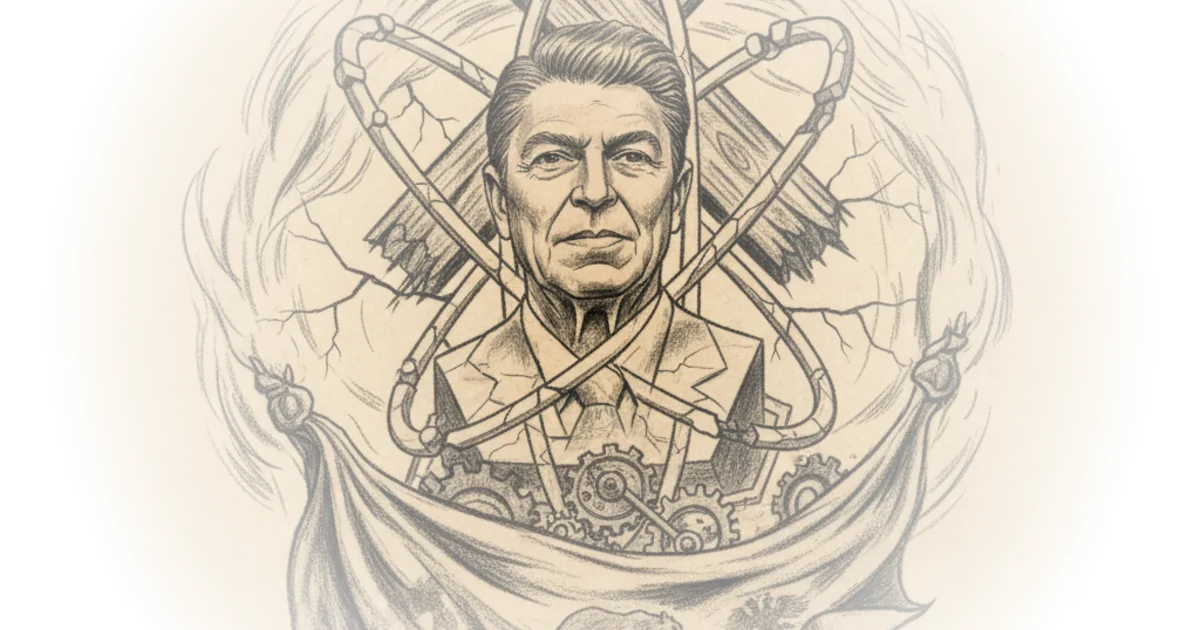
As the narrative shifts from discovery to infrastructure, the tone becomes more urgent. BobbyBroccoli explains that as the Standard Model filled in, the energy required to find the remaining pieces—specifically the Higgs boson and the top quark—demanded larger, more powerful machines. The United States, once the undisputed leader with four major labs, faced a strategic dilemma. "The fear was that europe's consolidation into one entity cern would allow them to pool all their resources and take the lead," BobbyBroccoli writes. This pressure led to the proposal of the Superconducting Super Collider (SSC), a project envisioned as the "particle physics equivalent of landing on the moon." The author highlights the political momentum behind the project, quoting Ronald Reagan's assertion that "inner space... hold out infinite possibilities" and that building the world's largest accelerator was a "visible symbol of our nation's determination to stay out front."
The commentary effectively contrasts the fragmented US funding model with Europe's consolidation at CERN. BobbyBroccoli argues that the US strategy of splitting the budget among four labs was becoming a weakness, necessitating a "one new giant lab" approach. The piece paints a vivid picture of the SSC's potential, describing the machine as a "big gun" built underground to shoot "really really tiny bullets." The narrative builds to a tragic climax: "within five years the project will have completely collapsed and with it american leadership in the realm of particle physics." This sudden reversal from the height of ambition to total failure is the piece's most powerful emotional beat.
The Cost of Abandonment
The final section of the piece serves as a somber reflection on the SSC's cancellation. BobbyBroccoli does not shy away from the magnitude of the loss, stating, "this was a failure so big so massive in its scope that it's hard to put into words." The author quotes Burton Richter, who called the project "one of high energy physics's greatest failures," underscoring the regret felt by the scientific community. The piece contrasts the grandeur of the initial vision with the mundane reality of political budget cuts. BobbyBroccoli notes that the project was abandoned not because the science was flawed, but because the political will evaporated. "I'm warning you now this story has a lot of things what it doesn't have is a happy ending," the author warns, setting the stage for a conclusion that emphasizes the fragility of long-term scientific investment.
Critics might argue that the piece places too much blame on the executive branch and Congress, ignoring the genuine fiscal concerns and the shifting geopolitical landscape of the post-Cold War era that made such a massive expenditure harder to justify. However, the author's focus on the loss of American leadership remains a compelling critique of short-term political thinking. The narrative effectively uses the SSC's collapse to illustrate a broader point: scientific progress is not just about the brilliance of the ideas, but the stability of the institutions that support them.
Bottom Line
BobbyBroccoli's strongest argument is the seamless connection between the microscopic discovery of the charm quark and the macroscopic failure of the Superconducting Super Collider, demonstrating how a single month of scientific triumph can be undone by years of political instability. The piece's biggest vulnerability is its somewhat romanticized view of the "November Revolution," which may understate the complex, non-linear nature of scientific progress. Readers should watch for how current global collaborations in particle physics, particularly at CERN, are navigating the same challenges of funding and international cooperation that the US failed to manage in the 1990s.