The Next Frontier Of Ancient DNA
Stefan Milo presents a breakthrough in genetic sequencing that promises to reshape our understanding of prehistoric life. By analyzing genetic material preserved in soil sediments, scientists are now able to reconstruct entire ecological histories without requiring fossilized bones.
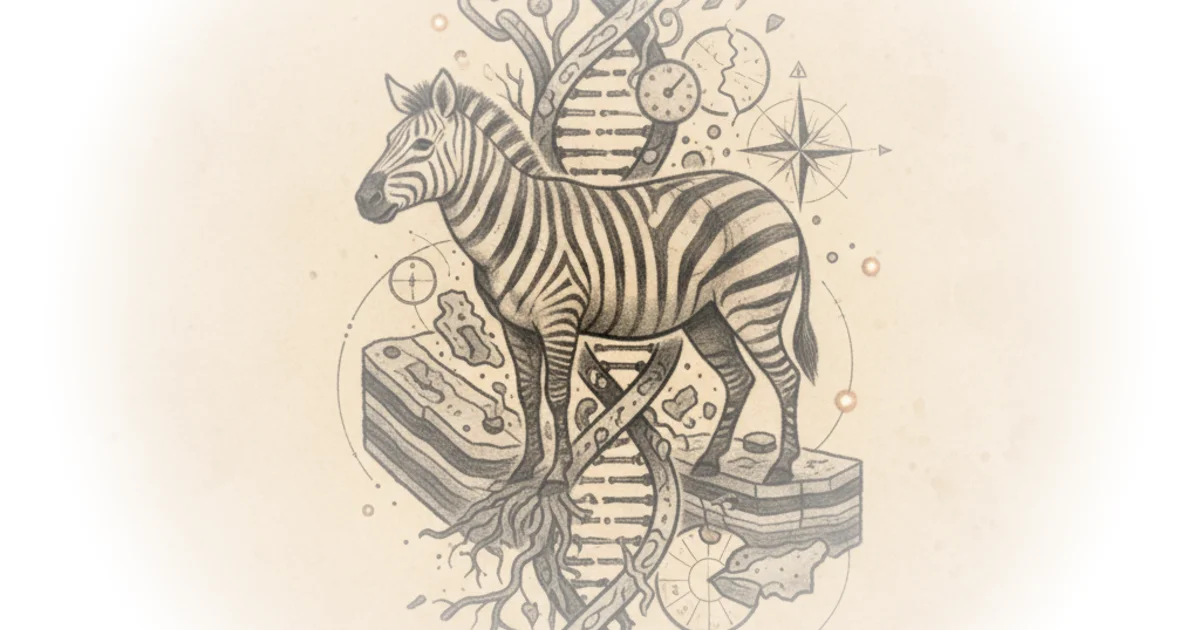
The Age of Ancient DNA
The revolution began with the quagga—a zebra-like animal hunted to extinction in 1883. In 1984, researchers successfully extracted DNA from preserved muscle tissue of a specimen housed in museums. They discovered that quaggas and zebras shared a common ancestor roughly three to four million years ago. More importantly, this study proved that ancient DNA could be preserved in tissue long after an animal had died.
The implications were enormous. From that moment forward, ancient DNA became one of the most powerful tools for understanding human evolution. It revealed entirely new branches on our evolutionary tree and tied us intimately to our closest cousins—particularly Neanderthals. The scientific community embraced this breakthrough enthusiastically.
But there was a limitation: skeletal remains are rare.
Getting DNA from Dirt
The next frontier is sedimentary ancient DNA, or sedDNA—a technique that extracts genetic material directly from soil sediments.
Elena Zavala, an assistant professor at the University of Copenhagen and a leading expert in the field, has been investigating where this genetic material actually originates. Is it from urine? From microscopic fossils? From tiny bone fragments?
"It's probably a combination of both," Zavala explained. "We see evidence that where you have places of higher occupation, there's more DNA from an individual or from a group."
When animals occupy a cave—eating, defecating, and leaving biological material behind—their fluids ooze into the sediment. Carcasses contribute their DNA as well. This creates a rich genetic tapestry in the soil.
Zavala was one of the geneticists behind a landmark study at Denis Cave in Russia. The cave has been occupied for roughly 200,000 years, but skeletal remains from actual human occupants are remarkably scarce—fewer than fifteen individuals found in all that time. Studying human evolution based on such limited samples is extraordinarily difficult.
SedDNA changes this entirely.
Each Dot Represents a Soil Sample
The cave's southeast wall drops down at least three to four meters into the earth. In Elena Zavala's paper, each white dot represents a soil sample taken for genetic analysis. This technique allows researchers to get a genetic profile of the entire occupation through time—not just one specific moment when one specific person was alive.
This capability reveals how occupations changed over thousands of years.
"In Denis Cave," Zavala noted, "where one area I thought was interesting is we have this period where below and above it we had Denisovan DNA that we found—but then there's this time section that we only found Neanderthal DNA from roughly 90,000 to 120,000 years ago. Only Neanderthal DNA is detected at the cave. No Denisovans at all."
This finding is extraordinary. It suggests Neanderthals occupied Denis Cave while Denisovans mysteriously vanished. Researchers might have reached this conclusion from skeletal remains alone—but with so few samples, it's nearly impossible to know for certain.
When you have dozens of samples across different chambers containing only Neanderthal DNA and no evidence of Denisovans, that's considerably stronger evidence that the absence is real.
"Potentially this lack of evidence is evidence of absence, which is hard to say otherwise."
Beyond Humans
The technique also captures DNA from everything else—bears, hyenas, and other animals that lived in these spaces. During the period when Neanderthals appear and Denisovans disappear, there's evidence of a cold snap. With changing climate came changes in animal populations. Bears shifted from predominantly cave bears in lower layers to brown bears in upper layers.
The types of ancient mitochondrial DNA found correlate directly with climatic change in the region. This ability to get a cross-section through time of an entire occupation could truly be revolutionary—untangling migration, movement, and evolution regardless of whether fossils are present.
Mammoths on the Mainland
One early paper that highlighted sedDNA's potential tracked environmental changes in the Yukon region of Canada using DNA from sediment cores. They found that the decline of the mammoth steppe after the last glacial maximum coincided with the decline of mammoths.
But remarkably, they detected horse and mammoth DNA as recently as 5,700 years ago—roughly 7,000 years after these animals were believed to have vanished everywhere except Wrangler Island. The authors hypothesized that high-altitude regions in Canada may have served as refugia for these creatures—similar to what happened on Wrangler Island.
The implications are staggering: mammoths and horses may have roamed the Americas as recently as 5,700 years ago—not on some isolated island but on the mainland.
The Dirt's Dilemma
But there's a significant challenge. How can researchers be certain that DNA from tiny sources hasn't moved through the sediment?
In the mammoth study, they found mammoth DNA signals in three out of four sites and nine core samples—so it wasn't just a one-off reading. Still, this remains a central concern.
"that's always it's still a hot topic of conversation," Zavala acknowledged. "How do we know where we think it's from?"
There's no shortcut. The only way results can be shown reliable is by doing extensive work analyzing excavations in as many ways as possible. Researchers need contextual information to have confidence in their findings—collaborating with geochronologists and micromorphologists who understand what's happening with the sediments.
Is there evidence of bioturbation? Burrowing? Has some small mammal burrowed down through different layers mixing up all the signal?
Zavala's own study at Denis Cave presented a notable challenge. In one diagram, blue, red, and yellow dots appear close together—representing genetic signals from Neanderthals, Denisovans, and modern humans all from basically the same layer.
This is fascinating because we know our ancestors interbred with them—we must have done that at some location. So researchers wonder: was it here in Denis Cave? That particular layer was jokingly referred to as "the party layer" by some on the team.
The issue is these dotted lines aren't clearly defined, and researchers cannot be certain the layer hasn't been disturbed. This represents sedDNA's primary limitation—the sediment itself. If the layers can't be verified, neither can the results.
Collecting so many samples requires enormous effort. For that study, it took two years to generate all that data—and that was with automation.
DNA from an Artifact
But these technologies can also tell incredibly personal stories. Researchers extracted human DNA from an actual artifact—a pendant made from a deer tooth found in Denis Cave.
Elena Essel had worked for years developing a technique to extract DNA from artifacts, and Elena Zavala was involved in that project too. The DNA suggested the pendant belonged to a woman who lived roughly 19 to 25,000 years ago and belonged to haplogroup U.
When asked how they could be sure the DNA came from the pendant itself rather than somewhere else, Essel explained that colleagues had found the pendant during excavations. They put it straight in a bag and asked what could be done with it.
Essel devised a method involving multiple washes of solutions. With each wash, results became further refined—until initial extractions showed tons of different types of fauna similar to sediment samples, while later washes revealed more specific DNA evidence.
The technique is extraordinary: extracting genetic material from an object that people handled and wore—and reconstructing the identity of its owner.
Bottom Line
Sedimentary ancient DNA represents one of the most significant technological advances in understanding human evolution. It allows researchers to reconstruct entire ecological histories continuously through time without requiring fossilized remains. The biggest strength is sampling continuity across thousands of years; the greatest vulnerability is uncertainty about sediment layer preservation. Scientists must collaborate extensively with stratigraphers and dating specialists before making claims. This technology will fundamentally change how we understand prehistoric life—and it's developing faster than most people realize.