This piece transcends a standard crime report by mapping Jeffrey Epstein's New Mexico operations onto a landscape already saturated with nuclear secrets, espionage, and institutional cover-ups. The Hunt for Tom Clancy argues that the state's history of hiding the world's first atomic bomb created a cultural and bureaucratic blind spot that allowed a sex trafficking ring to flourish in plain sight.
The Geography of Secrets
The core of the argument is that New Mexico's unique ecosystem of secrecy acted as a shield for Epstein. The author reframes the Zorro Ranch not as an isolated anomaly, but as the center of a radius containing the Trinity Site, where the Manhattan Project detonated the first nuclear weapon, and the historic center of Santa Fe, once a hub for Russian espionage. "If there's a secret, New Mexico will try to keep it," The Hunt for Tom Clancy writes, establishing the premise that the state has a long, practiced history of concealment. This framing is effective because it shifts the focus from individual malice to systemic opacity; the environment itself facilitated the crime.
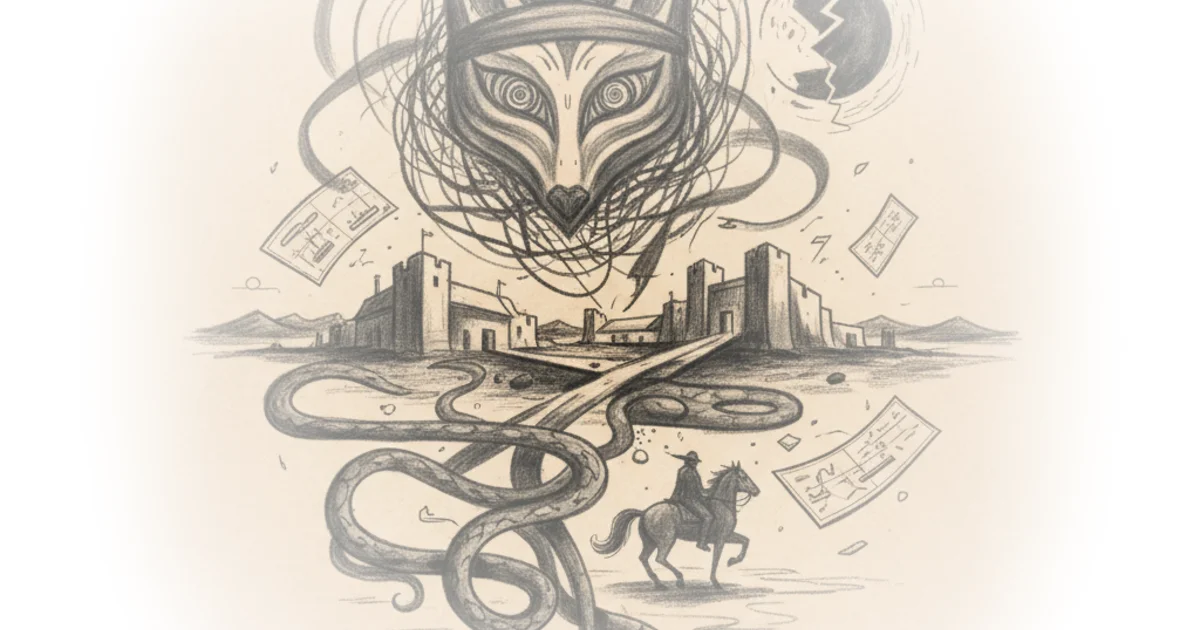
The author draws a chilling parallel between the state's handling of the atomic bomb and its tolerance of other hidden horrors. They note that while tourists can now visit the epicenter of the Manhattan Project, the state also harbored sites where the Catholic Church hid pedophile priests until lawsuits forced bankruptcy. "We travel inside the circle, from one abusive church to another," the piece observes, linking the institutional protection of abusers across different sectors. This comparison is powerful, suggesting that the mechanisms of secrecy used for national security were repurposed to protect the powerful from accountability for sexual violence.
If there's a secret, New Mexico will try to keep it. The Land of Enchantment has gotten a lot of practice over the years, well before Jeffrey Epstein purchased the Zorro Ranch south of Santa Fe.
Critics might argue that drawing such a direct line between the Manhattan Project and Epstein's crimes risks conflating state-level strategic secrecy with criminal negligence. However, the author's evidence regarding the density of high-security and high-cover-up sites within a specific geographic radius lends weight to the idea of a regional culture of non-disclosure.
The Architecture of Deception
The piece meticulously details the mundane administrative failures that allowed Epstein's empire to operate. Despite his immense wealth and sophisticated shell companies, the author points out that Epstein was often caught in bureaucratic slippages, such as failing to pay grazing fees or withdrawing a permit request when inspectors were sent to his proposed runway. "For all the care he took purchasing it through shell companies and lawyers, the little things were often neglected," The Hunt for Tom Clancy notes. This detail is crucial; it suggests that Epstein's operation relied less on a flawless conspiracy and more on the assumption that no one would look closely enough to notice the small errors.
The author also explores Epstein's intellectual interests, specifically his funding of the Santa Fe Institute and his connections to theoretical physics and eugenics. The narrative highlights how Epstein leveraged the state's reputation as a hub for cutting-edge science to legitimize his presence. "When these men describe Epstein," the piece quotes from Vanity Fair, "they talk about 'energy' and 'curiosity,' as well as a love for theoretical physics that they don't ordinarily find in laymen." This framing exposes how the allure of scientific prestige can be weaponized to mask criminal behavior, turning a think tank into a potential cover for a predator.
Local residents, however, remained largely in the dark, relying on visual cues rather than official knowledge. Gene Peach, a photographer, told the author that locals knew the Epstein crowd was present because "the mansion lights drown out the stars." This observation is haunting; in a place known for its dark skies and astronomical research, the physical light of the mansion became the only indicator of the darkness within. The author uses this to illustrate the disconnect between the local community and the hidden activities of the elite.
Institutional Complicity and Response
The commentary concludes by examining the response of state officials, specifically Land Commissioner Stephanie Garcia Richard. Unlike many who might have ignored the scandal, Richard proactively assembled a briefing book of every interaction the state had with Epstein and delivered it to the Attorney General. "Even before Epstein's arrest in New York, as soon as she heard about Virginia Roberts Giuffre's accusations... Richard instructed her staff to pull every relevant document," The Hunt for Tom Clancy writes. This stands in stark contrast to the decades of inaction and highlights a rare instance of institutional accountability breaking through the culture of secrecy.
The piece also touches on the broader implications of Epstein's investments, noting his interest in eugenics and cryogenics within a state that once imported Nazi war criminals to run its space program. "It seems Epstein, a canny investor, saw value in both the physical and human terrain of New Mexico," the author concludes. This final point is the most disturbing, suggesting that the state's history of utilizing controversial human capital created a fertile ground for Epstein's own twisted ambitions.
Once Hubbard adopts a new body, he's expected to make his way to one of the CST bases. That's where he's supposed to be raised and be taken care of.
The inclusion of the Church of Spiritual Technology's Trementina Base, with its hardened vaults for L. Ron Hubbard's writings, serves as a surreal counterpoint to Epstein's own vaults of secrets. It reinforces the theme that New Mexico is a place where the boundaries between science, religion, and criminality are dangerously porous.
Bottom Line
The strongest element of this piece is its geographic and historical contextualization, which transforms a story about a single criminal into a critique of a region's culture of secrecy. The argument's vulnerability lies in its speculative nature regarding the direct causal link between nuclear secrecy and sex trafficking, yet the sheer density of cover-ups in the region makes the connection compelling. Readers should watch for how state officials continue to navigate the legacy of these secrets, particularly as more documents are unsealed and the true extent of the institutional protection becomes clear.