This piece cuts through the noise of a recent sports controversy to reveal a stark, uncomfortable truth about who gets punished for protest in America. Kahlil Greene doesn't just recount the warning issued to San Francisco Giants pitchers; he constructs a historical mirror that reflects how institutional power protects some dissent while crushing others. The argument is vital because it challenges the prevailing narrative of religious persecution by contrasting a minor uniform infraction with career-ending silencing, forcing readers to question why the reaction depends entirely on who is being opposed.
The Asymmetry of Consequence
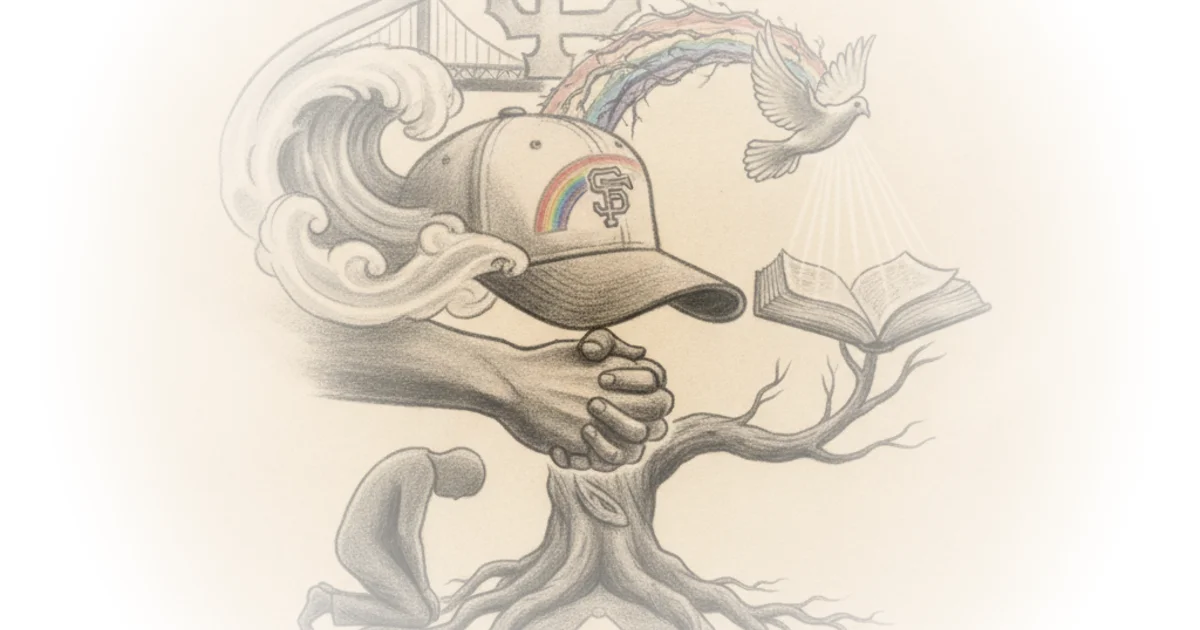
Greene opens by detailing how three pitchers altered their caps for Pride Night, writing "Gen 9:12-16" across the rainbow symbol—a direct reference to the biblical covenant where the rainbow serves as a promise after the flood. While one player chose to simply wear a standard black cap, the others reframed a symbol of inclusion into a theological statement. The league's response was measured: a verbal warning for violating uniform rules, with no fines or suspensions. Greene notes that this rule is applied consistently, citing previous warnings for caps reading "Dad" or "Hi Mom."
"Kaepernick knelt and lost his career... Yet only Kaepernick lost his livelihood."
The core of the argument rests on the contrast between this minor reprimand and the fate of Colin Kaepernick. Greene writes that when Kaepernick knelt to protest police killings, he did not alter a symbol or tell fans they were unwelcome; he asked the country to stop killing people who looked like him. Despite being a private employer issue where the First Amendment does not apply, the result was total professional erasure. This framing is powerful because it strips away the "free speech" debate to focus on the tangible cost of dissent. Critics might argue that altering a uniform is a breach of contract distinct from kneeling during an anthem, but Greene effectively counters this by highlighting that the league's enforcement only escalated after political intervention turned a routine rule into a national controversy.
The piece then broadens its scope, weaving in historical precedents to show that athletes who defend the powerless have always faced severe retribution. Greene draws a sharp line from Muhammad Ali, stripped of his heavyweight title and barred from boxing for refusing induction into the Army, to Tommie Smith and John Carlos, who were suspended and thrown out of the Olympic Village after their 1968 Black Power salute. He notes that even the "Wyoming 14," Black football players cut for protesting racial doctrines in 1969, faced immediate exile from the sport.
"The officials defending the Giants pitchers today have placed themselves alongside Avery Brundage and the coaches who punished those earlier athletes."
This historical weaving is the article's strongest asset. By invoking the 1968 Olympics, Greene reminds us that the "Victory Salute" statue at San Jose State University now honors men who were once treated as pariahs. The argument suggests that history often corrects these judgments, but only after the damage is done. A counterargument worth considering is whether the current political climate has simply shifted the definition of which protests are deemed acceptable, rather than revealing a consistent pattern of bias. However, Greene's evidence regarding the swift mobilization of government officials to protect the pitchers—despite the players themselves feeling no discrimination—undercuts the idea that this was a neutral enforcement of rules.
The Politics of Protection
The commentary shifts to analyze the reaction from Washington. Greene points out that while the players were content with a warning, powerful figures intervened aggressively. He quotes Vice President JD Vance stating, "Trump won we don't have to do this anymore," and notes how Senator Josh Hawley threatened baseball's antitrust exemption. The Department of Justice opened an investigation, and Florida's attorney general launched a probe into what they termed religious discrimination.
"Kaepernick's protest defended people with little power, while the pitchers refused a group of fans a single night of welcome."
This observation lands with particular force because it highlights the direction of the protest. The article argues that the pitchers' actions were directed at a marginalized community, effectively refusing them a space of welcome, whereas Kaepernick protested state violence against his own community. Greene writes that in 2025, Dodgers pitcher Clayton Kershaw wrote a Bible verse on his Pride cap with no consequence from the league; the rule was only enforced once the episode became a political wedge issue. This suggests the enforcement was not about uniform integrity but about managing a narrative of victimhood for specific groups.
The piece also contrasts this with leagues that chose to back their players during times of crisis. Greene recalls how Celtics owner Walter Brown refused to play in the South when his team faced segregation, and how NFL Commissioner Joe Foss moved an All-Star game out of New Orleans rather than blame Black players who refused to play amidst racism. He notes that when the Milwaukee Bucks boycotted a playoff game in 2020 following the shooting of Jacob Blake, the league supported them rather than fining them.
"Americans tend to revise these judgments over time... That company has rarely looked good with time."
The final section serves as a warning to current officials. Greene suggests that those rushing to defend the pitchers are aligning themselves with historical figures like Avery Brundage, whose legacy is now defined by his punishment of Smith and Carlos. The argument implies that while the immediate political win may belong to those defending the players, the long-term judgment of history will likely be harsh.
Bottom Line
Greene's most compelling contribution is reframing a uniform dispute as a litmus test for who society values enough to protect from consequence. The piece's greatest vulnerability lies in its assumption that all athletes protest with equal moral weight, though the evidence strongly supports his distinction between protesting state violence and refusing inclusion to fans. Readers should watch how this incident influences future league policies on political expression, as the precedent set here could either normalize religious exemptions or reinforce the principle that uniform rules apply equally regardless of the message.