Dan Snow doesn't just recount the history of Greenland; he reveals how a frozen, seemingly empty rock became the world's most contested real estate. In an era where Arctic ice is melting and superpowers are circling for resources, Snow's narrative transforms Greenland from a distant footnote into the central stage of global strategy. The piece is notable not for what it says about the past, but for how clearly it maps the trajectory toward a future where Greenland's independence could redraw the map of the North Atlantic.
The Great Deception and the Vanishing Settlers
Snow begins by dismantling the myth of the uninhabited north, grounding the island's history in a complex tapestry of migration. He writes, "The earliest known inhabitants of Greenland are believed to be the Inuit peoples who crossed from North America via the islands that are scattered off the coast of modern Canada." This framing is crucial because it establishes that the land was never truly empty before the Europeans arrived; it was already a homeland. Snow details the successive waves of Inuit culture, from the Independence I to the Thule, noting how the final group "gave rise to the Inuk culture which centered on West Greenland... and saw greater reliance on hunting on the water by kayak."
The narrative then pivots to the Norse, introducing a figure whose name alone suggests a history of violence and ambition. Snow describes Eric the Red as a man who "got into trouble with the law, too," eventually being banished from Iceland for killing several men. The core of the Norse settlement story rests on a brilliant marketing stunt. As Snow puts it, "Eric called the new place Greenland to deliberately deceive the Icelanders he was trying to convince." This sales trick worked, bringing 14 ships to a land that was, for the most part, frozen as far as the eye could see. The author effectively highlights the fragility of this experiment, noting that the settlements eventually vanished, with the last written record appearing in 1408.
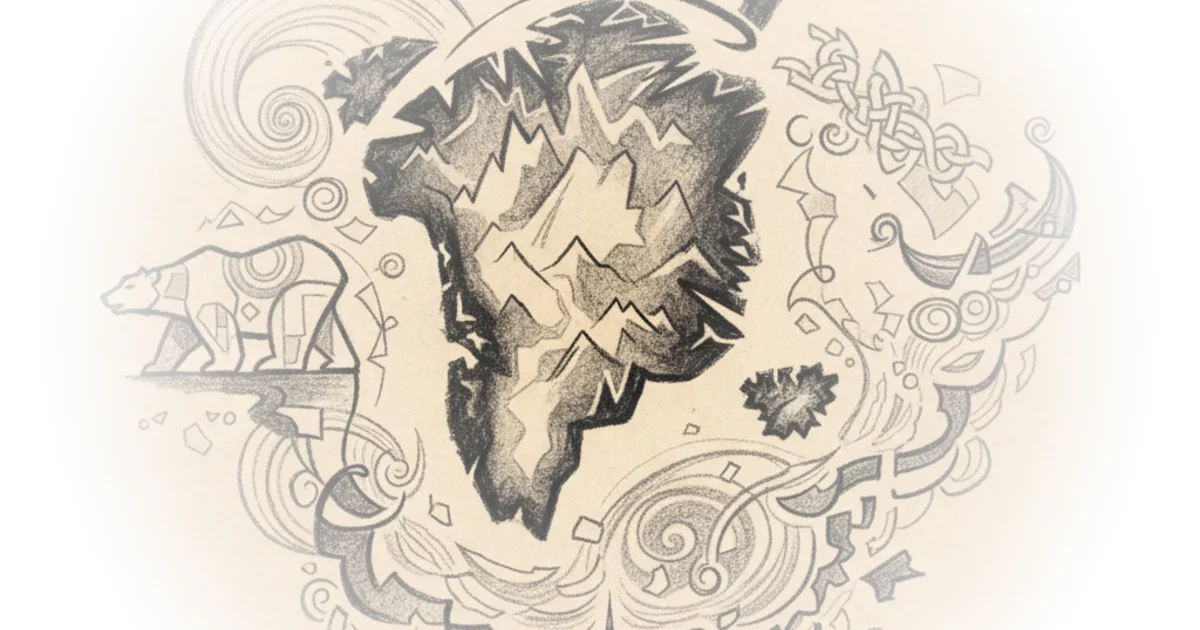
The story of how somewhere so cold became such hot property is a long and fascinating one.
Snow suggests the "Little Ice Age" was the primary culprit for the Norse collapse, a period of global cooling that made life "increasingly impossible." However, critics might note that this explanation often overlooks the possibility of conflict with the expanding Thule Inuit or the Norse settlers' refusal to adapt their farming practices to the changing environment. Snow hints at this by mentioning the Thule arrived during the Viking settlement but keeps the extent of their interaction vague, leaving the reader to wonder if the Norse were simply outcompeted rather than just frozen out.
From Colonial Monopoly to Cold War Chessboard
The second act of Snow's history shifts from medieval mystery to modern geopolitical maneuvering. He traces how Denmark reasserted control in the 18th century, driven by a religious mission that "found no Vikings and struggled to convert the Inuit population they encountered." This led to a strict monopoly on trade that lasted until 1950, effectively isolating the island. But the true turning point arrives with World War II, where Greenland's strategic location in the high north Atlantic made it vital for hunting U-boats and forecasting weather.
Snow captures the absurdity and tension of the era when the Danish ambassador to the US, refusing to acknowledge German control of Denmark, signed a treaty allowing US military bases. "Greenland became a United States protectorate," Snow writes, noting that the US established 14 military bases along the coasts. This autonomy during the war planted the seeds for the modern independence movement, as Greenlanders realized they could govern themselves when cut off from Copenhagen. The author details the formation of the "Sledge patrol," where Greenlanders used dog sleds to locate and attack German weather stations, suffering only one casualty.
The post-war era, however, brought new dangers. Snow recounts the 1968 crash of a B-52 bomber carrying hydrogen bombs, a disaster that left radioactive debris and, crucially, a missing fourth bomb. "It emerged that the plane had been transporting four hydrogen bombs and radioactive debris from the crash contaminated the surrounding area," he notes. This incident, along with the "Thulegate" scandal where it was revealed nuclear weapons were flown over a nuclear-free Denmark, underscores the friction between local safety and global strategy. The US view of Greenland as a vital radar point against Moscow meant that "inhabitants on the island began to raise concerns that it would make Greenland a prime target for any strike."
The Road to Independence
The final section of Snow's piece focuses on the political evolution of Greenland from a colony to a self-governing entity. He highlights the irony of Greenland joining the European Common Market in 1973 as part of Denmark, despite a 70% vote against it. The consequences were immediate: "free trade meant other nations had access to its waters and they became heavily overfished." This economic pain drove the 1982 referendum where 53% voted to leave the EEC, a process completed in 1985.
Snow describes the gradual devolution of power, culminating in the 2009 Self-Government Act, which allowed Greenland to withdraw Danish as the official language. The narrative builds to the present day, where the question of independence is no longer theoretical. He notes that recent elections have become "increasingly focused on the question of independence from Denmark," with parties campaigning on a platform of full sovereignty. The author points out a significant shift in the political landscape: "In 2025, elections delivered a shock result as the center-right Democratic Party tripled its vote and took the largest share." This party, alongside the pro-independence Naleraq, signals a move away from the cautious status quo.
The strategic location and natural resources of Greenland have made it a focus for international attention and attempts to control it for a long time.
While Snow paints a picture of inevitable independence, a counterargument worth considering is the economic reality. Full independence would require Greenland to replace Danish subsidies with revenue from mining and oil, industries that are environmentally contentious and subject to volatile global markets. Snow mentions the focus on natural resources but doesn't fully explore the economic risks of severing ties with the Danish welfare state.
Bottom Line
Dan Snow's coverage succeeds by connecting the dots between ancient migrations, medieval failures, and modern nuclear strategy, proving that Greenland's history is a mirror for global power struggles. The piece's strongest asset is its ability to humanize a geopolitical chessboard, showing how the "Sledge patrol" and the "Thulegate" scandal are not just footnotes but the catalysts for a nation's desire for self-determination. The biggest vulnerability lies in the assumption that political will alone can overcome the economic and environmental hurdles of independence, a tension that will define Greenland's next chapter.
The story of how somewhere so cold became such hot property is a long and fascinating one.