Devin Stone flips the script on a beloved holiday classic, arguing that the true villains of "Home Alone" aren't the bumbling burglars, but the parents who left an eight-year-old child unsupervised for days. By applying strict Illinois statutes to a fictional comedy, Stone exposes a legal landscape where the "heartwarming" premise of the film collapses under the weight of child abandonment laws, turning a family vacation mishap into a potential felony.
The Negligence of the MacAllisters
Stone begins his legal dissection not with the intruders, but with the adults who created the crisis. He posits that the power outage and subsequent rush to the airport do not excuse the parents' actions. "A person commits child abandonment when he or she... knowingly leaves that child who is under the age of 13 without supervision... for a period of 24 hours or more," Stone writes, highlighting the specific statute that Kevin's parents likely violated. The argument is compelling because it strips away the movie's comedic framing to reveal a stark reality: leaving an eight-year-old alone for multiple days is not a plot device, it is a Class 4 felony in Illinois.
The commentary suggests that the parents' eventual realization of their mistake offers little legal reprieve. Stone notes that while the situation might drop the charge from abandonment to negligent parenting, the core issue remains. "Kevin is a small child who can't even pack his own suitcase," Stone observes, emphasizing the vulnerability of the victim. This framing forces the audience to reconsider the "typical heartwarming family Christmas movie" as a scenario of severe endangerment. A counterargument worth considering is the legal doctrine of mens rea, or criminal intent; the parents' genuine panic and the chaotic circumstances might provide a strong defense against a "knowing" abandonment charge, though Stone effectively argues that the duration of the absence negates this defense.
The Wet Bandits' Escalating Criminal Enterprise
Shifting focus to the antagonists, Stone details how Harry and Marv's crimes compound rapidly, moving from minor infractions to serious felonies before they even enter the house. The duo's decision to impersonate law enforcement to gather intel sets the tone for their legal downfall. "It is completely illegal to impersonate a police officer in Illinois," Stone states, noting that this offense alone carries a potential three-year sentence. This is a crucial distinction often missed by viewers who see the disguise as merely a funny gag rather than a distinct crime of false personation.
Stone further argues that the conspiracy between the two thieves makes them jointly liable for each other's actions. "Because Marv has entered into a conspiracy with Harry, he's now on the hook for all the crimes that Harry has committed," he explains. This legal principle transforms their individual stunts—like clogging sinks or driving a creepy van—into a coordinated criminal enterprise involving burglary, grand larceny, and stalking. The analysis holds up well under scrutiny, as the "Wet Bandits" calling card of leaving water running serves as tangible evidence of wanton destruction of property, a charge that sticks regardless of their comedic incompetence.
You could argue that Kevin McCallister is a criminal mastermind up there with Jigsaw and Martha Stewart.
Kevin's Legal Liability and the Castle Doctrine
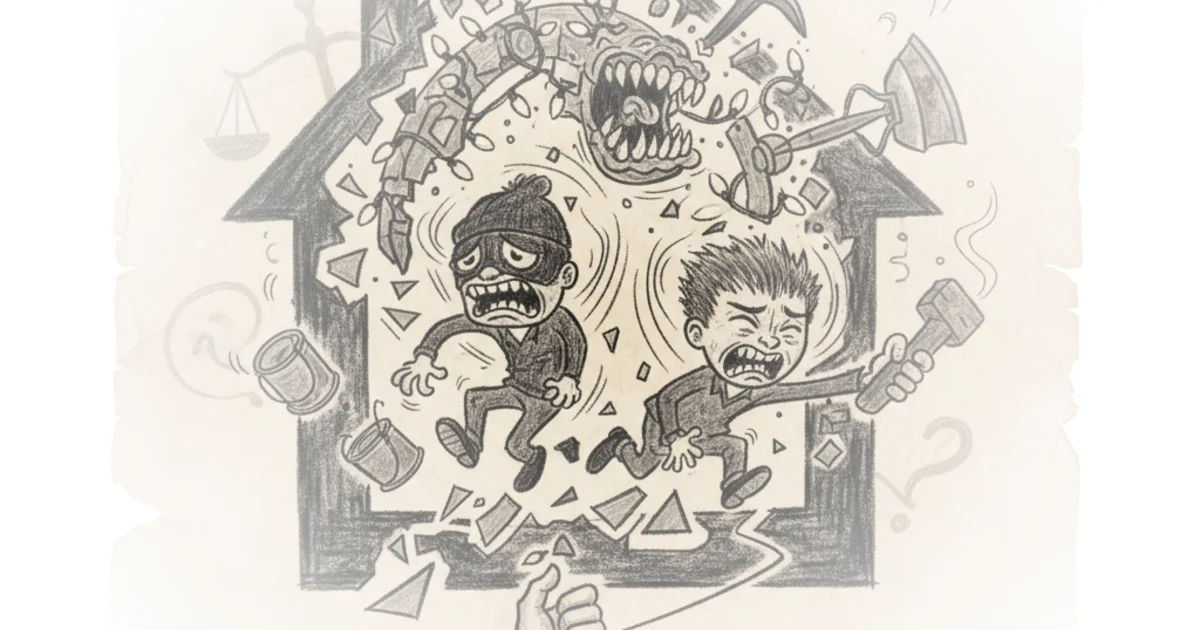
The most provocative section of Stone's analysis concerns Kevin himself. The commentary dismantles the notion that the child is purely a victim, pointing out his own history of petty crimes, from shoplifting a toothbrush to assaulting his brother. "Shoplifter," Stone declares, noting that even unintentional theft can be prosecuted under retail theft statutes. However, the core of the argument pivots to the elaborate traps Kevin sets, which Stone classifies as potential battery and assault.
Stone navigates the complex intersection of self-defense and defense of property, specifically within the context of Illinois law. "Illinois statutes allow for both self-defense and defense of the home," he writes, explaining that the state's "Castle Doctrine" allows residents to use force without a duty to retreat. This is the linchpin of Kevin's potential acquittal. Stone argues that while the paint cans and flamethrowers are extreme, the burglars' entry was "violent, riotous, or tumultuous," justifying the use of force. However, the analysis hits a snag when Kevin leaves the house to pursue the thieves. "Having retreated from his home, he can no longer use deadly force to defend himself," Stone points out, suggesting that Kevin's pursuit could legally constitute attempted murder. Critics might note that a jury would likely apply a "jury nullification" defense, refusing to convict a child for defending his home against armed intruders, regardless of the technical statutory violations.
Bottom Line
Stone's strongest contribution is reframing a cultural touchstone through a rigorous legal lens, proving that the film's comedy relies entirely on the suspension of criminal law. The argument's biggest vulnerability lies in its rigid application of adult statutes to a child's actions, ignoring the likelihood of judicial leniency. Ultimately, the piece serves as a stark reminder that in the real world, the "fun house of horrors" Kevin built would likely result in a very different ending than the one we celebrate every Christmas.