This piece from Kings and Generals does something rare for military history: it treats the transition from wood to iron not as a slow drift, but as a sudden, terrifying rupture that threatened to erase a century of naval supremacy overnight. While many accounts focus on the glamour of the battles, Kings and Generals zeroes in on the industrial anxiety that drove the British Empire to scrap its entire fleet in a single decade. The real story here isn't just about better guns; it's about how a single French ship, the La Gloire, forced a superpower to admit its entire way of war had just become obsolete.
The Illusion of Stability
Kings and Generals begins by dismantling the idea that naval power was a steady evolution. For three centuries, the rules barely changed. "During the age of sail, over three centuries, protection, mobility, and their related technologies changed little, even as ships grew larger and more capable," the authors note. This framing is crucial because it highlights how shocking the subsequent shift was. When the status quo is stable for 300 years, a disruption feels less like progress and more like an apocalypse.
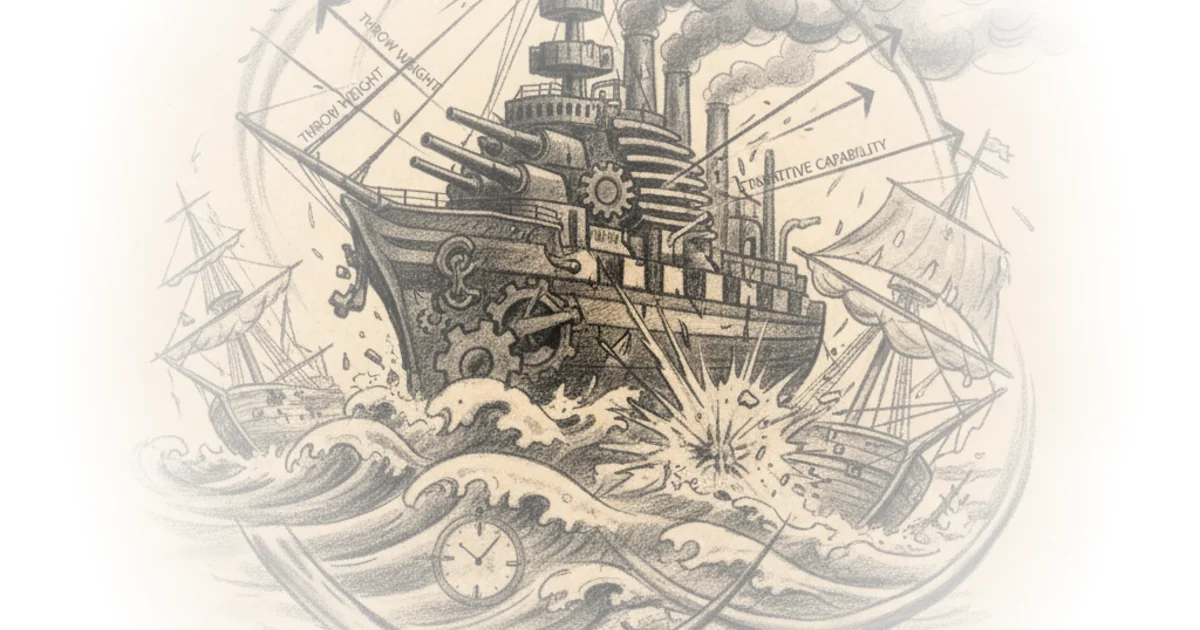
The commentary correctly identifies that the initial shift to steam was clumsy. Early paddle steamers were "impractical due to their bulky side paddles, which hindered the mounting of large numbers of broadside guns." Kings and Generals points out that these vessels were vulnerable to damage that could literally split the ship in two. This detail matters because it explains why navies hesitated. They weren't just afraid of new technology; they were afraid of new technology breaking their existing ships.
"The transition from sail to steam was not instantaneous, nor was it linear."
This observation is the anchor of the piece. It prevents the reader from viewing history as a straight line of improvement. Instead, Kings and Generals shows a messy, experimental period where the wrong solutions (paddle wheels) had to be tried and discarded before the right one (the screw propeller) could take hold. The British breakthrough with the Archimedes and the Rattler proved that screw propulsion was superior, but the real game-changer was how it freed up space for armor and guns.
The French Gambit
The narrative pivots sharply when it introduces the French artillery officer Henri-Joseph Paixhans. His vision of shellfire was the first crack in the wooden hull's armor. Kings and Generals writes, "The idea of heavy shell-fired Paixhans guns mounted on ships with armor soon took hold." The authors argue that this wasn't just about firepower; it was a strategic concept designed to neutralize Britain's greatest asset: its massive pool of experienced sailors. "Paixhans claimed all of this would neutralize Britain's traditional advantage of a large seafaring population so that 20,000 sailors born and nurtured on the ocean would no longer have the power to dictate the law to the entire world."
This is a brilliant reframing of the naval arms race. It wasn't just a contest of shipbuilding; it was a contest of demographics and industrial capacity. The Crimean War provided the grim proof of concept. When Russian shells annihilated a Turkish wooden fleet, the French realized that armor was the only answer. Kings and Generals notes that the floating batteries used at Kinburn "withstood numerous shell hits as its guns silenced the Russian batteries."
However, the piece glosses over the logistical nightmare of this transition. Critics might note that while the technology was sound, the industrial capacity to build these ships was not evenly distributed. France, despite its innovative designs, lacked the infrastructure to build them all, forcing them to ask Britain for help. This irony—that the rival nation had to build the weapons that would threaten it—adds a layer of complexity that the authors touch on but could have explored deeper.
The Shock of the La Gloire
The climax of the article is the launch of the French ironclad La Gloire. Kings and Generals describes it as a vessel that "effectively rendered Britain's fleet of over 200 wooden ships of the line obsolete, igniting widespread alarm over the risk of invasion and the loss of naval supremacy." The authors capture the panic perfectly. It wasn't just a new ship; it was a declaration that the old world order was dead.
The British response was immediate and desperate. The Admiralty didn't just tweak their designs; they threw out the rulebook. "If Britain was to maintain its naval standing, something had to be done and done quickly," Kings and Generals writes. They commissioned two ships, the HMS Warrior and the HMS Black Prince, which were designed to outclass the French threat in every metric.
"She stood as a direct assertion of Britain's industrial prowess and naval ambition, more heavily armed than La Gloire and built entirely of iron, marking the emergence of the first true seagoing ironclad warship."
The description of the Warrior is technical but accessible. Kings and Generals details its "box girder design" and "cellular structure" that reinforced resilience. They note that the armor belt was 4.5 inches of wrought iron backed by 18 inches of teak. This specific data grounds the argument in reality. It shows that the British didn't just copy the French; they engineered a solution that was superior in scale and sophistication.
The Paradox of Peace
The most striking part of the commentary is the ending. Despite being the most powerful warship in the world, the Warrior never fired a shot in anger. "Warrior would not fire a shot in anger for some years," Kings and Generals observes. Instead, it became a "living embodiment of a nation's pride," escorting royalty and patrolling home waters.
This creates a fascinating paradox. The ship that was built to win a war became a tool of peace. Its mere existence deterred conflict. Kings and Generals writes that by 1862, navies across Europe had adopted ironclads, but the first battles using them would take place across the Atlantic in the American Civil War. This sets up a perfect cliffhanger, suggesting that while Europe had solved the problem of naval supremacy, the real test of these new weapons was yet to come.
Critics might argue that the piece focuses too heavily on the British perspective, treating the French as a foil rather than an equal innovator. The French La Gloire was the catalyst, yet the narrative quickly shifts to British industrial might. While this fits the "Great Race" framing, it risks downplaying the French strategic genius that started the whole chain reaction.
"The era's first ironbuilt vessel had already demonstrated the potential in civilian service... The Royal Navy's own foray into iron came a decade later... With iron now established as a viable medium for warship construction, the Admiralty turned to two engineers to push the concept forward."
Bottom Line
Kings and Generals succeeds in turning a technical history lesson into a story of existential dread and industrial triumph. The strongest part of the argument is the emphasis on how quickly the rules of war can change when technology outpaces tradition. The biggest vulnerability is a slight over-reliance on British sources, which frames the French as the aggressor rather than the innovator. Readers should watch for how this technological leap influenced not just naval battles, but the very nature of global power projection in the decades that followed.
The Warrior didn't just save the British Empire; it proved that in the modern age, the ability to adapt is the only true defense. As Kings and Generals puts it, the ship was a "milestone as the world's first seagoing ironclad warship built entirely of wrought iron," a fact that still echoes in the steel hulls of today's navies.