Richard Coffin dismantles a dangerous financial myth with a clarity rarely found in wartime analysis: the idea that war is "good for business" is not just cynical, it is empirically fragile. While headlines often focus on the immediate spike in defense stocks, Coffin argues that the broader economic reality is a story of destruction, debt, and inflation that rarely favors the average investor. In an era where geopolitical tensions in Ukraine, Gaza, and the Taiwan Strait feel increasingly normalized, understanding the true cost of conflict is not just academic—it is essential for portfolio survival.
The GDP Illusion
Coffin begins by addressing the seductive logic that drives the "war is good for the economy" narrative. He notes that "some have indeed found a positive impact to GDP when a country has entered into a conflict," primarily because governments pour money into weapons and enlistment. This spending acts as a stimulant, creating jobs and boosting productivity through what the author calls "learning by necessity." The United States is often cited as the ultimate proof, having seen its GDP grow 72% during World War II.
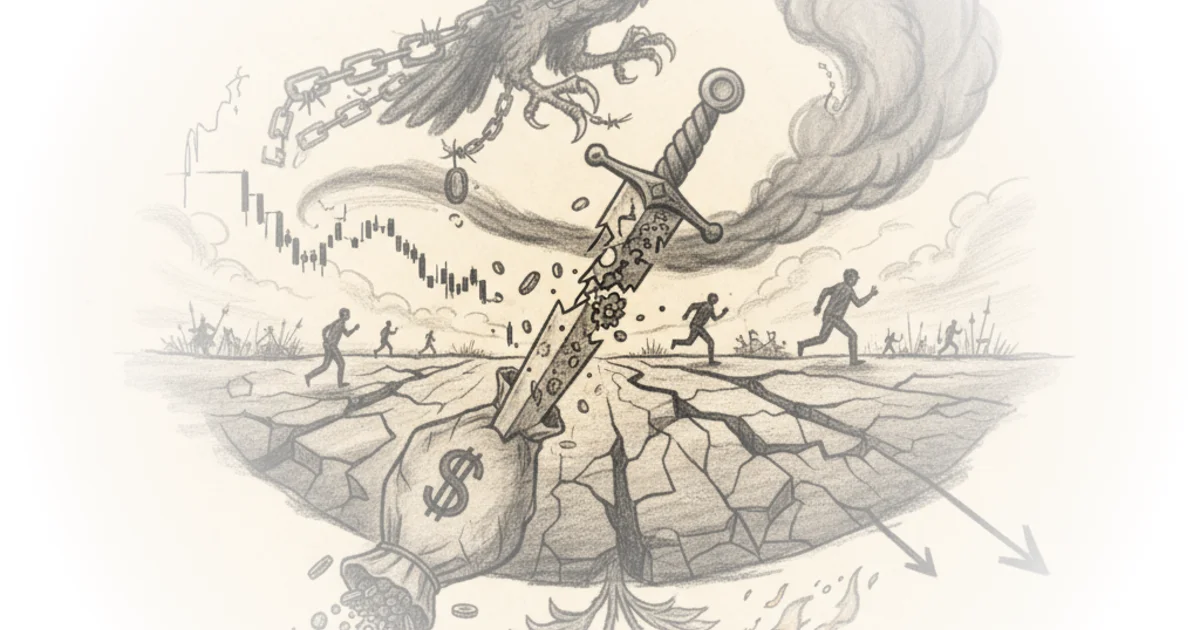
However, Coffin immediately punctures this bubble by pointing out that the U.S. is a statistical outlier. "A major war really hasn't been fought on US soil since 1865," he writes, making the American experience a poor proxy for the global norm. When you look at the 700 conflicts analyzed over the last two centuries, the data tells a grim story. For nations fighting on their own territory, the economic outcome is almost invariably negative. The author highlights that countries in this position saw an average decline in GDP per capita of 9 percentage points relative to pre-war levels.
"The outcome tends to be negative."
This distinction is crucial. Critics might argue that modern warfare is different, or that technological advancements mitigate physical destruction, but the historical data Coffin presents suggests otherwise. The destruction of capital stock—factories, farmland, and infrastructure—creates a drag that government spending simply cannot overcome. As Coffin puts it, "Large institutional improvements are the exception not the rule," and the focus on military spending often "crowds out other investments and even private consumption."
The Hidden Costs of Conflict
The commentary deepens as Coffin moves beyond simple GDP figures to the structural scars war leaves on an economy. He points out that war decimates the labor force not just through casualties, but by disrupting family formation and driving down birth rates. Furthermore, the financial burden is immense. To fund these conflicts, governments inevitably take on massive debt. "In the US, levels of taxation and debt increase during World War II and most major conflicts thereafter," he notes, with debt historically peaking by an average of 47 percentage points of GDP.
Perhaps most alarming is the inflationary pressure. When a country fights on its own soil, the median inflation rate jumps by 8 percentage points. In extreme cases, this spirals into hyperinflation, as seen in Weimar Germany. Coffin warns that even countries not directly involved in the fighting are not immune. "Countries closest to a conflict, see an average 10% decrease in GDP growth and a 5% increase in their inflation rate after 5 years," he explains. The spillover effects are profound, driven by disruptions to global supply chains and key commodities like oil.
"There's not a tremendous amount of evidence that war is in fact good for business unless again you are perfectly isolated from its costs."
This is the piece's most vital takeaway for investors. The idea that one can simply buy a defensive stock and ignore the macroeconomic rot is a fallacy. The author illustrates this with the "Price of War Calculator," which suggests that a war in Iran could cost the global economy more than double what it costs Iran itself, purely due to the impact on energy markets.
The Stock Market Paradox
Finally, Coffin addresses the specific question of equity performance. He acknowledges that stocks often react negatively to the onset of a crisis but have historically shown remarkable resilience. "The S&P 500 has taken a maximum of 307 days and an average of just 41 days to recover all its lost ground from geopolitical shocks ever since Pearl Harbor," he writes. However, he cautions against reading too much into this. The performance of the market varies wildly depending on the specific conflict, and there is no direct correlation between war activity and market valuation.
The author points out that the sectors that perform well during war often defy conventional wisdom. "Some of the strongest sectors during the Second World War had very little to do with war efforts," he notes, challenging the notion that defense contractors are the only winners. Yet, he ends with a stark reminder: "If a country sees its economy devastated, that's going to devastate investors in that economy." He cites the near-total wipeout of equity markets in Japan and Germany following their defeat in World War II as a warning that insulation is not guaranteed.
Bottom Line
Richard Coffin's analysis succeeds in separating the emotional narrative of wartime patriotism from the cold, hard arithmetic of economic destruction. His strongest argument is the empirical evidence showing that while the U.S. may have profited from wars fought elsewhere, the global norm is a severe contraction in wealth and stability. The biggest vulnerability in the "war is good for the economy" thesis is its reliance on a single, geographically isolated example. For the busy investor, the verdict is clear: war is a tax on the global economy, and the only safe harbor is a diversified portfolio that acknowledges the high cost of conflict.