David Smith delivers a stark warning: Moldova is not just a bystander in the regional conflict but a direct victim of cross-border energy warfare, facing a dual crisis of contaminated water and soaring fuel costs. The piece stands out by connecting the dots between a specific Russian strike on a Ukrainian hydroelectric station and the immediate, life-threatening silence of water taps in Moldovan cities. This is not abstract geopolitics; it is a real-time test of a small nation's resilience against an invisible, flowing enemy.
The Hydro-Environmental Crisis
Smith anchors the narrative in the immediate aftermath of the March 7th strikes on the Dniester Hydroelectric Station, a facility that serves as a critical node in the regional energy grid. He writes, "Russian Strikes Cause Oil Spill in the Nistru... The strikes began the process of a spillage of technical oil into the Nistru river which has since flowed downstream and threatened the water supplies for much of Moldova's Northeast." This framing is crucial because it shifts the blame from a natural disaster to a deliberate act of war, highlighting the fragility of shared infrastructure.
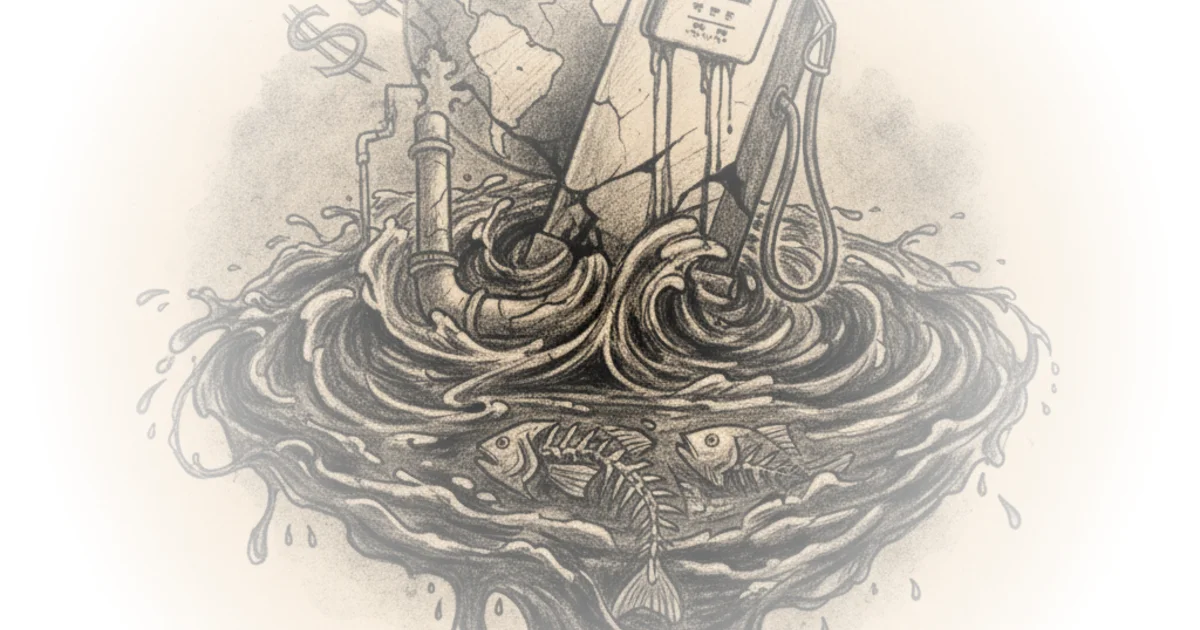
The author details the rapid escalation, noting that by March 11th, the city of Balti was forced to cut off drinking water. Smith observes, "By March 13th Moldovan, Ukrainian and Romanian teams were working to contain the oil using oil containment booms and other containment technologies." This international cooperation is a silver lining, yet the author rightly points out the opacity of the situation. He quotes Minister of Environment Gheorghe Hajder, who admitted, "We don't know exactly what happened because these hydroelectric power plants are under the jurisdiction of the Ministry of Energy and are protected by martial law."
This lack of transparency creates a dangerous vacuum of information. While the government has activated the European Union Civil Protection Mechanism to "rapid mobilize teams of specialists and the equipment necessary to manage the situation on the ground," the uncertainty remains a strategic vulnerability. The author notes that the Prime Minister, Munteanu, dispatched the army and declared a 15-day "State of Alert," a middle ground that frees resources without the full weight of a State of Emergency.
"If we now provide water to the supply network, knowing that it has petroleum substances in it, we will poison the network."
Smith captures the high stakes of the political fallout between Chisinau and Balti. When Chisinau Mayor Ion Ceban suggested supplying technical water to the network, Minister Hajder pushed back hard, calling the proposal "extremely irresponsible." The author uses this clash to illustrate the broader tension between local desperation and technical safety. Hajder's warning that oily water could take months to clean out underscores the long-term nature of this crisis. Critics might argue that the government's refusal to supply technical water leaves residents with no immediate alternative, but Smith's reporting suggests that the risk of poisoning the entire municipal network outweighs the short-term relief.
The historical context adds another layer of gravity. As Smith notes, the Dniester Hydroelectric Station is not just a power plant; it is a legacy of Soviet engineering that now faces modern warfare. The article implicitly connects this to the broader "Boom (containment)" challenges discussed in related deep dives, where the sheer volume of oil threatens to overwhelm traditional containment strategies used in previous decades.
The Economic Squeeze
Beyond the water crisis, Smith turns to the "Pain at the Pump," linking the regional instability to a sharp rise in fuel prices. He writes, "Compared to prices before the American-Israeli attack on Iran, prices for gasoline have increased 16.4% at the pump and for diesel 36.1%." This connection to events in the Persian Gulf illustrates how global shocks ripple through Moldova's small, import-dependent economy.
The author explains that the National Energy Regulatory Agency (ANRE) sets prices based on the Platts average, a formula that has become increasingly volatile. Smith quotes Minister of Energy Dorin Junghietu, who sought to calm consumers by stating, "Imports of fuel are continuing as normal and that the country maintains stocks of 22 days of LPG, 12 days of gasoline and 11 of diesel." However, the author notes that despite these assurances, the market uncertainty is driving hoarding behavior.
The government's response has been a mix of fiscal discipline and public appeals. Prime Minister Munteanu called for a 10% reduction in non-critical purchases and a 20% cut in official transportation, stating, "Public resources must be concentrated where they are truly needed: in infrastructure, in the functioning of essential state services and in maintaining economic stability." This move to lead by example is a strategic attempt to stabilize public sentiment.
"In a tense international economic context and with increasing pressures on energy and fuel prices, the state must set the first example of financial discipline and responsibility towards public money."
Smith also highlights the government's use of technology to combat panic, promoting the e-Carburanti website to show real-time fuel availability. This digital transparency is a smart countermeasure against the "run on gas stations" that often accompanies such crises. However, the author acknowledges that the rising costs are already forcing difficult decisions, such as tax support for farmers and the loss of millions in revenue for the Chisinau city hall.
Sovereignty Under Siege
The piece concludes by addressing the direct violation of Moldova's airspace. Smith reports on the nightly overflights of Shahed drones, noting that one "crash landed in a field near Tudora" and was subsequently destroyed by sappers. He quotes President Sandu, who declared, "The Russian drone discovered today in the village of Tudora, Moldova, was assessed as carrying explosives. This is a gross violation of our airspace and a threat to our citizens."
This section reinforces the central theme: Moldova is a frontline state. The author connects this to the broader foreign policy efforts, including President Sandu's visit to Lithuania, where she emphasized the shared history of Soviet occupation. Smith writes, "We simply found ourselves in an empire that we had never chosen," a poignant reminder of the historical context that shapes current security threats.
The article also touches on the internal political friction in Gagauzia, where a dispute over the name of the electoral body has delayed elections. Smith notes that the People's Assembly passed a resolution to set the election date for June 21st, but the Ministry of Justice has appealed to the Constitutional Court. This internal instability, while distinct from the oil spill, adds to the sense of a nation under pressure from multiple fronts.
"We simply found ourselves in an empire that we had never chosen."
Critics might argue that the focus on external threats overshadows the need for internal political reform, particularly in regions like Gagauzia. However, Smith's narrative suggests that the external pressure is exacerbating internal divisions, making the resolution of these political crises even more urgent.
Bottom Line
David Smith's coverage is a masterclass in connecting immediate environmental disaster to broader geopolitical strategy, revealing how a single strike can trigger a cascade of crises in a vulnerable nation. The piece's greatest strength is its refusal to treat the oil spill as an isolated incident, instead framing it as a symptom of a larger war on infrastructure. The biggest vulnerability lies in the uncertainty of the cleanup timeline and the potential for the crisis to deepen if Chisinau's water supply is compromised. Readers should watch closely for the next phase of the EU Civil Protection Mechanism's deployment and any signs of escalation in the Gagauz political dispute.