Architecture as Puzzle, Not Solution
Carlos H. Matos occupies an unusual position in contemporary architecture. Based in Mexico City, trained as an architect, and descended from two generations of architects, he nonetheless resists the label in its conventional sense. For Matos, architecture is not a profession so much as a medium -- one that bleeds freely into sculpture, material experimentation, and what might be called archaeological speculation. In a conversation filmed at his studio, he lays out a practice that is less about building things and more about making people wonder what they are looking at.
The central tension in his work is between legibility and mystery. He wants his pieces to provoke interpretation without rewarding it. As he puts it:
I guess a successful piece for me is the one that triggers people into trying to resolve or identify the puzzle that is inherited in the pieces and the things that are only slightly being suggested in it.
This is a deliberately frustrating aesthetic proposition. Where most architects and sculptors aim to communicate -- a function, a feeling, a concept -- Matos aims for something closer to productive confusion. His pieces should look like they mean something, but they should never confirm what.
The Grandfather's Mobius House
The biographical throughline is compelling. Matos grew up in a house that was perpetually under construction, built by a father who was himself an architect. His grandfather, a functionalist who later turned experimental, built a house on a triangular grid organized around a Mobius form -- a continuous loop threading through the structure. For Matos, this was formative not because of the specific geometry but because of what it represented: architecture as an ongoing, obsessive investigation rather than a finished product.
My grandfather, although he was a functionalist, he later evolved into a much more experimental and sculptural approach, and in his house I think is where he actually manifested all of the ideas that he wanted to develop.
There is something almost too neat about this origin story -- the architect-artist who inherits his sensibility from a grandfather who was also an architect-artist. But the detail about the Mobius house is genuinely interesting. A functionalist who abandons functionalism for sculptural experimentation in his own home is making a statement about the limits of his profession. Matos has inherited that restlessness.
Mexico's Double-Edged Freedom
The most provocative moment in the conversation comes when Matos addresses why Mexico has been so fertile for architectural experimentation. His answer is bracingly honest and uncomfortable:
Mexico is a place that enables experimentation because of, you could say, lack of regulation or corruption. But there is an inherent freedom in a place like Mexico where a lot of people have come here historically because there is that possibility to explore out of regulation or other limits.
He goes further, acknowledging the destructive flip side of that freedom:
There's also a lot of destruction of the heritage, which is unfortunate, but I guess the freedom to destroy that heritage and to knock down a building that is worth preserving and opening up another shopping center or something like that is the same freedom that all these architects and artists have at the same time to create something propositive and also to reinvent the culture itself.
This is a rare admission. Most architects working in developing countries either romanticize the lack of regulation (celebrating the creative freedom it affords) or lament it (mourning the heritage it destroys). Matos does both simultaneously, recognizing that these are not separate phenomena but the same phenomenon producing opposite outcomes. The deregulation that allows a developer to demolish a colonial-era building is the same deregulation that allows an artist to build a pre-Hispanic sweat lodge in upstate New York without a committee approving every detail.
A counterpoint worth raising: this framework can become a convenient justification for the very corruption Matos names. The freedom to experiment is not evenly distributed. Wealthy architects and artists benefit from regulatory gaps in ways that poor communities -- whose heritage is being demolished for shopping centers -- decidedly do not. Matos seems aware of this asymmetry but does not quite reckon with it.
The Temazcal in New York
The most concrete project Matos describes is a temazcal -- a pre-Hispanic sweat lodge -- commissioned for an artist residency in upstate New York. Five years in the making, the structure reinterprets the traditional circular form. It sits on the ledge of a pond, controls the water level, and creates a waterfall on its back side. Where traditional temazcales are dug into the ground so that participants must crawl inside, Matos's version has a compressed doorway but does not require crawling. It is pitch black inside, with controllable light and an integrated sound piece that dictates the stages of the ritual.
The project is interesting precisely because it sits at the intersection of Matos's stated interests: architecture as infrastructure (it controls water flow), architecture as sculpture (its form in the landscape), and architecture as cultural investigation (the pre-Hispanic ritual it houses). He is careful to note that the project is not politically motivated but rather an act of drawing inspiration from heritage:
It's something kind of vital and necessary, you know, when you're from here, also to understand your context, I guess.
The qualifier "I guess" is telling. Matos resists definitive statements about meaning with the same stubbornness he brings to his sculptural work. Even when discussing cultural heritage, he prefers ambiguity.
Materials That Refuse to Be Named
Matos works primarily in concrete and milled aluminum -- materials chosen for their capacity to confuse. Concrete can be made to look like stone, metal, or resin. Aluminum components add a futuristic precision that contradicts the primitive texture of the concrete. The goal, again, is illegibility:
I really enjoy not being able to fully understand -- like, people not being able to fully understand how something is made. People were speculating whether it's stone, which is a more obvious speculation, but people were suggesting it could be metal or resin, and I like that idea of people not being able to pin down what it is.
This approach to materials mirrors his approach to form and meaning. Everything in Matos's practice is oriented toward a single effect: the viewer's inability to resolve what they are seeing. His pieces are designed to look ancient and futuristic, handmade and machine-cut, functional and purely abstract -- all at the same time.
The risk, of course, is preciousness. An art practice built entirely on ambiguity can become its own cliche, a refusal to commit disguised as intellectual sophistication. At what point does productive confusion become mere obfuscation? Matos does not address this, and the conversation does not push him on it. But his best work -- the temazcal, with its genuine functional and cultural purposes -- suggests he is most compelling when the ambiguity serves something beyond itself.
Working Without a Brief
One of Matos's more interesting observations concerns the difference between architectural and sculptural practice. Architecture, he notes, begins with a brief -- a problem to be solved. Sculpture allows him to work "more blindly," following intuition and material experimentation rather than a defined outcome. He describes collecting objects -- old rocks, archaeological fragments, tools -- that possess what he calls an "aura" of their usage and time.
I like to think a lot of my work like it's a puzzle that somehow needs to be resolved, and I think the longer the span in time, the broader chances for speculation there is.
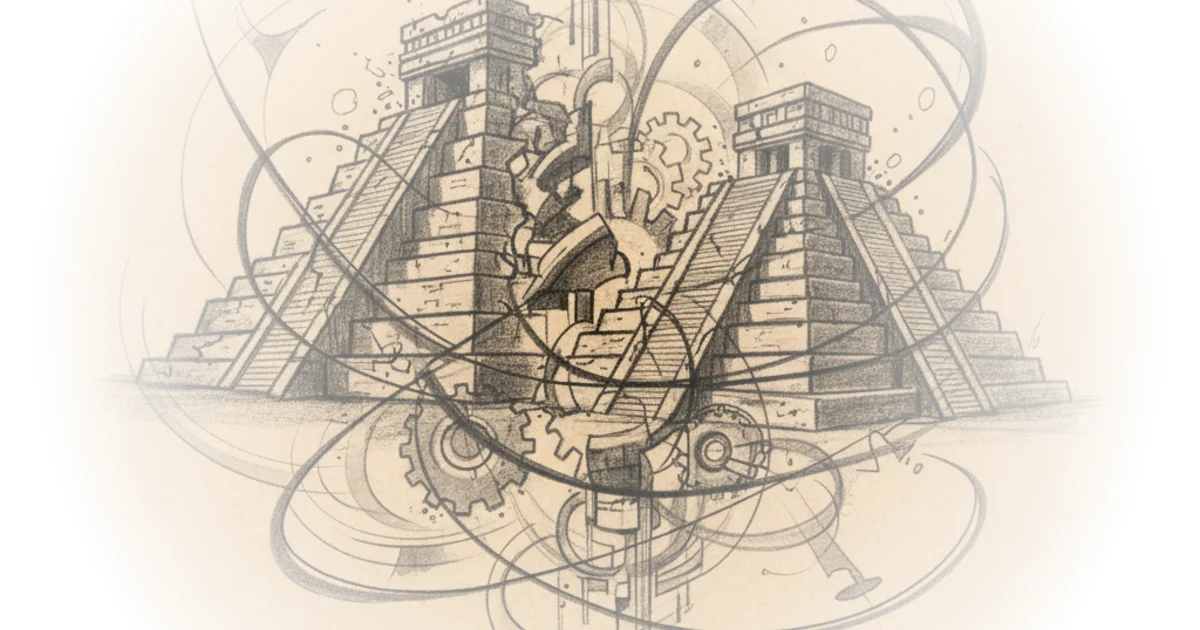
This is the clearest statement of his aesthetic philosophy: he wants to make things that look like they have existed for an indeterminate amount of time, objects that could be artifacts from a lost civilization or prototypes from an imagined future. The childhood visits to Mexican archaeological sites -- where massive civilizations are reduced to abstract ruins that visitors must puzzle over -- clearly inform this ambition.
Bottom Line
Carlos H. Matos is building a practice around the idea that the best architecture refuses to explain itself. His work is most persuasive when it combines this philosophical commitment to ambiguity with genuine material ingenuity and cultural depth, as in the temazcal project. It is least persuasive when ambiguity becomes an end in itself -- when the refusal to be pinned down starts to feel like there is nothing underneath to pin. His frank acknowledgment of Mexico's paradoxical creative freedom -- born of the same deregulation that destroys heritage -- is the most intellectually honest moment in the conversation, and the one that deserves the most scrutiny. Whether Matos can sustain a career-length investigation of the unsolvable puzzle remains to be seen, but the questions he is asking about architecture's relationship to time, meaning, and legibility are worth asking.