While Silicon Valley descends into existential panic over the imminent arrival of superintelligence, Alberto Romero offers a jarringly pragmatic antidote: treat artificial intelligence not as a god, but as a screwdriver. In a landscape saturated with doomerism and hype, Romero's central claim is that the "ontological uncertainty" paralyzing tech workers is a self-inflicted wound, distracting us from the tangible utility of tools that already exist. This is a necessary corrective for anyone feeling the tremors of the current AI boom, urging a shift from speculative dread to immediate application.
The Bubble of Existential Dread
Romero begins by dissecting the frenetic atmosphere of San Francisco, where a recent viral observation by venture capitalist Deedy Das highlighted a deep malaise. Das noted that while a small elite has achieved retirement-level wealth, the broader workforce faces a terrifying ambiguity: "The divide in outcomes is the worst I’s ever seen... Many software engineers feel like their life’s skill is no longer useful." Romero argues that while Das framed this as a financial crisis, the root cause is far more psychological. He cites former OpenAI researcher Nick Cammarata and rationalist Quiaochu Yuan to illustrate that the anxiety isn't about money, but about the "foreshocks of the singularity."
"The money is the concrete manifestation of a much larger eldritch hyperobject roaring into existence. The stormclouds gather. The winds whip. The world holds its breath."
Romero contends that this "SF bubble" creates a feedback loop where fear of the future prevents engagement with the present. He suggests that for those outside the epicenter, this anxiety is a "psychological infohazard"—a paralyzing truth that, even if true, renders you incapable of acting. This framing is effective because it reframes the "permanent underclass" narrative not as an inevitable economic outcome, but as a mindset that blocks agency. However, critics might note that dismissing these fears as purely "ontological" risks underestimating the very real structural shifts in labor markets that are already displacing workers, regardless of whether they believe in the singularity.
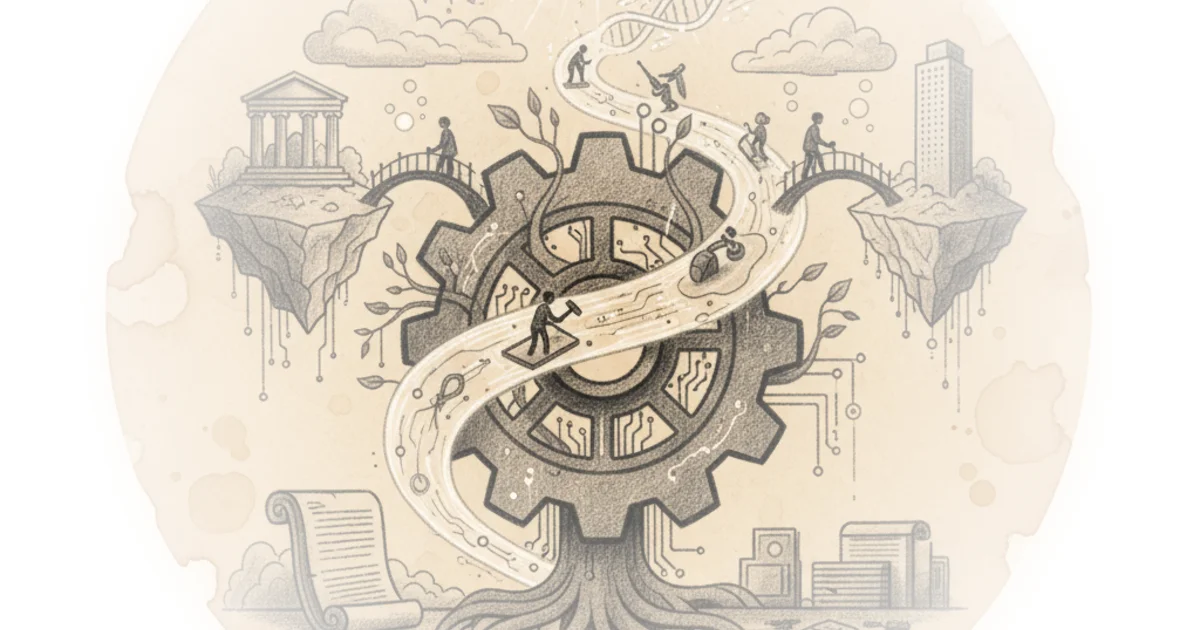
The Screwdriver Principle
To combat this paralysis, Romero proposes a radical simplification: "You must fight the appeal of the SF bubble." He urges readers to separate AI as a tool from AI as a civilization-altering event. The core of his argument rests on the historical reality that the distance between invention and widespread impact is always longer than it appears. He invokes Amara's Law—"People tend to overestimate the effect of a technology in the short run and underestimate its effect in the long run"—to argue that while innovation is fast, adoption is slow due to human friction and bureaucracy.
"Even if superintelligence is eventually real, it’s not synonymous with omniscience or omnipotence. Like you and me, it will have to wait for the electrician."
This is a crucial distinction. Romero points out that even if the technology is revolutionary, the "bottleneck for effective change doesn't disappear; it moves somewhere else." He draws a parallel to the companion topic of "Information hazard," suggesting that worrying about the distant future is a trap. Instead, he champions the "screwdriver" analogy: "Whatever may happen next, it doesn’t retroactively influence what you can do today." The argument here is that the gap between current capabilities and human imagination is the real opportunity, not the gap between current AI and hypothetical superintelligence. By focusing on the tool, we reclaim our agency.
The Distortion of Proximity
Romero is particularly sharp when critiquing the voices closest to the technology. He argues that industry leaders like Dario Amodei and Sam Altman are often the worst judges of AI's meaning because they are "high on their own supply." Their warnings about existential risk or mass unemployment, he suggests, are strategic moves to influence regulation and investment rather than reflections of ground-level reality.
"They live inside the SF bubble, and so they see the future in real time—a distorted one at that—but perceive nothing about the present. They are tone-deaf."
He contrasts this with the reality outside Silicon Valley, noting that in places like Spain, "there’s literally no trace of AI anywhere." This observation serves as a powerful reality check against the media narrative. While Romero's dismissal of industry warnings as mere "hype-y anti-hype" is a bold stance, it requires nuance; these leaders do hold unique insights into technical trajectories, even if their public messaging is often performative. Nevertheless, his call to ignore the "fictions coming out of SF" is a vital reminder to evaluate technology based on its actual utility, not its marketing.
Reclaiming the Human Element
Finally, Romero addresses the ultimate question of purpose in a post-work world. He argues that even if AI becomes a "normal technology" that transforms the economy, it cannot conquer the "sacred places" of human experience. He quotes philosopher Shannon Vallor to challenge the notion of "superhuman" machines, asking, "Doesn’t granting the label ‘superhuman’ to machines that lack the most vital dimensions of humanity end up obscuring from our view the very things about being human that we care about?"
"Humans like humans. I don’t want to kiss a robot, however perfect the robot or the kiss might be."
This section ties back to the theme of "Post-work society" by suggesting that the solution isn't to fear the end of labor, but to recognize that our value lies in our imperfections and connections. Romero's conclusion is that we should stop viewing ourselves as "kings losing our kingdom" and start relishing the very human traits that AI cannot replicate. It is a comforting, if somewhat idealistic, counter-narrative to the cold efficiency of the algorithm.
Bottom Line
Romero's strongest contribution is the pragmatic reframing of AI anxiety as a barrier to utility, urging readers to focus on the "screwdriver" in their hand rather than the "god" in the clouds. However, the argument's vulnerability lies in its potential to minimize the immediate, non-existential economic disruptions that are already occurring for many workers. The most valuable takeaway is not to ignore the future, but to refuse to let a speculative future rob you of the present. Watch for how this "normal technology" framing holds up as the gap between AI's promise and its reliability continues to narrow.