Rafael Holmberg challenges a dominant narrative in contemporary continental philosophy, arguing that reality is not broken or unfinished, but dangerously over-saturated. In a field often obsessed with what is missing, Holmberg makes the surprising claim that the true crisis of our time is not a gap in knowledge, but a surplus of contradiction that systems cannot process. This is not merely an academic squabble; it reframes how we understand the collapse of meaning in physics, theology, and the human psyche.
The Trap of Incompleteness
Holmberg begins by dismantling the popular reading of Slavoj Žižek, who posits that quantum physics and Hegelian dialectics prove the universe is ontologically incomplete. According to Holmberg, this view reduces complex systems to simple failures. "Žižek's uniting theme across Hegel, Lacan, and quantum mechanics is that epistemological insufficiency is in fact ontological incompleteness," Holmberg writes. He argues that this interpretation misses the forest for the trees, suggesting that our inability to fully map reality does not mean reality itself is a patchwork job.
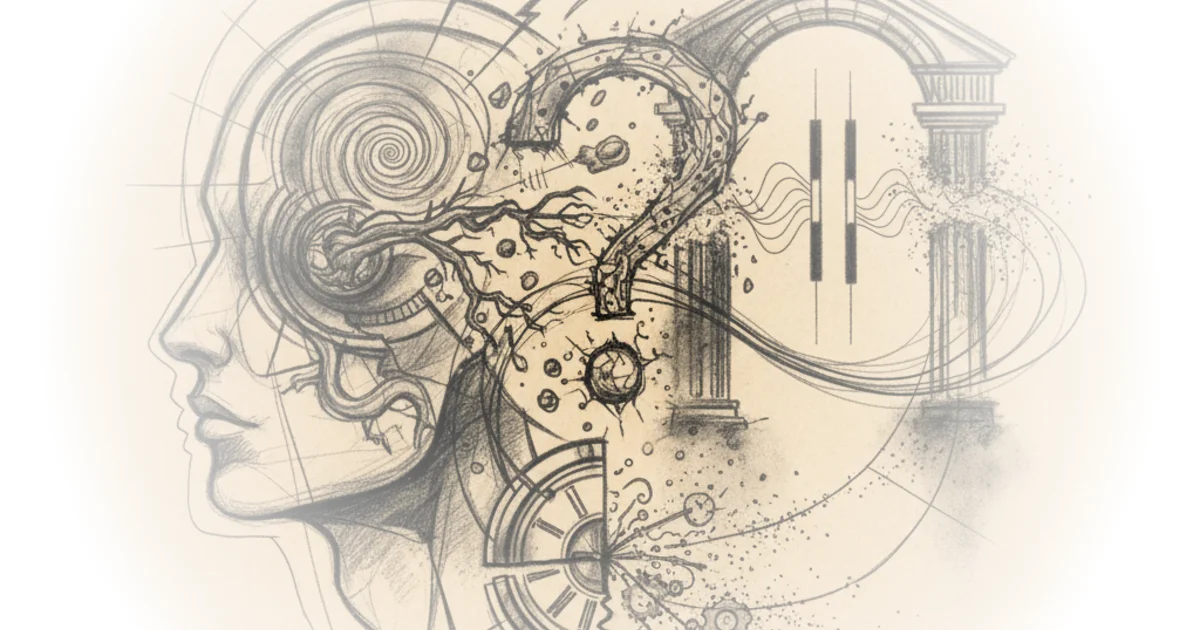
Instead, Holmberg proposes a far more unsettling alternative: hyper-completeness. He suggests that systems like language, logic, and the subatomic world are so dense with internal rules that they generate their own contradictions. "These ontological systems are not incomplete, they are what I would call hyper-complete: they are structured by conceptual systems that are in a perpetual overestimation, or non-identity, with themselves," he explains. This distinction is crucial because it shifts the blame from a lack of data to an excess of structure. The problem isn't that the code is missing lines; it's that the code is running too many loops at once.
The Real is not a simple remainder of the process of symbolisation, but a distortion of the Symbolic that is produced by the Symbolic itself.
Critics might argue that Holmberg's distinction between "incompleteness" and "indeterminacy" is a semantic hair-splitting exercise that changes nothing for the practicing scientist or the suffering individual. However, Holmberg insists the stakes are high: viewing the world as incomplete invites us to keep trying to fix it, while viewing it as hyper-complete forces us to confront the fact that the system is working exactly as designed, just in a way that is fundamentally unintelligible to itself.
The Reckless Automaton
The argument takes a sharp turn toward theology and political economy when Holmberg critiques Žižek's depiction of God. In Žižek's framework, God is a "lazy programmer" who left holes in reality that we are only now discovering. Holmberg finds this image too passive. If reality is hyper-complete, then the creator is not lazy, but recklessly over-invested. "God is not so much lazy as he is reckless. To be reckless does, after all, take more energy than to be lazy," Holmberg asserts.
He reimagines the divine not as a distant architect, but as a chaotic force that generates more reality than it can contain. This leads to a striking metaphor for the modern condition: "God is not simply a lazy programmer - he's an irresponsible automaton." In this view, the universe is like a late-capitalist system that has automated itself into a frenzy, producing endless antagonisms that the system itself cannot understand or account for. The "holes" in our understanding are not errors; they are the exhaust fumes of a machine running at maximum capacity.
This framing effectively bridges the gap between abstract metaphysics and the tangible chaos of the modern world. By replacing the "lazy God" with the "irresponsible automaton," Holmberg captures the feeling of living in a system that seems to have a will of its own, generating crises that no single human or institution can solve. "The reality furnished by God is a reality that produces an endless series of antagonisms," he notes, suggesting that the instability we feel is a feature, not a bug.
Indeterminacy as the Core
Holmberg extends this logic to quantum physics, challenging the idea that the observer's inability to pin down a particle proves the particle doesn't exist or is incomplete. He argues that the uncertainty is a product of the system's own density. "Whether we argue that the function of consciousness is entirely incalculable, or whether we argue that observation internally determines the observed thing, the crux of quantum entanglement is indeterminacy," he writes.
The core of his argument is that indeterminacy is not a failure of measurement, but a fundamental property of a "hyper-complete" reality. "Incompleteness implies that whatever problem there is with reality, it is subordinate, a simple failed programming. Indeterminacy, however, is based on the fact that reality is too complete for its own good, that it is all too real." This is a profound shift in perspective. It suggests that the universe is not waiting for us to finish the puzzle; the puzzle is actively generating new pieces faster than we can assemble them.
Reality is, in other words, far too real for reality itself to make sense of.
Bottom Line
Holmberg's strongest move is reframing the crisis of modernity not as a lack of truth, but as an overload of it. His argument that systems are "hyper-complete" offers a compelling explanation for why our most advanced theories in physics and philosophy often feel like they are spinning their wheels. The biggest vulnerability in his approach is the sheer density of the language, which risks alienating readers who are looking for practical solutions rather than metaphysical diagnoses. Ultimately, the piece demands that we stop trying to fill the gaps and start learning to navigate the storm of excess.