"We tell ourselves stories in order to live with ourselves" is not a celebration of literature; it is a searing indictment of how the literary world uses narrative to sanitize its own complicity in global violence. Matthew Clayfield arrives at the Ubud Writers & Readers Festival not to find magic, but to expose the "kitschy magic" of storytelling that often serves as a shield against the body count of real-world atrocities.
The Illusion of Narrative
Clayfield immediately dismantles the romanticized view of storytelling that dominates modern cultural festivals. He observes that we have become "a little bit silly when it comes to our relationship with stories," often invoking them with an "air of glamour and celebration" that feels entirely disconnected from the grim realities of war and genocide. As he puts it, the "sacredness we ascribe to storytelling... often smacks too much of the spiritual retreat for me, too much of the scented candle aisle." This framing is crucial because it challenges the reader to question whether the empathy generated by a novel or a speech actually translates to action, or if it merely allows us to feel virtuous while doing nothing.
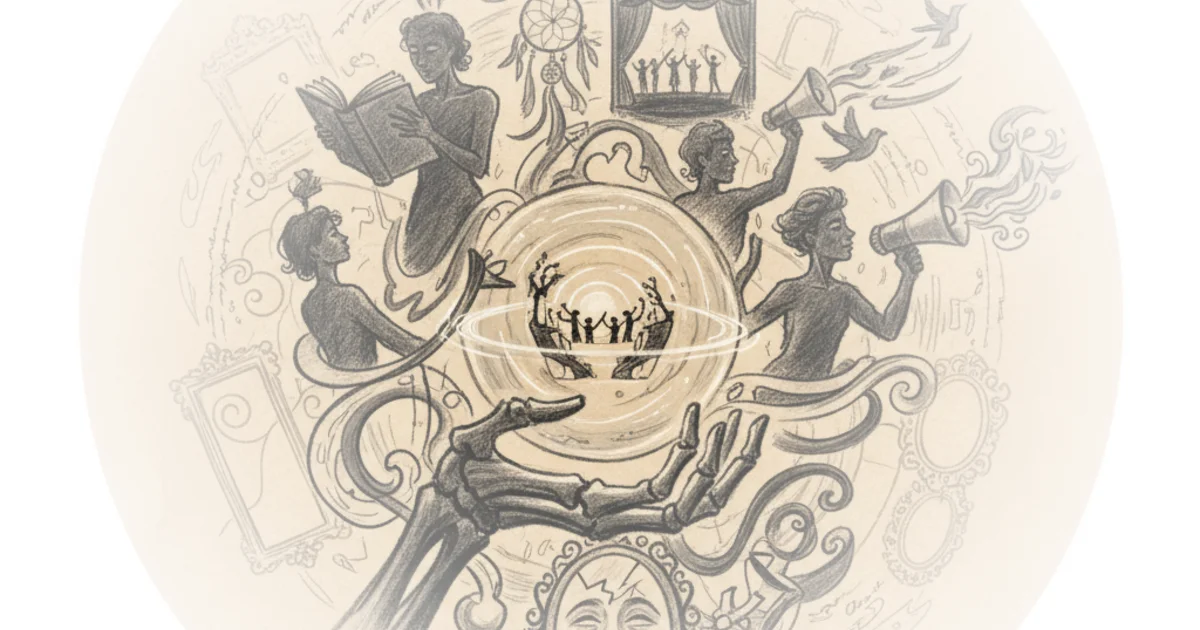
The author argues that stories are not inherently good; they are tools that can be used to impose order on chaos or to obscure the truth. He notes that storytelling is "as much a reflex of the right as it is of the left," and warns that "stories got us into our current spate of predicaments as much as anything else did." This is a bold claim, suggesting that the very act of narrative construction can be a form of evasion. It recalls the historical context of New Order Indonesia, where the state's rigid, singular narrative about stability and development was used to justify the brutal suppression of dissent and the erasure of history, a parallel that underscores how dangerous a "single story" can be when enforced by power.
"Neither the moral weight we ascribe to storytelling nor the role we too often claim for it as an empathy-generating machine is backed up by the evidence of the body count."
Clayfield's critique extends to the specific cultural landscape of Australia, which he describes as "genteel, predictable affairs" where truth is spoken "politely and preferably without an accent." He contrasts this with the "cacophony" of voices at Ubud, where the festival's "fearless emphasis on anti-genocide and pro-Palestinian voices" offered a "welcome reprieve from the overwhelming whiteness and too-frequent timidity" of Western cultural programming. This shift in focus is significant; it moves the conversation from the abstract power of words to the concrete necessity of hearing voices that are often silenced or marginalized in Anglophone spaces.
The Cost of Privilege
The commentary takes a sharp turn as Clayfield confronts the uncomfortable reality of the festival itself: it is an event of immense privilege held in a location that many tourists treat as a "vast theme park." He admits that the experience of sitting in a "gilded hall" drinking cocktails while listening to poets speak of slaughter is "kind of grotesque in context." The author does not let the audience off the hook, noting that the festival "wants to monetise that privilege, and therefore constantly appeals to and rewards it."
This tension is palpable when he describes the "champagne socialism" of the attendees, who feel "smart and cultured" while paying thousands of dollars for fundraising dinners. Clayfield writes, "It felt all too easy to sit there and nod, self-righteous, as though that were actually doing something." This self-reflection is the piece's moral core. It forces the reader to acknowledge that listening to a story about suffering does not absolve one of the responsibility to act, and that the very act of consuming these stories can become a form of indulgence.
"We don't tell ourselves stories in order to live so much as we tell them in order to live with ourselves."
The author highlights the presence of writers like Omar El Akkad and Ghayath Almadhoun, whose anger is "so quiet, so pent up in their bodies, that you can't look away from them." Their presence serves as a counterweight to the festival's luxury, reminding everyone that "every poem is a grave at this point." Critics might argue that this perspective is too cynical, suggesting that art and storytelling have intrinsic value regardless of their immediate political impact. However, Clayfield's point is not that art is useless, but that it cannot replace the urgent need for justice and that the celebration of art in the face of ongoing genocide risks becoming a form of moral evasion.
The Power of Voice Over Story
Despite the critique, Clayfield finds hope in the "fearless emphasis" of the festival's programming, particularly in its focus on Indonesian issues and the reckoning with the Suharto era. He notes that the festival was "entirely free of either both-siderism or whataboutism," allowing for expressions of anger and grief without the need for "throat-clearing or self-flagellation." This stands in stark contrast to the "parochialism" of Australian festivals, where writers are often expected to conform to a polite, middlebrow sensibility.
The author draws a parallel to the history of Western New Guinea, where the struggle for self-determination has been long obscured by the dominant narratives of the Indonesian state. By centering these voices, the festival does more than just tell stories; it challenges the official histories that have been used to justify decades of conflict and oppression. Clayfield writes, "It was a festival entirely free of either both-siderism or whataboutism. It didn't demand any throat-clearing or self-flagellation prior to expressions of anger or grief." This refusal to sanitize the narrative is what makes the event a "breath of fresh air" for those weary of the sanitized discourse of the West.
"I'm just telling you to live in it. Not just to endure it, not just to suffer it, not just to pass through it, but to live in it. To look at it. To try to get the picture."
The piece concludes with a call to action, urging readers to "look at it" and "try to get the picture" of the world as it is, not as we wish it to be. This final invocation of Joan Didion's words serves as a reminder that the goal of storytelling is not to escape reality, but to engage with it fully, even when that engagement is painful.
Bottom Line
Matthew Clayfield's piece is a powerful reminder that storytelling, when divorced from the reality of human suffering, can become a tool of self-deception rather than a vehicle for truth. Its greatest strength lies in its unflinching critique of the literary world's complicity in masking the horrors of war with the "kitschy magic" of narrative. The piece's vulnerability is its potential to alienate readers who believe in the redemptive power of art, but this tension is precisely what makes the argument so necessary and urgent.