Chris Chappell delivers a rare, on-the-ground account of Hong Kong's National Day protests that cuts through official narratives by documenting the stark contrast between Beijing's military spectacle and the city's paralyzed reality. While the world watches tanks roll in the capital, Chappell reports from a Hong Kong where the government has effectively locked down the city to prevent dissent, creating a tense atmosphere where everyday life collides with political defiance.
The Architecture of Control
Chappell opens by highlighting the absurdity of the situation: a celebration of the Communist Party's 70th anniversary coinciding with a massive, unauthorized gathering in Hong Kong. He notes that while the mainland celebrates with a grand military parade, "the hospital government and the like they basically shut down most of the transportation." This strategic paralysis is the administration's primary tool; by disabling the Mass Transit Railway (MTR) and blocking major malls, the executive branch attempted to strangle the protest before it began.
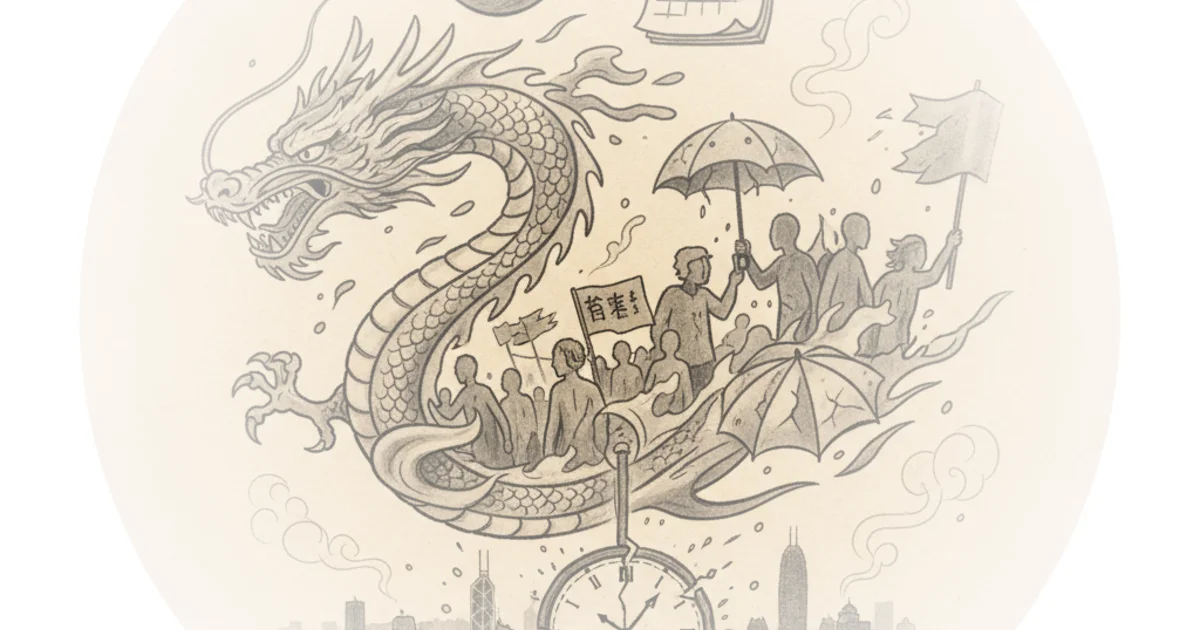
The commentary effectively reframes the narrative from a simple clash of ideologies to a logistical battle. Chappell observes that despite these barriers, "a lot of them took the time... we were actually surprised that so many people managed to show up." This resilience underscores a critical point: the administration's heavy-handed tactics, including warnings of potential terrorism, failed to deter the public. Instead of quelling the unrest, the intimidation tactics appear to have galvanized a diverse crowd, ranging from the elderly to young students, many of whom were prepared with gas masks.
"The government would say that there are tens of people... I really wonder how this is gonna be swung in like the papers and in the Chinese media if they're even going to mention another try and spin it."
This skepticism toward official state media narratives is a recurring theme. Chappell points out the irony of a digital display celebrating the party's anniversary standing just yards away from protesters who have defaced it with graffiti and trash bags. The visual juxtaposition serves as a powerful metaphor for the disconnect between the state's projection of strength and the ground-level reality of dissent.
The Evolution of Symbolism
One of the most distinctive elements Chappell captures is the creative, almost surreal nature of the protest's symbolism. He details how protesters have co-opted internet culture, specifically the "Pepe the Frog" meme, transforming it into a localized symbol of resistance. He clarifies a crucial nuance often missed by Western observers: "to be clear Pepe the Frog in Hong Kong has been it doesn't mean what doesn't mean what it means in the US." In this context, the meme is stripped of its alt-right associations in America and repurposed as a tool for solidarity and defiance.
The coverage also highlights the protesters' sophisticated use of historical and artistic references. Chappell describes a banner that is a "riproof of the Liberty leading the people," a famous French Revolution painting, signaling a desire for universal suffrage and freedom. Furthermore, the act of throwing "paper money for the dead"—joss paper traditionally used for ancestors—is interpreted as a direct insult to the ruling party, signaling that the protesters view the regime as something to be mourned or exorcised.
Critics might argue that relying on internet memes and parody songs risks trivializing the serious human rights concerns at stake. However, Chappell suggests these symbols serve a vital function: they allow a fragmented society to find common ground and maintain morale in the face of overwhelming state power. The adoption of these symbols demonstrates a movement that is not just reacting to police presence but actively constructing a new cultural identity.
"They're really targeting the Chinese Communist Party as the big bath sort of the final boss."
This framing of the political struggle as a battle against a monolithic "final boss" simplifies complex geopolitical dynamics, yet it resonates deeply with the protesters' sense of urgency. Chappell also touches on the linguistic shift in the city, noting that Mandarin has surpassed English as the second most spoken language due to state pressure, yet many locals still harbor a nostalgic, if complicated, view of the British era—not necessarily to return to colonialism, but to recall a time when the "Sino-British Joint Declaration" was a binding promise of autonomy.
The Human Cost
Beyond the politics, Chappell's reporting grounds the story in human experience. He describes a frazzled woman dragging luggage and walking a dog, trying to navigate a city where the police have occupied skybridges, forcing pedestrians to cross busy highways. These vignettes illustrate the collateral damage of the administration's strategy. The police, while initially hesitant to use tear gas in this specific area, have been reported to deploy it in other districts like Sha Tin, creating an environment where "there is always a chance we might have to end this very quickly."
The coverage also notes the protesters' discipline in clearing paths for emergency vehicles, a detail that counters the administration's narrative of the demonstrators as violent rioters. Chappell observes, "this is why you see how protesters make very very rapidly for emergency vehicles," highlighting a moral clarity that stands in contrast to the government's heavy-handed warnings.
Bottom Line
Chappell's on-the-ground reporting succeeds in humanizing a complex geopolitical standoff, revealing a society where the administration's attempts to control the narrative have only deepened the resolve of the populace. The piece's greatest strength lies in its ability to capture the absurdity and creativity of the resistance, from meme culture to artistic protests, while its main vulnerability is the inherent difficulty of predicting how the central government will escalate its response to such persistent, decentralized defiance. The world should watch not just for the next military parade, but for how the administration chooses to dismantle a protest that has already proven immune to intimidation.