This piece cuts through the noise of standard geopolitical analysis to ask a disturbing question: what if the American executive branch isn't just failing to help the underdog, but is actively rooting for the giant? Timothy Snyder, channeling the insights of Ukrainian journalist Nataliya Gumenyuk, argues that the persistence of a "David versus Goliath" narrative has become a trap, masking a deeper psychological preference within the White House for the victory of brute force over ingenuity.
The Trap of the Archetype
Gumenyuk, whose voice Snyder amplifies, begins by dismantling the comforting story we tell ourselves about the Russo-Ukrainian war. She notes that the metaphor of a small nation fighting a vast aggressor resurfaces "each time we have to deal with another burst of so-called 'negotiations,'" often serving as a pretext for demanding concessions that the battlefield reality does not justify. The core of her argument is that this archetype blinds observers to the actual correlation of forces. When the White House insists that Ukraine must cede the entire Donetsk region—a sector Russia has proven incapable of taking militarily—it is not acting on logic, but on a stereotype that assumes the big must always crush the small.
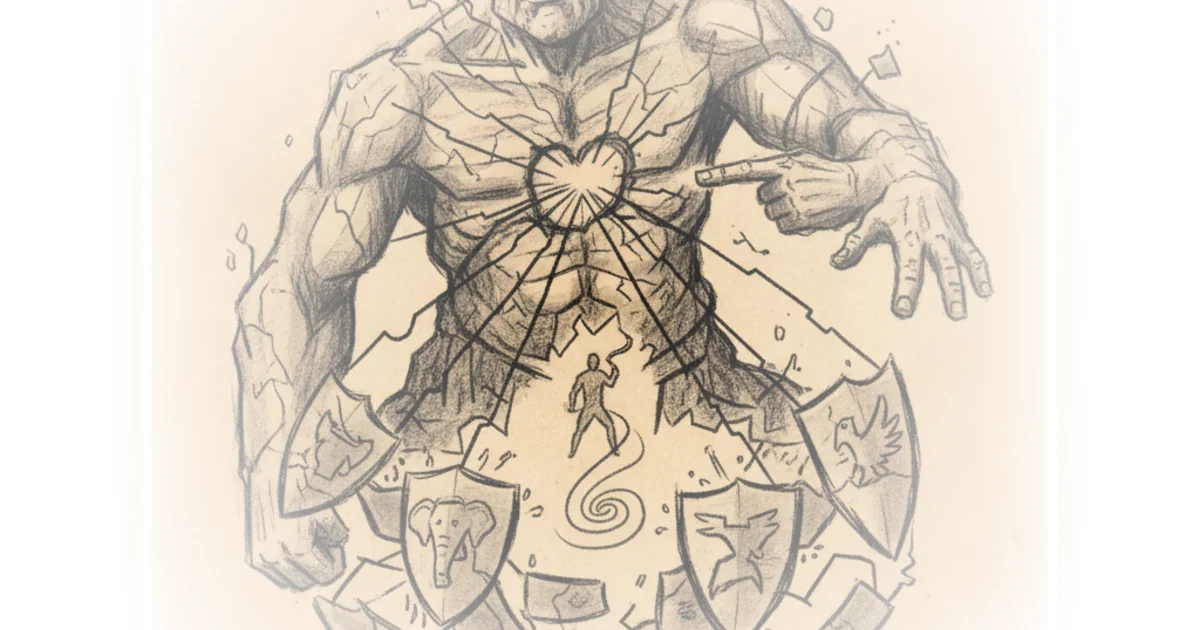
Snyder highlights how this dynamic plays out in the Oval Office, where the administration's mood often dictates policy regardless of facts on the ground. "If Russia is a Goliath, if that image is what matters, then Ukraine's arguments and indeed the actual correlation of forces on the battlefield do not matter," Gumenyuk writes. This is a devastating critique of how foreign policy is currently being conducted: not as a strategic calculation of interests, but as a performance of power dynamics where the underdog is expected to lose. The administration's insistence on a ceasefire that would freeze Russian gains ignores the reality that such a move would merely grant Moscow time to rebuild, a scenario that favors the aggressor while punishing the victim.
"We are seeing affirmative action for Goliath."
Critics might argue that the administration is simply being pragmatic, seeking to avoid escalation in a nuclear-armed conflict. However, Gumenyuk's analysis suggests that the push for concessions often aligns too perfectly with Russian demands, such as the desire to take Donetsk without a fight, to be dismissed as mere caution. It suggests a worldview where the status quo of power is preferred over the disruption of justice.
When the Underdog Wins, the Giant Loses
The commentary takes a sharp turn when examining the administration's reaction to actual Ukrainian successes. Gumenyuk details "Operation Spiderweb," a deep-strike campaign in early June 2025 where Ukraine's Security Service (SBU) targeted Russian airfields, inflicting billions in damage and striking a significant portion of the strategic bomber fleet. Logically, this should have been a moment of triumph for the "David" narrative. Instead, the reaction from the White House was one of blame.
After a phone call with the Russian leader, the American president stated that Russia "will have to respond to the recent attack on the airfields," effectively blaming Ukraine for provoking the giant. "His reaction to Operation Spiderweb, such as it was, seemed to arise not from the event itself, not from what David had done, but from what Goliath had to say about it," Snyder observes. This reversal is crucial: it suggests that for some in power, the success of the underdog is not a victory to be celebrated, but an irritation to be suppressed. The administration appears to prefer a world where hierarchies are respected and the powerful are not challenged.
This behavior echoes the historical pattern of appeasement, where concessions are made to a rising aggressor in the hope of maintaining order, a strategy that failed catastrophically in the 1930s. Just as the West once hoped to satiate a hungry giant with the blood of smaller nations, the current dynamic sees Ukraine being asked to sacrifice its sovereignty to soothe the ego of a powerful adversary. "The whole traditional scheme, the whole moral scheme, the whole archetype of David-versus-Goliath seems itself to be hurting Ukraine," Gumenyuk concludes. The very story we tell to inspire hope is being weaponized to demand surrender.
The Psychology of the Sling
Snyder and Gumenyuk arrive at a profound psychological conclusion: the resistance to the David narrative is not about strategy, but about identity. The administration's stance reflects a worldview where the strong should win, and where the idea of a smaller, smarter force overturning a giant is deeply unsettling. "What if for somebody like [the leader] the victory of a small David defeating a big Goliath is irritating because he thinks that the big should beat the small?" Snyder asks. This reframes the entire debate away from policy details and toward the moral character of the leadership.
The piece suggests that the refusal to support Ukraine's victory is rooted in a hatred of surprise and meritocracy. "It is not so much that [the leader] himself is a Goliath. It is rather that in the tv show of David versus Goliath, he roots for Goliath," Gumenyuk writes. This is a stark accusation: that the executive branch is not merely neutral, but actively antagonistic to the concept of justice prevailing over brute force. The human cost of this preference is immense, as it prolongs a war where civilians are the primary victims, all to satisfy a psychological need for a predictable, hierarchical world order.
"In his comportment towards the Russo-Ukrainian war, [the leader] does not behave as a statesman with an idea of US interests; it seems that he is driven by personality."
A counterargument worth considering is that the administration is trying to prevent a total war that could spiral out of control. Yet, the evidence presented—such as the refusal to acknowledge Ukraine's military successes and the push for a ceasefire that freezes Russian gains—suggests that the motivation is not caution, but a fundamental alignment with the aggressor's narrative. The human suffering in Ukraine is treated as a variable to be managed, not a moral imperative to be resolved.
Bottom Line
The strongest part of this argument is its ability to explain the inexplicable: why a superpower would actively undermine a smaller ally's military successes. It shifts the blame from tactical errors to a deep-seated ideological preference for the status quo of power. However, its vulnerability lies in its reliance on psychological interpretation of the executive branch's motives, which can be difficult to prove definitively against claims of strategic caution. Readers should watch for whether this "affirmative action for Goliath" continues to dictate policy even as the human cost of the war escalates, or if the reality of the battlefield will eventually force a return to a more principled stance.