Chris Chappell delivers a raw, on-the-ground account of Hong Kong's July 1st anniversary that strips away the polished PR narratives of both the state and the opposition. Rather than relying on second-hand reports, Chappell places the listener directly into the tense standoff between riot police and protesters, revealing a city where the "one country, two systems" promise is visibly fraying under the weight of barricades and tear gas warnings. This coverage matters because it captures the immediate, chaotic reality of a political crisis before the historical record is sanitized.
The Spectacle of Control
Chappell opens by painting a vivid picture of the morning's atmosphere, noting that the riot police are "trying to clear the protesters out of the protest area" while the demonstrators aim to disrupt a flag-raising ceremony meant to celebrate the handover to China. The sheer scale of the security apparatus is the story here; Chappell observes that the police are equipped with "rifles for rubber bullets" and "heavy-duty shields," creating a militarized zone around the Legislative Council. This visual evidence underscores the administration's determination to control the narrative of the anniversary at all costs.
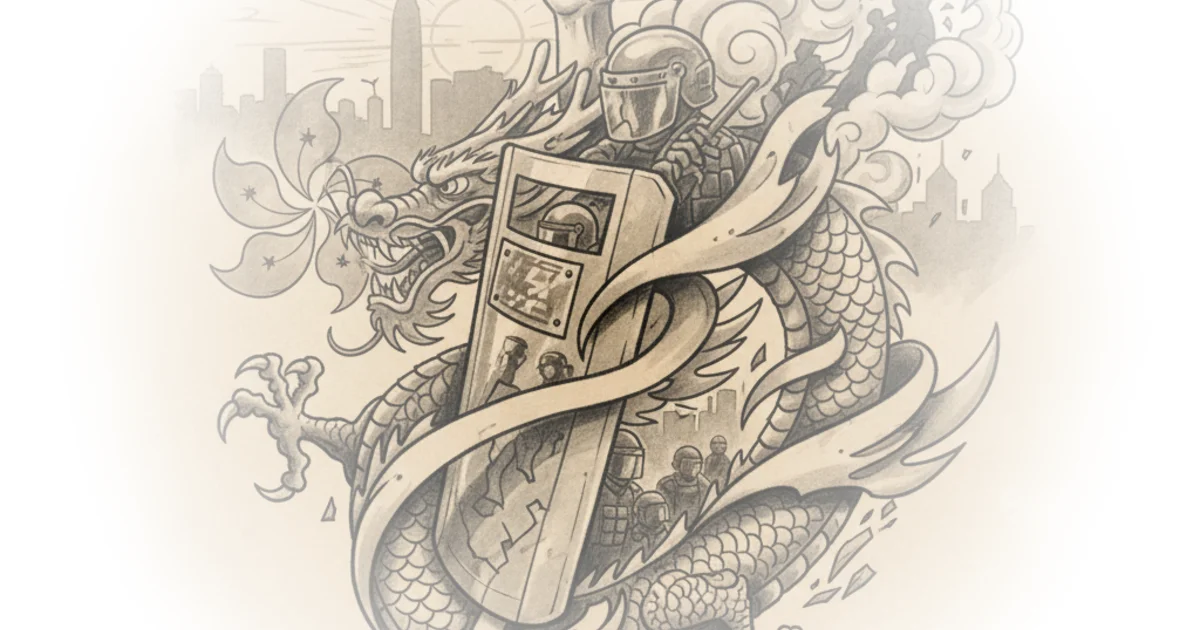
The author highlights the absurdity of the situation, describing the event as a "rehearsal for the flag-raising ceremony" that has devolved into a fortress siege. Chappell notes that the police have erected barriers "taller than a person" to prevent access to the convention center, effectively turning a civic celebration into a military operation. This framing is effective because it exposes the disconnect between the official ceremony's intent—to show unity—and the reality of a city bracing for conflict.
"This shows just how kind of pathetic everything has become here in Hong Kong."
Critics might argue that focusing on the visual spectacle of the protest distracts from the deeper structural grievances driving the demonstrators. However, Chappell's point is that the spectacle itself is the message: the state's reliance on overwhelming force signals a lack of confidence in its own legitimacy.
The Media as a Buffer
A significant portion of Chappell's commentary focuses on the precarious role of the press in this environment. He notes that the Hong Kong Press Association had to provide "helmets and safety gear and vests" for journalists, a stark reminder that reporting is now a hazardous activity. Chappell reflects on his own experience during the 2014 Umbrella Movement, suggesting that the mere presence of cameras can "de-escalate the situation" because both sides know they are being watched.
Yet, the dynamic is shifting. Chappell points out that police officers are now carrying their own camcorders on monopods, tasked with documenting protesters to build cases for future legal action or public relations campaigns. This creates a strange standoff where the media is no longer just an observer but a participant in the information war. The author notes that protesters are using laser lights and strobe flashes to blind these police cameras, turning the act of documentation into a tactical battle.
"In a way, it does protect both sides... both sides knew they were being watched and nothing really could get too out of hand."
This observation is crucial, as it highlights the fragility of the current truce. If the protective shield of media scrutiny is removed or overwhelmed, the potential for violence increases dramatically. A counterargument worth considering is that the presence of international media might actually provoke a harder line from authorities who wish to avoid global scrutiny of their tactics.
The Erosion of Access
Perhaps the most chilling detail in Chappell's report is the exclusion of dissenting voices from the territory itself. He recounts the story of Joe Fung, a survivor of the 1989 Tiananmen Square massacre, who was denied entry to Hong Kong despite his long history of visiting during protests. Chappell uses this incident to illustrate a broader trend: "more and more people who are critical of the CCP are not being allowed into Hong Kong."
This restriction signals a fundamental shift in the "one country, two systems" framework. Chappell argues that the inability of a historical figure like Fung to enter the city is a clear indicator that "the freedoms a little less free." The author's tone shifts from observational to concerned as he speculates on whether his own team will be allowed to return to Hong Kong after this coverage.
"One country, two systems' but more and more people who are critical of the CCP are not being allowed into Hong Kong. That's not a great sign."
This point is the piece's strongest argument, moving beyond the immediate violence to address the long-term erosion of civil liberties. While the administration may frame these entry bans as necessary for national security, the practical effect is the silencing of historical memory and dissent.
Bottom Line
Chappell's live reporting succeeds in capturing the visceral tension of a city on the brink, using the physical presence of riot police and the exclusion of critics to illustrate the collapse of Hong Kong's autonomy. The strongest element of the argument is the juxtaposition of the state's PR efforts with the reality of a militarized blockade, while the biggest vulnerability lies in the difficulty of predicting how long this fragile standoff can hold before escalating. Readers should watch for how the administration handles the aftermath of these protests, as the exclusion of figures like Joe Fung suggests a hardening of policy that goes beyond temporary crowd control.