Dave Borlace delivers a sobering but essential correction to the climate conversation: the transition to a low-carbon future is not automatically a just one, and without deliberate intervention, it could actively deepen the very inequalities it seeks to solve. While much of the public discourse fixates on the physics of warming, Borlace guides us through the human geography of the Intergovernmental Panel on Climate Change (IPCC) report, revealing how a 2-degree world guarantees a deterioration in living standards for 73 of the 149 countries assessed. This is not merely a prediction of heat; it is a forecast of systemic economic collapse for the world's most vulnerable populations if we fail to integrate social equity into our adaptation strategies.
The Trap of Isolated Solutions
Borlace's central thesis challenges the assumption that economic growth alone will shield us from climate impacts. He points out that the IPCC report identifies four critical transformations, starting with the need for integrated approaches. "Problems and solutions can't be addressed in isolation," Borlace writes, noting that ending poverty is only effective as climate adaptation if that new wealth is specifically directed toward risk management. This framing is crucial because it exposes the flaw in traditional development models that treat climate change as a separate silo from economic policy. The argument lands with force because it demands that governments stop viewing sustainability as a technical fix and start seeing it as a structural overhaul.
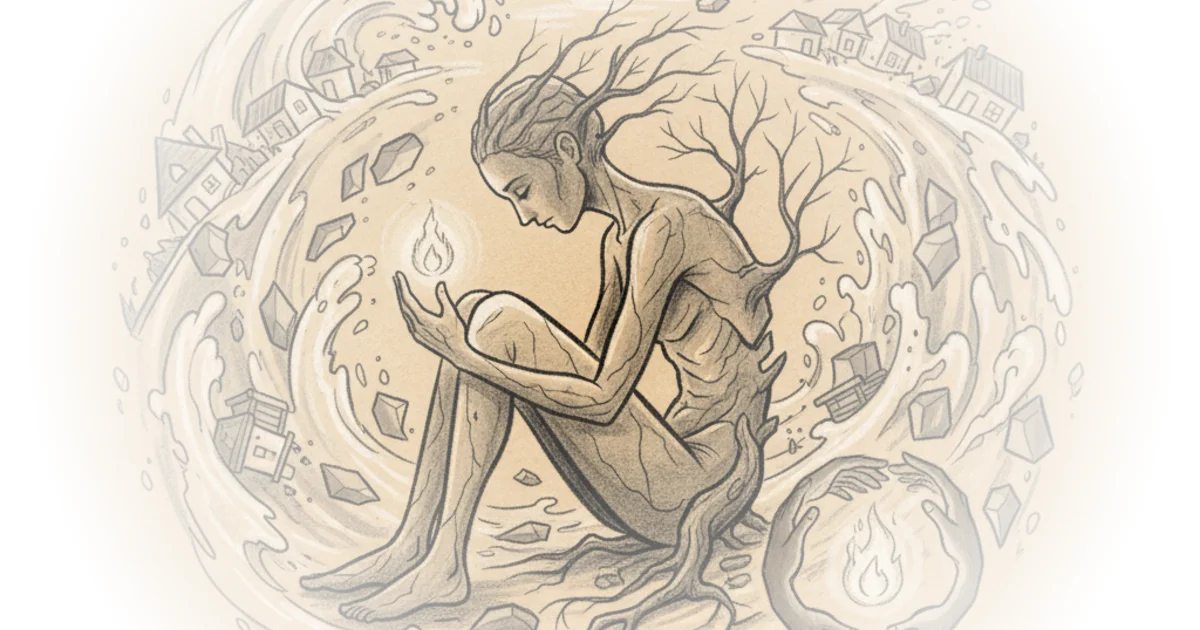
The commentary highlights how climate variability worsens existing fractures in society. Borlace explains that at just 1.5 degrees of warming, an additional 122 million people could be pushed into extreme poverty, primarily due to food price shocks and health declines. "Even at 1.5 degrees Celsius of warming the IPCC assessed that a hundred and twenty two million extra people will find themselves in extreme poverty mainly due to higher food prices and declining health." This statistic serves as a stark warning that the margin for error is vanishingly small. Critics might argue that technological innovation in agriculture could offset these food price spikes, but Borlace rightly counters that such solutions often favor those who can afford the technology, potentially leaving the poor further behind.
"All of which brings us to the first of the two key points... the United Nations sustainable development goals. The report highlights four key principles and caveats the global governments are going to need to embrace if we want sustainable development to lead to effective adaptation."
The Double-Edged Sword of Adaptation
Perhaps the most compelling section of Borlace's analysis is his exploration of "maladaptive pathways"—solutions that solve one problem while creating a worse one elsewhere. He illustrates this with the example of the Mekong River Basin, where hydropower dams intended to generate clean energy have ironically increased food insecurity and poverty. "Land and water diversion can take away the income of poorer farmers," Borlace notes, citing billions in lost GDP for Thailand, Laos, and Cambodia. This is a vital distinction often missed in mainstream climate reporting: the pursuit of green energy can still be extractive and unjust if it ignores local livelihoods.
Borlace extends this critique to urban environments, where well-intentioned infrastructure can backfire. He points out that while urban wetlands are smarter than concrete flood barriers, in hotter climates they can breed mosquitoes and displace residents. "The creation of urban wetlands as flood control measures is in many regions a smarter move than trying to build concrete and steel flood barriers at city boundaries but in hotter countries these very wetlands can breed mosquitoes and could force people to move away from their homes." This nuanced view prevents the commentary from sliding into simple optimism. It forces the reader to confront the complexity of implementation, where a solution in one context becomes a hazard in another.
The analysis also touches on the paradox of air conditioning. As temperatures rise, the demand for cooling is projected to triple by 2050, yet this creates a feedback loop of energy consumption that undermines climate goals. "Air conditioning is a very effective way to combat heat stress... but the more we install the higher the energy consumption and energy consumption is something that goal number 30 is trying to reduce." This highlights the tension between immediate human safety and long-term planetary stability, a dilemma that requires policy interventions like subsidies to ensure the poor aren't left to suffer the heat or the bill.
The Politics of Power and Equity
The piece culminates in a sharp examination of how power dynamics dictate who benefits from the green transition. Borlace argues that entrenched political and economic structures often block necessary change, reinforcing the status quo. "This kind of intransigence can constrain adaptation futures by reinforcing dominant political economic structures and processes and narrowing option spaces." He uses the example of London, where mainstream resilience thinking promotes self-reliance, effectively shifting the burden of protection onto low-income citizens who cannot afford flood insurance or heat-resistant gear. This is a powerful indictment of a system that treats climate adaptation as a consumer choice rather than a public right.
Borlace also addresses the situation in Brazil, noting that while the country has made strides in sustainable transportation and slowing deforestation, persistent inequalities remain. He warns that without addressing the uneven distribution of power, societal transformation could exacerbate poverty. "Addressing the uneven distribution of power is critical to ensure that societal transformation does not exacerbate poverty and vulnerability or create new injustice." This moves the conversation beyond technical metrics to the ethical core of climate policy. It suggests that the biggest barrier to a 1.5-degree world is not a lack of technology, but a lack of political will to redistribute resources and power.
"A fundamental examination of the values ethics attitudes and behaviors that underpin each nation an agreement on how to move from local to global solutions with a fair and equitable distribution of responsibilities rights and mutual obligations between nations."
Bottom Line
Borlace's strongest contribution is his insistence that climate resilience cannot be achieved through technology alone; it requires a fundamental restructuring of how societies value equity and justice. The piece's greatest vulnerability lies in its reliance on the assumption that governments will eventually embrace these "integrated transformations" despite the entrenched interests that currently block them. The reader should watch for how the administration and global bodies navigate the tension between rapid decarbonization and the immediate economic needs of the world's poorest, as this friction will define the next decade of climate policy.