Then & Now delivers a startling historical correction: the chaos we see in today's digital news cycle isn't a new anomaly, but the inevitable result of a century-long shift from diverse, radical pamphlets to consolidated, profit-driven corporations. The piece argues that the "fourth estate" never truly existed as a neutral guardian of truth; rather, it was engineered by economic forces that prioritized advertising revenue over working-class voices, a dynamic that has only accelerated in the internet age.
The Myth of Linear Progress
The narrative begins by dismantling the comforting story that media history is a straight line from ignorance to enlightenment. Then & Now writes, "We too often think of the news... as becoming progressively more free linearly Through Time... but when you look at the history of the media we find that people have always believed this and that quickly what seems to be making us Freer reveals itself as also having a darker side." This framing is crucial because it stops us from romanticizing the past or assuming the internet is a magical solution. Instead, the author suggests that every technological leap—from the printing press to the telegraph—has been co-opted by those with capital to consolidate power.
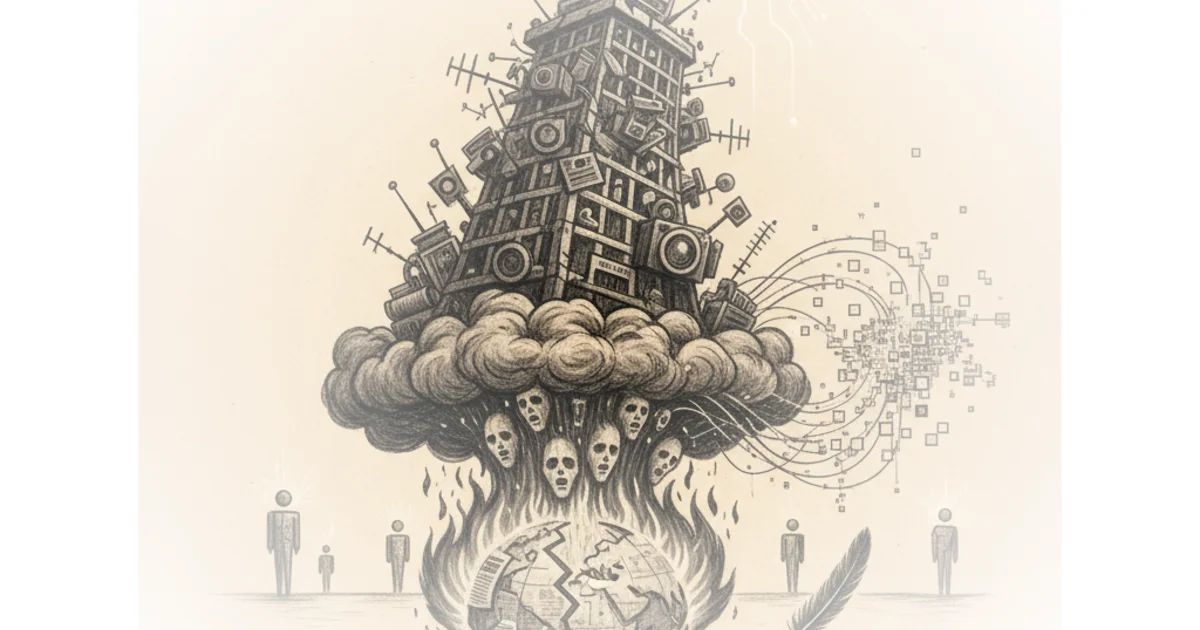
The piece traces the early days of the press, noting that the initial explosion of the printing press was met with immediate state control. "Censorship was the norm," the author notes, "the Vatican granted licenses the French government granted monopolies the tuders gave out licenses for monopolies on different types of News." It wasn't until the English Civil War and the Glorious Revolution that censorship collapsed, allowing for a brief, vibrant era of diverse political debate. Then & Now highlights this period as a peak of genuine pluralism, where pamphlets like Thomas Paine's Rights of Man reached massive audiences. "One in 50 bought copies," they point out, demonstrating a level of public engagement that modern metrics struggle to replicate.
The original diversity of opinion was slowly transformed into the large media Corporation ations we know today.
The Economics of Sensationalism
However, this diversity was not destroyed by ideology alone; it was stamped out by economics. The introduction of the steam-powered printing press in the 1810s allowed for mass production, but it also raised the barrier to entry. Then & Now explains that to afford these machines, publishers turned to advertising, which required a specific demographic: the middle class. "An advertising executive wrote that certain Publications should be avoided because quote their readers are not purchasers and any money thrown upon them is so much thrown away." This single economic shift fundamentally altered the purpose of journalism. The press stopped serving the public and started serving the wallet of the advertiser.
As newspapers grew, they became less about political philosophy and more about entertainment. The author describes how publishers like Joseph Pulitzer and William Randolph Hearst engaged in "yellow journalism," using headlines filled with words like "guilty," "glory," and "treachery." Then & Now writes, "Murder stories made up 50% of the pages of London's Lloyd's weekly despite the rates in violent crime decreasing across century." This wasn't a reflection of reality; it was a reflection of what sold. The argument here is compelling because it connects the dots between the tabloid culture of the 19th century and the clickbait algorithms of the 21st. The incentive structure hasn't changed; only the delivery mechanism has.
Critics might note that this economic determinism overlooks the genuine public service work done by many legacy outlets, even during their most profit-driven eras. However, the author's point remains that the systemic pressure always favors the sensational over the substantive.
Manufacturing Moral Panics
By the 20th century, the media had perfected the art of the "moral panic," using fear to distract from structural issues. Then & Now cites sociologist Stuart Hall, who argued that tabloids focused on superficial scare stories while the ruling class ignored real problems like oil shocks and poverty. "The front pages of the tapy press focused their attention on superficial scare stories," the author observes, targeting everything from sexuality to video games. This strategy allowed powerful interests to deflect blame from themselves and onto marginalized groups.
The piece highlights how this dynamic was not accidental but a feature of the business model. "Sections of the mass media subjected to Market pressures have responded by presenting dramatic narratives with a strong moral content," writes Then & Now. The result was a press that claimed to hold power to account while simultaneously acting as an engine for the very status quo it claimed to critique. The author notes that even working-class papers struggled to survive because advertisers refused to pay to reach readers who couldn't afford their products. "The daily Herald's fortunes decline the paper was sold and became the Tabloid the sun," illustrating how even the most popular working-class voice was eventually consumed by the profit machine.
The press was pandering to the worst in its readers tastes.
Bottom Line
Then & Now's most powerful insight is that the current crisis of trust in media is not a failure of the internet, but the logical conclusion of a century of corporate consolidation and the prioritization of profit over public interest. The argument is strongest in its historical tracing of how economic incentives, not just political bias, shaped the news. The biggest vulnerability is a slight underestimation of the genuine, albeit flawed, attempts by legacy media to self-correct through ethics codes and press councils. As we navigate the current media landscape, the lesson is clear: the medium may change, but the drive to manufacture consent and sell fear remains constant.