Sabine Hossenfelder delivers a rare, unvarnished forecast that cuts through the usual optimism of theoretical physics: she believes we are on the brink of experimental breakthroughs in quantum gravity, yet the ultimate question of how the universe began may remain forever beyond the reach of science. While many physicists cling to the hope of a final "Theory of Everything," Hossenfelder argues that our current reliance on mathematical elegance has stalled progress, and that the next decade will be defined not by new equations, but by laboratory tests and artificial intelligence. This is not a plea for patience; it is a roadmap for a paradigm shift that challenges the very definition of what science can solve.
The End of Pure Math
Hossenfelder's most provocative stance is her rejection of the decades-long strategy of solving physics through mathematical consistency alone. She notes that for years, the field treated theories like string theory as valid simply because they were mathematically sound, ignoring the fact that "maths alone was never going to work." This approach, she argues, was a "philosophical enterprise" where researchers believed they could deduce the laws of the universe without ever touching a lab instrument. The shift she identifies is critical: physicists are finally realizing that "requiring mathematical consistency alone would be enough" is a dead end.
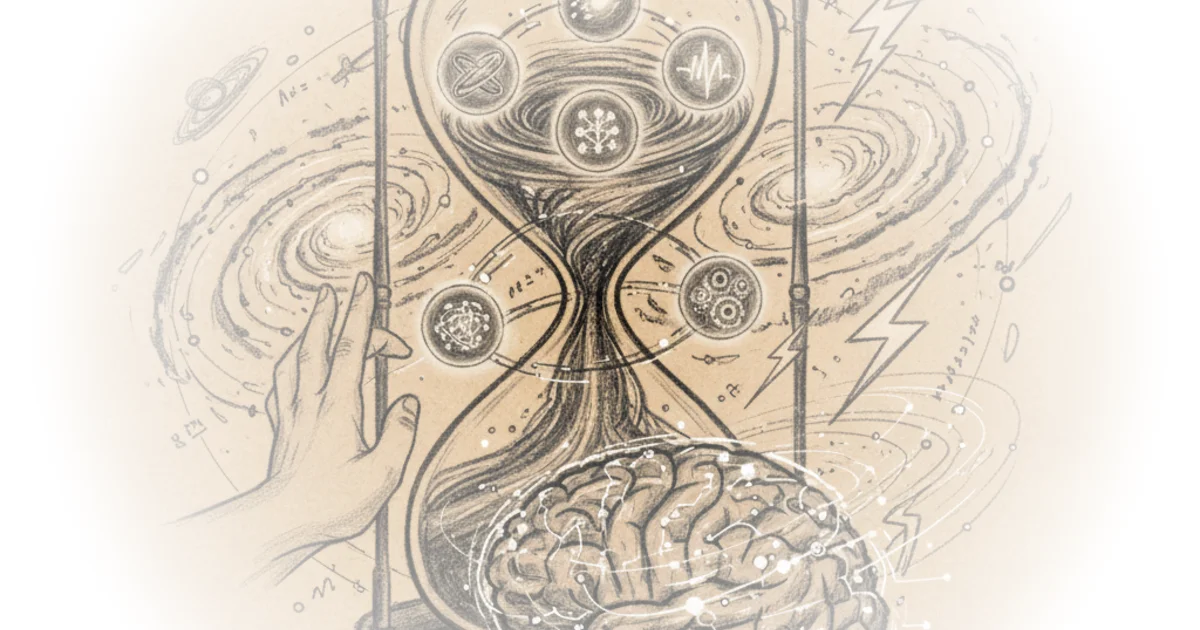
The author is particularly sharp when describing the new path forward. She writes, "I doubt that the astrophysical evidence will ever be decisive, but I do think that laboratory tests will advance the field in the next decade or so." This confidence stems from the ability to bring massive particles into quantum states, a technological leap that makes testing quantum gravity in a lab possible for the first time. The implication is clear: the era of purely speculative theory is ending, replaced by an era of empirical verification. A counterargument worth considering is that the energy scales required for such tests might still be prohibitively high, but Hossenfelder's insistence on the rapid improvement of technology suggests the gap is closing faster than skeptics admit.
"The people who worked on it didn't actually think these theories could ever be tested. They seem to have believed that requiring mathematical consistency alone would be enough."
The Dark Sector and the AI Wildcard
When addressing the twin mysteries of dark matter and dark energy, Hossenfelder adopts a skeptical but hopeful tone. She acknowledges the solid evidence for dark matter—galaxies rotating too fast, gravitational lenses acting strangely—but questions whether we will ever identify the particle. "To be honest, I think the chances are slim," she admits, noting that without direct detection on Earth, the problem may be inextricably linked to a modification of gravity that is nearly impossible to rule out. However, she introduces a crucial variable that many traditionalists overlook: artificial intelligence.
Hossenfelder posits that "if artificial intelligence advances somewhat further, there's a real possibility that that will move us forward." She suggests a deep, perhaps hidden link between dark matter and quantum gravity that human intuition has missed, but which AI might uncover. This is a bold claim in a field often resistant to algorithmic discovery. Regarding dark energy, she predicts a major upheaval in our understanding of the cosmos, suggesting that the "cosmological principle"—the idea that the universe is uniform everywhere—is likely false. "I suspect that the cosmological principle will be abandoned," she writes, arguing that we may simply be located in an odd, low-density region of a much more varied universe. This reframing turns a problem of missing energy into a problem of our specific location, a shift that could resolve the Hubble tension without new physics.
The Limits of Scientific Inquiry
Perhaps the most striking part of Hossenfelder's commentary is her humble admission of science's boundaries. When discussing the origin of the universe, she argues that the question may be fundamentally unanswerable by scientific methods. "I suspect that the question of how a universe began will remain unsolvable potentially forever because I can't see how science can ever tackle it," she states. Her reasoning relies on Occam's razor: science requires simple explanations, but the origin of the universe inevitably involves "unnecessary details" that cannot be derived from observation alone.
She draws a sharp line between science and religion, not to dismiss the latter, but to protect the integrity of the former. "We need the requirement of simplicity to distinguish science from religion," she explains, noting that adding untestable details to explain the beginning of everything is a theological move, not a scientific one. While this is a sobering conclusion for those seeking a grand narrative of creation, it is a necessary guardrail against pseudoscience. Critics might argue that future data could eventually constrain these "details," but Hossenfelder maintains that the data simply won't contain the answer to the initial condition.
"Science has limits and this is one of them."
The Myth of the Final Theory
Finally, Hossenfelder tackles the holy grail of physics: the "Theory of Everything." She is blunt in her assessment, stating, "I don't believe that such a theory exists." She argues that the standard model's particle patterns are not the result of some grand symmetry group waiting to be discovered, but rather something deeper that requires a new approach. "I hope that physicists will soon realize that this just didn't work and that instead of starting with the symmetry assumptions, they need to look for an origin of the symmetries themselves," she urges. However, she is pessimistic about the timeline, predicting that the physics community is too entrenched in its current paradigm to change course quickly. "Decades," she says, is the likely wait time for this shift.
Bottom Line
Sabine Hossenfelder's strongest argument is her insistence that physics must pivot from mathematical elegance to experimental reality, a shift she believes AI and new lab technologies will soon enable. Her biggest vulnerability lies in her dismissal of the "Theory of Everything" as non-existent, a stance that risks alienating the very theorists whose creativity might yet unlock the next breakthrough. Readers should watch closely for the next decade of laboratory results on quantum gravity, as these will either validate her optimistic timeline or prove her skepticism of the field's direction correct.
"I'm actually hopeful that in the next decade or so, we'll make progress on many fundamental questions, not least thanks to artificial intelligence."
The Path Forward
Ultimately, Hossenfelder offers a vision of physics that is less about finding a single, perfect equation and more about understanding the limits of what we can know. By separating the solvable problems of quantum gravity and dark energy from the potentially unsolvable mystery of the universe's origin, she provides a realistic framework for future research. Her commentary serves as a reminder that the most profound scientific progress often comes from admitting what we cannot yet explain, and then finding new ways to test the questions we can.