Dave Borlace cuts through the noise of climate doom to present a solution that turns a zero-sum land war into a symbiotic partnership. While most coverage treats solar farms and food production as competing claims on the earth, Borlace argues that combining them is not just an environmental necessity but an economic lifeline for a farming sector facing an existential crisis. The data suggests that by 2050, we must double food production while water becomes scarcer, yet the proposed fix—agrivoltaics—offers a way to generate electricity and grow crops on the same acreage, effectively using sunlight twice.
The Physics of Efficiency
Borlace begins by dismantling the assumption that plants need maximum sunlight to thrive. He explains that there is a "light saturation point" beyond which extra light does not aid photosynthesis; instead, it causes plants to "sweat," leading to unnecessary water loss through evapotranspiration. This is a critical insight for water-scarce regions. By strategically placing solar panels above crops, the system regulates light to the optimum level for growth while capturing the excess energy.
"All the excess sunlight that would otherwise be wasted on the plants would then be captured on the upper side of the solar panels to generate energy."
This reframing is powerful because it shifts the narrative from land competition to resource optimization. Borlace notes that the relationship is mutually beneficial: the crops cool the panels, which ironically improves the panels' efficiency since solar technology degrades in heat. Citing an Oregon State University study, he points out that panels positioned correctly above vegetation can produce "as much as 10 percent more electricity." This creates a closed-loop economic model where the energy generated can power electric tractors and precision agriculture tools, further reducing water usage and operational costs.
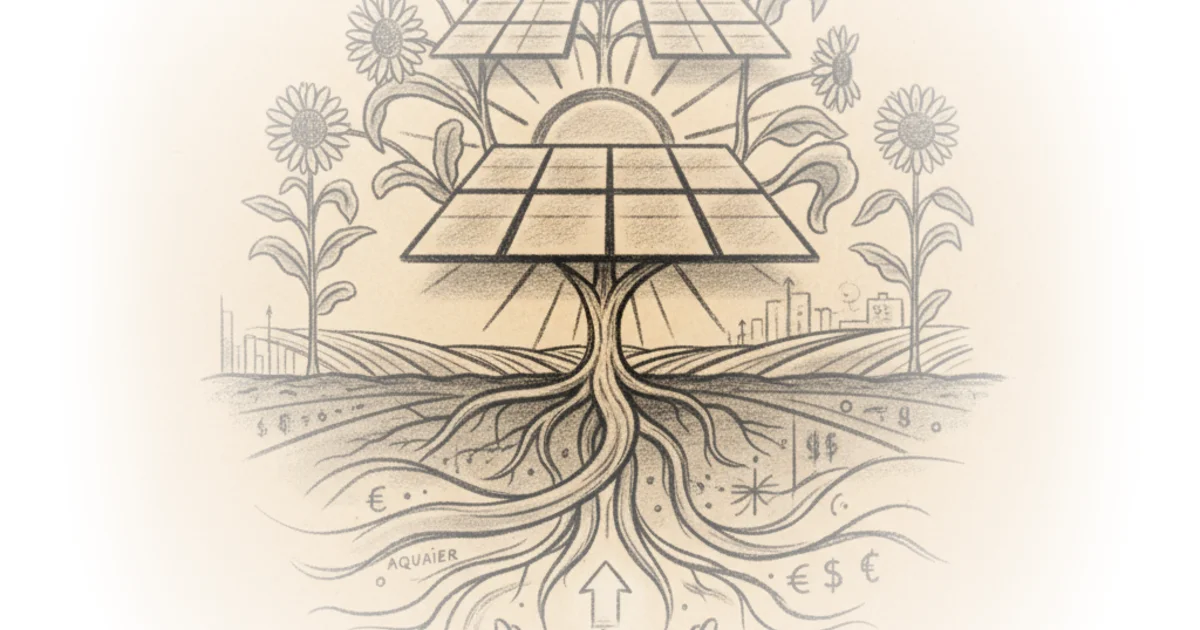
Critics might argue that the initial capital costs for the taller, more complex support structures required for these systems are prohibitive for small-scale farmers. However, Borlace counters that the long-term dual revenue stream from crops and energy sales could stabilize farms that are currently "nudge towards something more like an existential crisis."
Global Momentum and Local Barriers
The scale of adoption varies wildly depending on national policy and land dynamics. Borlace highlights that while the United States has seen over 100,000 farm closures between 2011 and 2018, the technology is surging elsewhere. He notes that China installed an estimated four gigawatts of agricultural photovoltaic capacity in just three years, while Japan implemented hundreds of projects. In contrast, he observes that Australia faces a unique hurdle: fierce competition for land near the electricity grid, which has pitted developers against farmers rather than uniting them.
"The only obstacles to be honest a willful ignorance and an unwillingness on the part of farmers and solar developers to cooperate for everyone's mutual benefit."
This blunt assessment of the Australian situation underscores a broader theme: the technology works, but the political will to integrate it often lags. Borlace points to Europe as a more advanced market, where renewable energy surpassed fossil fuels in the energy mix in 2020. He details a specific pilot in France where a viticulture project uses artificial intelligence to adjust panel tilt based on weather and crop needs. The results were striking: water demand was reduced by 34 percent in the sheltered vines.
"Vines are among the crops most affected by the effects of climate change so it's essential that they'd be at the heart of our experiments."
The French example illustrates that agrivoltaics are not a one-size-fits-all solution but require site-specific design. Borlace acknowledges that the Levelized Cost of Electricity (LCOE) for these systems is currently higher than standard ground-mounted solar, ranging from 7 to 12 euro cents per kilowatt hour. Yet, he argues this is comparable to rooftop systems and is dropping as the industry matures. Furthermore, these installations create valuable habitats for wildlife, turning industrial zones into ecosystems that support insects, birds, and bats.
"You're effectively using the sunlight twice to grow cash crops and to generate a second income stream from the solar power generation."
Bottom Line
Borlace's strongest argument lies in the economic pragmatism of agrivoltaics: it offers a tangible path to keep American farmers solvent while meeting national renewable energy targets without sacrificing food security. The biggest vulnerability remains the high upfront capital cost and the entrenched cultural resistance to sharing land between industries. As the technology evolves with translucent and mobile panels, the question is no longer if this works, but whether policymakers can dismantle the barriers preventing its widespread adoption.
"You're effectively using the sunlight twice to grow cash crops and to generate a second income stream from the solar power generation.""