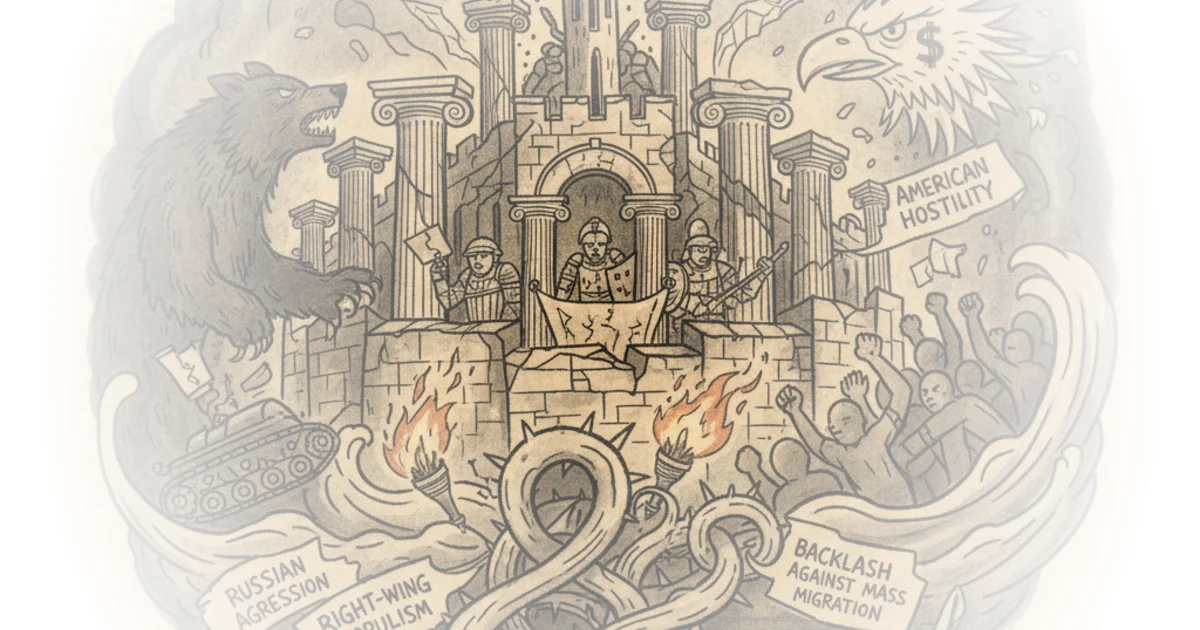
European liberalism is not dying — it is barricading itself in and hoping the siege lifts before the walls do. Compact Magazine's sweeping diagnosis of the continent's political transformation is among the more clarifying pieces of long-form analysis to emerge from the current moment of democratic anxiety.
The Garrison Mentality Takes Hold
The piece opens with a precise observation: the leaders who most loudly champion liberal values — Friedrich Merz, Keir Starmer, Emmanuel Macron — now govern as though liberalism were a finite resource requiring rationing rather than a universal project requiring expansion. The argument is captured in the coinage "Fortress Liberalism," a phrase that does real analytical work. It names something that has been happening in plain sight but has lacked a clean label.
The statistical foundation is sobering. In 2009, Europe's center-right and center-left parties combined to hold sixty-one percent of the seats in the European Parliament. By 2024, the forces to their right had more than doubled their share, capturing twenty-six percent of voting seats — and current polling suggests they would take a full third today. This is not a protest blip. It is a generational realignment, and the mainstream response has been to converge into what Compact Magazine describes as "an uncomfortable ruling coalition" rather than compete on separate visions.
The immigration numbers underpin the political numbers. Between 1994 and 2013, annual asylum applications in Europe never exceeded half a million. That figure reached 1.3 million during the 2015–16 migration crisis and has remained elevated — over 900,000 first-time asylum seekers arrived in 2024 alone. The piece reports that a recent YouGov survey across seven European countries found majorities supporting both immigration moratoria and mass deportations, and that fewer than ten percent of respondents believed legal immigrants were being integrated "very successfully." Those are not fringe attitudes. They are the median voter's attitudes.
The Frederiksen Pivot
The piece identifies Danish Prime Minister Mette Frederiksen as the prototype for the new model. She entered office in 2019 on a "zero refugee" pledge, representing the center-left Social Democratic Party — and her survival has made her a template. Polish liberals won their 2023 election by outflanking hard-right opponents on immigration. Starmer has warned of Britain becoming an "island of strangers." Greek Prime Minister Kyriakos Mitsotakis has similarly embraced restrictionist language.
What Compact Magazine finds particularly notable is the messenger strategy that fortress liberals have deployed: immigration restriction delivered by politicians with immigrant backgrounds. Starmer's crackdown is being led by Pakistani-British Shabana Mahmood. Frederiksen's was led by Ethiopian-Danish Matias Tesfaye. Sweden's Social Democrats tapped a Kurdish-Swede as their assimilation spokesperson. The leader of Germany's Green Party, Turkish-German Cem Özdemir, cited his daughter's experience being "stared at or sexualized by men with migrant backgrounds" to justify asylum restriction.
The political logic is obvious — and the piece does not shy from calling it out. These are not coincidental choices. They are calibrated deployments of identity as credentialing, designed to insulate restrictionist policies from racism charges. Whether this represents cynicism or pragmatic coalition management depends heavily on one's sympathies. The piece declines to render that particular verdict, which is one of its few evasions.
"The world has not yet known a liberal Europe that has no Uncle Sam to lean on."
The Security Awakening
The second major pillar of Fortress Liberalism is the security transformation. Compact Magazine asks readers to strain to remember how different Europe's situation looked in the early 2010s — when NATO held joint fighter exercises with Russia, when European Security conferences were occupied with troop drawdowns from Afghanistan, when the European Union collectively spent 1.3 percent of its combined economic output on defense.
Russia's full-scale invasion of Ukraine in 2022 ended that era definitively. The current American administration's posture has accelerated the reckoning. The piece describes the Oval Office confrontation with Ukraine's president and the subsequent Greenland episode as moments that brought European politicians "to new heights of shock and fear," with armed conflict between NATO members briefly entering the realm of thinkable scenarios.
NATO Secretary-General Mark Rutte exemplifies the speed of this transformation. As Dutch prime minister, he minimized his country's defense contributions. In 2025, he secured commitments from nearly every NATO member to spend five percent of economic output on defense — a figure that dwarfs even the two percent target the previous American administration pushed for. France is distributing survival manuals to citizens. Germany's Merz has declared the "Pax Americana" over and Europe on its own. Polish leaders describe their country as holding up the "Eastern Front." These are not rhetorical postures. They reflect a genuine strategic reorientation.
The piece frames this as part of the same fortress logic: just as liberal Europe has restricted who may enter its communities, it is now hardening the perimeter of its security architecture. The sequencing matters. Immigration restriction, defense buildup, and "militant democracy" at home are not three separate responses to three separate problems. Compact Magazine argues they are expressions of a single underlying psychology — a liberalism that has concluded its survival requires walls, not windows.
Militant Democracy and Its Discontents
The most provocative section of the piece concerns what the editors call "militant democracy" — a term borrowed from political theorist Karl Loewenstein, referring to the use of legal and institutional power to defend democracy from its internal enemies. The examples are real and the list is long.
In Poland, Donald Tusk's government justified extralegal removals of judges and the prosecution of former nationalist government officials. Marine Le Pen has been banned from running in France's 2027 presidential election on charges of misusing European Parliament funds. Romania's courts barred multiple candidates from running and annulled a presidential election citing Russian interference. Germany has labeled the right-wing AfD an extremist organization, authorizing extensive surveillance and ongoing debate about an outright ban. Mainstream parties across Germany, France, and elsewhere have constructed "firewalls" — formal pledges not to enter coalition with populist parties at any level of government.
The piece observes that these tactics have not reduced far-right support. They have, however, produced increasingly unwieldy governing coalitions. To block Le Pen's party from a parliamentary majority, the French Communist Party coordinated with centrist Macronists to withdraw from races and direct votes toward candidates with whom they shared nothing except opposition to the National Rally. Merz's governing agenda in Germany depends on the left-wing parties his voters despise. As Compact Magazine puts it: "Once they stop the right, there exists no agreed path forward."
Critics might note that the "militant democracy" framing does considerable work to normalize what are, in several cases, serious rule-of-law violations. Poland's extralegal judicial removals were condemned by the European Commission even as it supported Tusk's broader governance agenda. Romania's election annulment was more ambiguous than the piece suggests — there remains genuine dispute about the adequacy of Russian interference evidence. And the Le Pen conviction, whatever one thinks of her politics, involved real financial misconduct charges adjudicated by courts, not administrative decree. Bundling these cases together under a single concept can obscure important distinctions between legitimate institutional self-defense and opportunistic lawfare.
The Structural Trap
The piece's deepest insight is not about immigration or defense or judicial firewalls. It is about the governing psychology that fortress liberalism has produced. Compact Magazine reports that Europe's liberal leaders now "filter every move through the question: How does this affect support for the populists?" Welfare cuts are condemned not for hurting the poor but for feeding the populists. Immigration restriction is defended not on its own merits but as inoculation against the populist surge. "All over Europe, institutionalists cling to power while polls promise they will lose the next election."
This is a credibility problem that restrictions on asylum seekers cannot solve. When the dominant logic of governance becomes tactical — doing or not doing things based on their effect on the enemy's polling numbers — it hollows out the substantive case for why the establishment should govern at all. Voters are not stupid. They can sense when they are being managed rather than represented. The fortress metaphor, for all its analytical clarity, may also describe the trap: a fortified position is, by definition, one that has ceded the surrounding territory.
Critics might also note that the piece somewhat underplays the degree to which populist parties have themselves become institutionalized participants in European governance rather than outsiders threatening it. Giorgia Meloni governs Italy and has committed to NATO and Ukraine. The Sweden Democrats provide parliamentary support for a center-right government. The distinction between a "populist threat to liberal order" and "a new coalition of right-of-center parties" is blurring in practice, even if fortress liberals insist on maintaining the conceptual firewall. Treating every rightward-leaning party as categorically illegitimate — rather than engaging with the specific concerns that drive their voters — may be precisely the error that prevents liberalism's renewal.
Bottom Line
Compact Magazine has produced a rigorous, unsentimental account of how Europe's liberal establishment has responded to a decade of compounding crises — and the piece's conclusion is not reassuring. Fortress Liberalism may be buying time, but the walls are not getting higher as fast as the pressure is building. A liberalism that has abandoned expansion, subordinated principle to tactical survival, and made anti-populism its animating purpose is a liberalism that has already conceded the argument about what it stands for.