Adam Tooze reframes the 85th anniversary of Operation Barbarossa not merely as a military turning point, but as the catastrophic culmination of a long-standing colonial project that viewed genocide as a logistical necessity for land acquisition. This piece is essential listening because it strips away the abstraction of "war" to reveal the cold, bureaucratic engineering behind the murder of millions, arguing that the Holocaust was inextricably linked to a broader plan to starve and displace Slavic populations to make room for German settlers.
The Colonial Logic of Destruction
Tooze begins by dismantling the common perception that the invasion of the Soviet Union was solely about defeating Bolshevism or annihilating Jewish people in isolation. He writes, "The German invasion of the Soviet Union is far better understood as the last great land grab in the long and bloody history of European colonialism." This framing is powerful because it connects the specific horror of 1941 to a broader historical pattern of imperial expansion, suggesting that the machinery of death was built on centuries of European thought regarding "empty" lands waiting to be claimed.
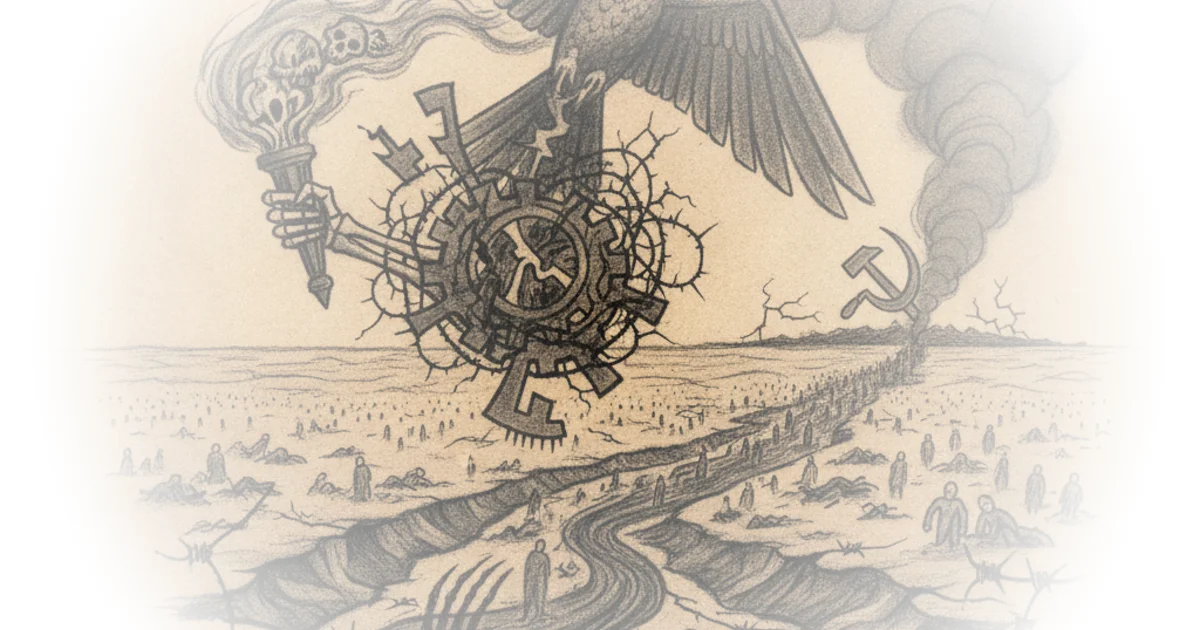
The author argues that the destruction of the Jewish population was merely the opening move in a much larger demographic surgery. As Tooze puts it, "Destroying the Jewish population was the first step towards rooting out the Bolshevik state." What followed, he explains, was a "gigantic campaign of land clearance and colonization" designed to settle millions of hectares with German colonists while removing the native Slavic inhabitants. This perspective forces the listener to confront the idea that the Holocaust was not an anomaly or a side effect of war, but a central pillar of a pre-meditated plan for territorial expansion.
The attainment of this entirely "pragmatic" objective required nothing less than the murder, by organized famine, of the entire urban population of the Western Soviet Union.
Tooze highlights how the regime's "practical" need to secure food supplies for Germany led directly to policies that would kill tens of millions through starvation. He notes that planners like Hans Frank and Herbert Backe were determined that "it would not be the Germans who were starved into defeat." This reveals a chilling inversion of morality: the survival of the German state was prioritized by engineering the mass death of others. The connection to the broader "Hunger Plan" deepens this argument, showing how food policy was weaponized as a tool of genocide from the very first days of the invasion.
Critics might argue that focusing on the colonial aspect risks diluting the unique ideological hatred directed specifically at Jews. However, Tooze's evidence suggests these motivations were intertwined; the SS viewed the removal of Jews and Slavs as part of a single "racial reorganization" necessary for the creation of Lebensraum.
The Bureaucracy of Displacement
The commentary then shifts to the administrative machinery that made this destruction possible. Tooze details how, even before the invasion of the Soviet Union, the SS had been experimenting with mass displacement in Poland, though they faced logistical hurdles. He writes, "The architects of this programme were Heinrich Himmler and his technical staffs... establishing the close connection in SS thinking between the removal of the Jews and the wider project of racial reorganization."
When the invasion of the Soviet Union was announced, it unleashed a "euphoria amongst the SS staffs" because the vastness of the East offered a solution to the logistical problems they had encountered in Poland. Tooze notes that the Soviet Union offered a chance where "unwanted bodies could be swallowed up in the wastelands of the East." This highlights how the sheer scale of the territory was seen not as a challenge, but as an opportunity to implement radical demographic engineering without immediate constraint.
The planning for this reorganization was swift and brutal. Tooze explains that within weeks of the invasion, the "Generalplan Ost" began to take shape, envisioning the removal of 80-85 percent of Poland's native population and similar percentages in Ukraine and Belarus. The plan was not vague; it was a blueprint for social order. As he states, "It provides what is effectively a blue-print for the kind of social order that the SS leadership hoped to create in Eastern Europe."
Only those capable of work were of any interest to the Germans. By the end of 1942, the talk was of the possible "physical annihilation" of entire populations, not only the Jewish minority, but the Poles and Ukrainians as well.
This section underscores the total dehumanization inherent in the planning process. The distinction between "evacuation" and "annihilation" blurred quickly, with officials openly discussing the physical destruction of millions to achieve a demographic balance favorable to German settlement. The reference to the "trial run" in Zamosc in 1942 illustrates how these theoretical plans were tested on real populations, separating children from families and segregating people based on their utility to the Reich.
The Human Cost of "Pragmatism"
Tooze's most devastating point is that this was not a chaotic outburst of violence, but a calculated strategy driven by what the perpetrators called "pragmatism." He describes how the "genocidal implications of the Generalplan Ost were clearly revealed" through these experimental evictions. The planning offices considered removing not just Jews, but the entire Polish population, viewing them as obstacles to German colonization rather than human beings with rights.
The scale of the intended tragedy is staggering. Tooze notes that realistic estimates put the number of victims at "closer to 45 million people," a figure that dwarfs the death tolls of many other conflicts when including those who would have died from starvation and exposure during forced displacement. This reframes the Holocaust not just as a crime against Jews, but as a crime against humanity on an industrial scale, targeting entire national groups for erasure.
The first and most fundamental assumption in all SS territorial planning from 1939 onwards was the assumption that the integration of Eastern European territory as German Lebensraum required the removal of the vast majority of the native population.
This assumption, Tooze argues, was the bedrock upon which the Third Reich built its eastern empire. The "racial sifting" and classification systems were not merely bureaucratic red tape; they were the mechanisms that determined who lived and who died based on their perceived value to the German state. The failure of earlier displacement attempts in Poland only intensified the resolve to implement these plans more ruthlessly in the Soviet Union, where the geography seemed to offer a blank slate for this horrific experiment.
Bottom Line
Tooze's argument is at its strongest when it exposes the seamless integration of colonial ambition and genocidal ideology, showing that the Holocaust was the logical endpoint of a long-standing desire to reshape Eastern Europe through mass murder. The piece's greatest vulnerability lies in its sheer density of bureaucratic detail, which risks overwhelming the listener with the cold mechanics of death rather than the human suffering; however, this is precisely the point—to show that the horror lay in the normalcy of these calculations for those who made them. Readers should watch for how this historical framing influences our understanding of modern conflicts where "demographic engineering" and resource extraction are still used as justifications for violence against civilian populations.