Margaret Killjoy reframes the crushing weight of climate anxiety not as a call to despair, but as a paradoxical mandate for radical joy and collective preparation. In a landscape dominated by doom-scrolling and individualistic survivalism, Killjoy argues that the only sane response to a potential apocalypse is to simultaneously prepare for death, build community, and fight for a future that might still be saved.
The Paradox of Planting Trees
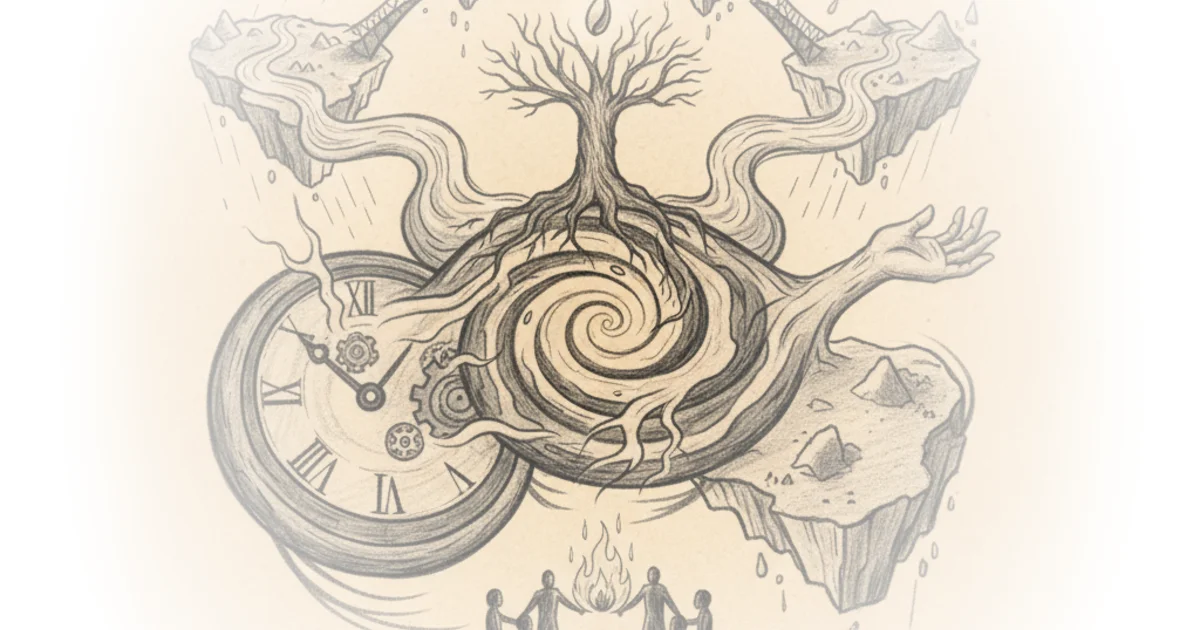
Killjoy anchors her essay in a piece of anarchist folk art: a drawing of a tree with a circle-A superimposed, bearing the text "even if the world was to end tomorrow I would still plant a tree today." She traces this sentiment back to a misattributed quote by Martin Luther and a hadith, noting its origins in the German Confessing Church's resistance to Nazi power. This historical grounding is crucial; it shifts the narrative from nihilistic resignation to active defiance.
"The quote was used to inspire hope, to inspire people to action."
Killjoy acknowledges the validity of the argument that for many, particularly those ravaged by Western imperialism, the world has already ended. Yet, she insists that the current acceleration of climate records and ecological collapse creates a unique, paralyzing urgency. She rejects the binary of denial and panic, proposing instead a four-part framework for living. This approach is effective because it validates the reader's fear without letting it become the sole driver of their existence. It acknowledges that while the machine gun slaughter of the past felt like an apocalypse, the current crisis demands a different kind of endurance.
Beyond the Bunker Mentality
The piece takes a sharp turn against the popular culture of prepping. Killjoy critiques the "plucky gang of survivors" trope found in cinema, arguing that isolation is a death sentence in a real crisis. She posits that the most vital resource for survival is not ammunition or rice, but human connection.
"The most effective means of survival in crisis is to create community disaster plans. To practice mutual aid. To build networks of resilience."
She dismantles the fantasy of the self-sufficient cabin, pointing out the dangers of groupthink and the lack of diverse skills in small, insular groups. More importantly, she argues that withdrawing from society cedes the political ground to fascists. "If you go hide in the woods with your stockpile and your buddies, and fascists take over, guess what? It's kind of your fucking fault," she writes. This is a powerful, if uncomfortable, reminder that survival is inherently political. Critics might argue that in a total societal collapse, community networks could fracture just as easily as institutions, but Killjoy's point stands: isolation guarantees vulnerability, while collective action offers a chance at agency.
"Fascism is always best stamped out when it starts. It's never safe to ignore it. Not now, not during any Mad Max future."
The Necessity of Contradictory Hope
Killjoy's most distinctive contribution is her insistence on holding four contradictory priorities at once. She urges readers to "Act like we're about to die" by pursuing hedonism and joy, while also "Act like we might have a chance to stop this" by engaging in direct action. She rejects the idea that we are merely "allowed" to effect change, challenging the notion that revolution is impossible.
"The revolution cannot be controlled by a vanguard of activists; if it is, it will fail. The revolution must be controlled by its participants, because only then will we learn how to claim agency over our own lives and futures."
She warns against the authoritarian urge to manage the revolution, noting that "authoritarian communism is the death of any revolution" just as "authoritarian liberalism is the death of any revolution." This is a nuanced take that avoids the trap of dogmatic ideology, focusing instead on the diversity of skills needed—from medics to musicians to hackers. She balances this urgency with a pragmatic "Act like everything will be okay," acknowledging that capitalism is a "sturdy beast" and that we must maintain careers and long-term projects even while preparing for collapse.
Bottom Line
Killjoy's argument is strongest in its rejection of the paralysis that often accompanies climate discourse, replacing it with a robust, multi-faceted strategy for living. Its greatest vulnerability lies in the sheer emotional and logistical demand of maintaining four contradictory mindsets simultaneously, a feat that may be difficult for those already overwhelmed by crisis. The piece serves as a vital reminder that the fight for a better world requires both the courage to plant trees in the face of doom and the wisdom to build the networks that will sustain us if the storm hits.