Then & Now delivers a surgical dissection of a popular cultural figure, revealing that the man most famous for warning against "isms" is himself operating from a deeply structured ideological framework. This piece doesn't just summarize Jordan Peterson's arguments; it exposes the internal contradiction of a thinker who condemns dogmatic rigidity while championing a "mythic conservatism" rooted in eternal, unchanging rules. For a busy professional trying to navigate the current cultural landscape, understanding this tension is crucial: it clarifies why the debate over individual sovereignty often stalls, and how the very tools we use to critique ideology can become the ideology itself.
The Three Charges
Then & Now begins by meticulously reconstructing Peterson's three-pronged attack on ideology, treating the subject with a charitable eye before turning the lens back on the critic. The author notes that Peterson defines ideology not merely as a political stance, but as a dangerous reduction of reality. "An ideologue... grants these small number of forces primary causal power while ignoring others of equal or greater importance," Then & Now writes, highlighting Peterson's view that this leads to a narcissistic belief that the world can be fixed if only one person held the controls.
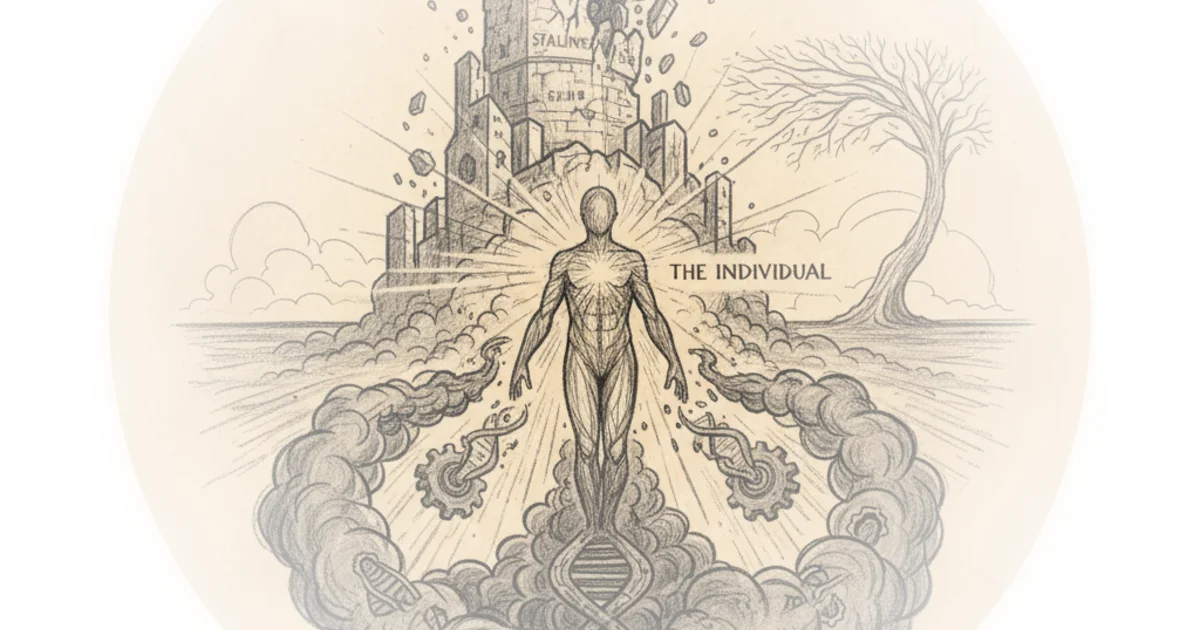
The commentary breaks this down into three specific failures: utopianism, oversimplification, and resentment. Peterson argues that we should aim for "incremental improvement" rather than grandiose systems, and that true problem-solving requires "careful particularized analysis" rather than applying a single algorithm to complex social issues. This framing is effective because it appeals to the pragmatic instincts of the audience; who doesn't want to avoid lazy thinking? However, the piece subtly hints that this rejection of broad theories might itself be a theoretical stance—a refusal to engage with structural patterns that don't fit a specific narrative.
Critics might note that Peterson's dismissal of "isms" often ignores how marginalized groups rely on these frameworks to name systemic injustices that otherwise remain invisible. The charge of "resentment" is particularly contentious, as it risks pathologizing legitimate grievances against power structures.
"The present or the status quo... has an ideological basis as much as marxism or feudalism... our world views are the product of ideologies theorized by thinkers like john locke john stuart mill montesquieu."
The Invisible Map
The pivot of the article is the realization that ideology is not just a tool for the radical left or right, but the very water in which we swim. Then & Now argues that the current reality is just as much a product of a coherent belief system as any revolutionary movement. The author cites philosopher John Gehring to suggest that the only true commonality among definitions of ideology is "coherence." Ideologies are simply "sets of ideas or values that are defined by their coherence and consistency," serving as a rough map to organize behavior and value judgments.
This section is vital because it dismantles the idea that one can be "non-ideological." As Then & Now puts it, "Reality becomes its own through the spell cast by its faithful duplication." The argument here is that the status quo—liberal, neo-liberal, or nationalist—is just as much a constructed worldview as the alternatives Peterson critiques. The piece effectively argues that Peterson's error is not in identifying ideology, but in failing to see that his own worldview is equally constructed and equally "ideological."
The Contradiction of Mythic Conservatism
The most striking part of the analysis is the exposure of Peterson's own ideological architecture, which Then & Now labels "mythic conservatism." The author traces Peterson's reliance on Judeo-Christian structuralism, noting that Peterson views the Ten Commandments as a "minimum set of rules for a stable society." Peterson argues that these rules are not arbitrary but are "limited, solid, in tune with our biology," emerging from the "universal constraints" of human existence.
Then & Now points out the irony: Peterson condemns ideologues for being "fundamentalists" and "pseudo intellectuals" who use a "single term" to explain everything, yet he relies on a "natural ethic" derived from ancient myths to explain the entirety of human behavior. The author writes, "Peterson's ideology goes something like this... arrangements must be made for our provisioning... it must work for me my family and the broader community." This sounds remarkably like a comprehensive, rigid system of belief—the very thing Peterson warns against.
The piece highlights a specific cognitive dissonance where Peterson critiques the "low resolution" of modern ideology while simultaneously elevating stories like The Hobbit or the Exodus as "archetypal" truths that "cannot be improved upon." Then & Now observes that this is a form of "Burkian traditionalism," trusting in "experience and in the gradual improvement of tried and tested arrangements." The author argues that this is a contradiction: if the rules are "eternal" and "unchanging," they cannot be subject to the "careful particularized analysis" Peterson demands for other social problems.
"Critiquing ideologues ideology while advocating for a type of conservative judeo-christian structuralism is a contradiction at best and hypocritical too."
The analysis suggests that Peterson's "limited rules" are actually quite ambiguous and varied across history, making the claim of their universality questionable. The piece notes that "post-structuralism argues that these rules are in fact unstable, subject to change and reinterpretation," a nuance Peterson's framework seems to ignore. By framing his worldview as a "natural ethic" rather than a political choice, Peterson effectively immunizes his ideology from the very critique he levels at others.
Bottom Line
Then & Now successfully demonstrates that the most potent critique of ideology is often the one that fails to recognize its own ideological nature. The piece's greatest strength is its refusal to let Peterson off the hook for his own reliance on dogmatic, myth-based structures, effectively turning his own arguments back on him. The biggest vulnerability in the broader debate remains the difficulty of distinguishing between necessary social cohesion and the rigid dogmatism Peterson warns against. Readers should watch for how this tension plays out in future cultural arguments, as the line between "wisdom" and "ideology" is often drawn by those who hold the pen.