Rohin Francis transforms the terrifying trope of the in-flight medical emergency into a masterclass on practical medicine, legal nuance, and the chaotic reality of high-altitude triage. By weaving a personal narrative of treating a woman in cardiac distress with hard data on aviation physiology, the piece dismantles the myth that doctors are helpless at 35,000 feet, revealing instead a landscape where improvisation and calm judgment save lives.
The Myth of the Reluctant Rescuer
Francis opens by addressing the visceral fear many medical professionals feel when hearing the cabin announcement: "Could any medical professionals on board please make themselves known to the crew?" He reframes this moment not as a summons to disaster, but as the very reason many entered the field. "Isn't stuff like this the whole reason we went to medical or nursing school in the first place?" he asks, challenging the paralysis that often accompanies such calls.
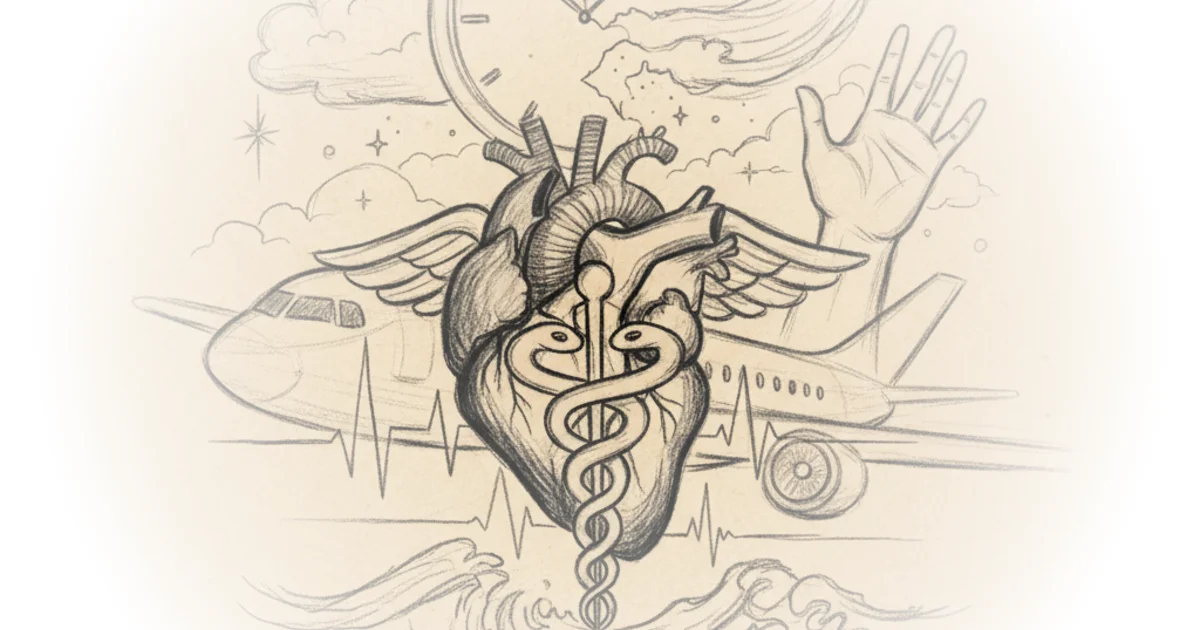
The author navigates the complex intersection of moral duty and legal obligation with precision. While acknowledging that strictly speaking, there is no legal mandate to intervene, he points to the General Medical Council's stance in the UK, which dictates that doctors "must help if you are able," barring genuine incompetence or incapacitation. This distinction is crucial; it shifts the burden from legal fear to professional ethics. However, Francis admits his own hesitation was compounded by a single whiskey, noting that while he felt fine, the alcohol "did give me pause just hoping that somebody else would volunteer first." This vulnerability humanizes the medical professional, suggesting that even experts grapple with the split-second calculus of risk and readiness.
"Trying to force liquid down the throat of someone that's unconscious is what we refer to as a bad idea."
This moment of clarity highlights a critical failure in initial crew response. The crew had assumed the unconscious passenger was hypoglycemic and attempted to feed her orange juice, a dangerous error that Francis identifies immediately. The narrative underscores that while airline staff are trained, they are not clinicians, and the presence of a doctor changes the trajectory of care from guesswork to assessment.
The Reality of In-Flight Medicine
The core of Francis's argument rests on the stark limitations of the environment. He describes the scene vividly: "Three of us just yanked her up in the air and hauled her off to business class and put her on a flatbed." The improvisation required is immense. When standard equipment failed, Francis had to insert a large metal needle instead of a plastic cannula, a procedure he admits was "less than ideal." The noise of the cabin made auscultation nearly impossible, forcing him to rely on subtle physical signs like a narrow pulse pressure to diagnose critical aortic stenosis.
Francis also clarifies a common misconception regarding the chain of command. Doctors often fear being pressured to divert a flight, yet he emphasizes that "it's the captain's decision whether to divert the plane. You can make a suggestion but it's not your responsibility." This separation of duties is vital for reducing the cognitive load on the treating physician, allowing them to focus on the patient rather than logistics.
Critics might argue that relying on the goodwill of passengers and the availability of ground-based medical support creates a fragile safety net. What happens when no doctor is on board, or when the ground support is unavailable? Francis acknowledges the variability in equipment, noting that "there is no internationally agreed minimum medical kit," and recounts how the crew asked him to falsify his report to claim the kit was fully stocked when it was not. This admission of systemic gaps in airline preparedness is a sobering counterpoint to the heroic narrative.
Physics, Physiology, and the Good Samaritan
The piece expands beyond individual cases to explore the unique physiological stresses of flight. Francis explains that planes are pressurized to the equivalent of 2,500 meters, meaning oxygen levels are lower than at sea level. For healthy people, this is negligible, but for those with compromised respiratory or cardiac function, it can be the tipping point. He illustrates the danger of trapped gas expanding with altitude, citing the dramatic 1995 case where two doctors performed a life-saving chest drain on a passenger with a tension pneumothorax using only "oxygen tubing, urinary catheter, sticky tape, a coat hanger, and a bottle of Evian."
"In what can only be described as medical MacGyverism not to mention total badassery, the two doctors fashioned a chest drain..."
Francis uses this anecdote to highlight the potential for extraordinary competence in dire circumstances, but he also warns against the "Dunning-Kruger curve" of unqualified individuals stepping in. He contrasts the skilled improvisation of the doctors with a chilling account of a chiropractor attempting to treat a pregnant woman in premature labor and a man having a heart attack using "applied kinesiology" and spinal adjustments. The author's critique here is sharp: "When one considers sawing through glue the capabilities of a chiropractor and medical doctor on an airplane, who has the advantage?" The answer is obvious, yet the legal protections for well-meaning but unqualified helpers remain a point of confusion.
Regarding legal liability, Francis offers reassurance through the Good Samaritan laws and the 1998 Aviation Medical Assistance Act. He notes that unless "gross incompetence or willful misconduct" can be demonstrated, volunteers are protected from litigation. However, he adds a fascinating caveat: accepting gifts from the airline, such as a voucher he received on a Delta flight, could technically void this protection by constituting payment. "If I had accepted the gift that would have counted as accepting payment and therefore you're no longer protected under the Good Samaritan Law," he writes, a detail that adds a layer of bureaucratic absurdity to the heroic act.
"There is no internationally agreed minimum medical kit with different airlines doing their own thing."
This observation serves as a stark reminder that while individual competence can save lives, systemic preparedness remains inconsistent. The reliance on the "emergency medical kit" versus the standard "first-aid kit" is a distinction that could mean the difference between life and death, yet it is often misunderstood by crew and passengers alike.
Bottom Line
Francis's commentary succeeds by grounding high-stakes medical drama in the mundane realities of airline logistics and human error, proving that the most critical tool in the sky is not the equipment, but the trained mind. The piece's greatest strength is its refusal to romanticize the situation, instead exposing the gaps in airline protocols while celebrating the improvisational brilliance of medical professionals. The biggest vulnerability remains the lack of standardized equipment across the industry, a systemic risk that no amount of individual heroism can fully mitigate.
"The argument is effective because it reframes something familiar — the fear of flying — through a lens that even policy wonks rarely use: the intersection of human physiology, legal protection, and the chaotic reality of improvised medicine."
Readers should watch for how airlines respond to the growing awareness of these medical gaps, particularly as the frequency of in-flight emergencies rises with an aging global population. The next frontier in aviation safety may not be better engines, but better medical kits and clearer protocols for the doctors who answer the call.