A new Renaissance could be unfolding right now—buried beneath the anxiety about culture's decline. The same conditions that sparked past moments of artistic and intellectual rebirth are present today: declining literacy, unchecked technological advancement, political fragmentation, universities defunding humanities. These aren't just problems—they're the conditions that have historically preceded periods of cultural renewal.
From Shadows to Light
The author begins with Plato's allegory of the cave as a metaphor for cultural awakening. In the allegory, prisoners chained in a dark cave can only see shadows cast by firelight. One prisoner breaks free, sees the sun, and returns to tell others—but the prisoners refuse to follow him out, preferring "the familiar comfort of the shadows."
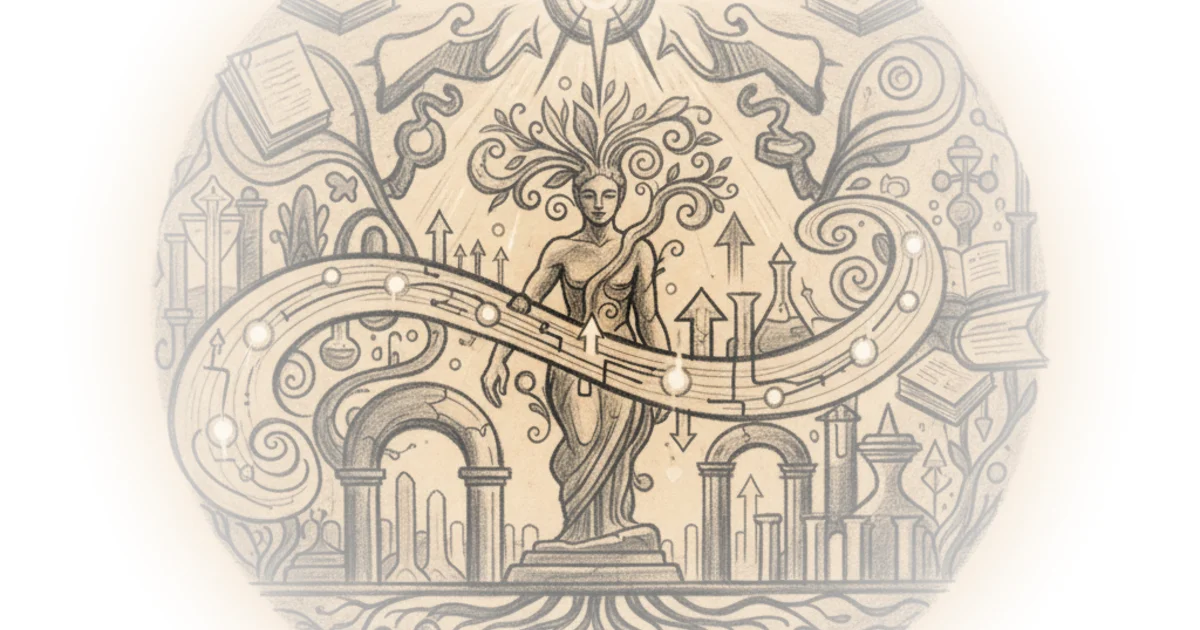
The allegory becomes a parable about how introducing new ideas to a culture that is either unready or too complacent to accept them faces perennial challenges. Yet history offers moments when entire cultures were liberated in thought and creativity—moments the author calls "Renaissance moments": periods where art, philosophy, and creative energy converge to release new freedom and possibility.
What Is a Renaissance Moment?
The word "renaissance" means rebirth. Historians first applied it in the 19th century to designate the period from roughly the 1400s to the 1600s—a dramatic departure from medieval constraints. The concept traces back to Giorgio Vasari, who described the revival of the arts as a "renacita." Scholars like Jee Michel and Jacob Burkhardt later adopted the term to describe periods of major innovations in politics, science, art, religion.
The European Renaissance saw unprecedented creativity: literature democratized as poets abandoned Latin for vernacular languages. It was a moment of freedom, expansion, and enlightenment—Europe witnessed the rediscovery of classical texts including Plato's Republic. Yet this cultural revival emerged during plagues, after the fall of the great Byzantine Empire, during stagnation in medieval scholastic systems.
The author argues that Renaissance moments are inherently fluid—they signify a process of rebirth rather than a neatly bounded epoch. The same patterns recur whenever a culture through a confluence of new ideas re-imagines its political, spiritual, and artistic paradigms and embraces a new vision of humanity.
Four Movements of Renewal
To understand how our own moment might be on the cusp of a new Renaissance, the author examines four major historical movements:
The European Renaissance emerged from medieval constraints, marked by unprecedented creativity in literature, art, and classical revival.
The Romantic Revival began during the industrial revolution—artists and philosophers contested attitudes toward nature and the human being that prioritized reason at the expense of imagination. They turned to emotion, imagination, and the sublime as antidotes to the dehumanizing logic of factories and railways.
The American Renaissance grew amidst pressures to find a distinctly American art and voice during tensions leading to the Civil War. Margaret Fuller and Ralph Waldo Emerson consciously wrote the American Renaissance into existence through their 1840s lectures.
The Modernist Movement emerged from similar circumstances of cultural alienation, industry, dehumanization, and ideological fragmentation.
The Opportunity Before Us
The author argues that our current moment contains the same conditions that sparked past Renaissance moments. While we live in a time of unprecedented anxiety about the fate of arts and culture—literacy rates declining, technology advancing unchecked, political discourse becoming polarized, universities defunding humanities—these conditions have historically preceded cultural renewal.
A Renaissance moment is not a golden age. These movements often emerge during periods of political and religious turmoil, under the shadow of war, in the wake of pandemics. But darkness passes, and the spirit of these moments is what drives away the clouds. If we act now, our moment could be the prelude to a new renaissance.
"A culture weary of the endless cycle of shadows suddenly breaks free and walks upward into the light of day."
Bottom Line
The author's strongest argument: cultural rebirth has always emerged from crisis, not from stability. The conditions for renewal aren't obstacles to overcome—they're catalysts that have repeatedly birthed moments of artistic and intellectual awakening. The vulnerability is that identifying these patterns doesn't guarantee we can replicate them; historical analysis offers a template, but the collective will to act remains uncertain.